

Simple Habits to Nurture a Balanced Life This New Year
Start the year with hope and balance! Discover simple habits to nurture your body, soul, and spirit. Embrace small steps, trust God with the results to live with faith and balance this year. Read, listen, or watch the podcast in this post (the video is at the end of the post).
The start of a new year is the perfect time to reflect, realign, and begin fresh habits that nurture your body, soul, and spirit for a balanced life. A fresh start to the new year isn’t about doing everything perfectly. It’s about leaning into God’s guidance, embracing His mercies, and taking small steps toward the life He’s calling you to.
Big changes don’t happen overnight, but small, intentional steps can create momentum that leads to lasting transformation. If you’re ready to embrace progress over perfection and build a balanced, hope-filled life, this post will guide you with practical steps, faith-filled encouragement, and actionable insights to help you thrive in 2025.
Why Small Beginnings Matter in the New Year
When starting something new, it’s easy to feel overwhelmed or think that small efforts don’t count. But the Bible reminds us in Zechariah 4:10: “Do not despise these small beginnings, for the Lord rejoices to see the work begin.” This is a principle that applies to many areas of life.
God values even the tiniest steps you take toward growth, balance, and alignment. Each small act—whether it’s drinking more water, spending five minutes in prayer, or journaling—is part of His greater plan for your life.As you approach the new year, remember: “Small steps + big faith=lasting change.” Your efforts, no matter how small, delight the heart of God.
Can you think of a better way to start the year?
How to Create a Balanced Life with Simple Habits and Small Goals
True balance isn’t about doing everything perfectly; it’s about aligning your actions with your priorities and faith. Here is a list of key takeaways to help you create harmony between your body, soul, and spirit:
Start each day with intention by inviting God into your plans.
Focus on one small action daily for your body, soul, and spirit.
Let go of perfectionism and embrace faithful progress.
Celebrate small wins to build momentum and gratitude.
Reset anytime by pausing, praying, and taking the next step.
Trust God to guide you and leave the results in His hands.
Practice simple habits like drinking water, resting well, or meditating on scripture.
Reflect and journal to track your progress and God’s work in your life.
These principles create a foundation for holistic wellness and a thriving, faith-filled life. Let’s unpack these a little more.
What is a Balanced Life?
A balanced life doesn’t come from massive overhauls or exhausting yourself trying to do it all. It begins with shifting our perspective. True balance comes from the faithful and consistent choices that nurture every part of us, body, soul and spirit.
It isn’t about doing everything perfectly or keeping all the balls in the air. Start small. Focus more on small goals and daily steps, the micro habits that help you get to those bigger goals. If we’re faithful with the small things, the bigger things are going to come.
A Simple Habit to Begin Your Day Well
We all have a morning routine of some kind. Start each day with intention by inviting God into your plans. Ask for His guidance in your choices for the day. Trusting in God and looking for his guidance, relying on it, inviting him into each day empowers us to approach our daily choices with purpose and balance.
Aim for Progress Over Perfection
This simple habit has been a game-changer for me. Let go of perfectionism and embrace faithful progress. Seek forward movement and remember growth, change, and goals take time. It’s important to be patient rather than hold yourself to a rigid standard of perfection.
Life happens and we aren’t going to make perfect choices every day.
Perfectionism often traps us in shame and discouragement, but true growth happens when we embrace grace and keep moving forward. “Faithfulness today builds momentum for tomorrow,” and small, consistent actions lead to transformation over time.
It’s easy to live in overwhelm and stress when our goals or expectations are rooted in perfectionism. It’s a quick shift into “good girl, bad girl”, “shoulda, woulda, coulda” thinking versus “today I was faithful.”
As you set goals for the new year, shift your mindset from “not enough” to “progress is enough.”
Celebrate Your Daily Wins
Recognizing small wins is a simple habit that builds momentum and inspires gratitude. At the end of the day, reflect on what went well and thank God for progress, no matter how small. Keeping a journal is helpful way to celebrate those wins and see the progress over time.
When you write some of those things down on the daily, you can look back over the year and see growth and development. God’s always working in our lives, and it feels good to celebrate your efforts and growth.
Reset Without Guilt
When you get off track, pause, pray, and make the next healthy choice. Setbacks will happen, whether we like it or not. Creating a balanced response is a powerful habit that keeps us moving forward.
For me, disruptions in my daily routines often throw me off-track for a bit-especially when traveling or working on big projects. This is a simple habit that keeps disruptions from becoming roadblocks.
Refocus and make the next best choice rather than dwelling on setbacks because every healthy choice matters.
A Framework for Daily Balance
To make your wellness journey manageable, use this simple framework for daily alignment. Commit to nurture your body, soul, and spirit each day with daily simple actions that add up over time. Here are a few examples:
Body: Drink water, eat nourishing foods, or get moving for 10 minutes.
Soul: Practice gratitude, journal, or take a moment for quiet reflection.
Spirit: Meditate on a Bible verse, spend time in prayer, or listen to worship music.
This balanced approach ensures you’re caring for every part of yourself in alignment with God’s design.
What Happens When You Trust God with the Results?
One of the most freeing truths about personal growth is that the outcomes don’t depend solely on you. When we trust God with our efforts, we release the stress of trying to control the results. Instead, we shift our focus to faithfulness and let Him guide the process.
As Zechariah 4:10 reminds us, “Do not despise these small beginnings, for the Lord rejoices to see the work begin.” God delights in our efforts, not just the end goal.
It’s easy to be hard on ourselves, especially when things don’t go as planned. Negative thinking can throw our soul out of balance and lead to discouragement. But when we trust God with the results, our work becomes about something bigger than just how we performed. It’s no longer about perfection but about walking in step with His purpose. This mindset not only honors God but also creates space for grace and peace in our lives.
Living this way allows us to focus on faithfulness in a balanced and healthy way. “Trust God with your journey, focusing on faithfulness while leaving the outcomes to Him.” Relying on His strength frees us from the pressure to achieve “perfect” results and reminds us that small, intentional steps are part of His greater plan.
Watch the Episode
Best Quotes from the Podcast
Enjoy a selection of memorable moments from this episode. Which of these quotes resonates with you today?
“Small steps, big faith, lasting change.” — Ginger
“God rejoices when we begin, no matter how small.” — Larissa
“Faithfulness today builds momentum for tomorrow.” — Ginger
“The next right step doesn’t have to be big—it just has to be faithful.” — Larissa
“Don’t despise small beginnings; they lead to big blessings.” — Ginger
“True balance comes from grace, not from grinding.” — Larissa
“Celebrate what’s going right instead of dwelling on what’s wrong.” — Ginger
“God works in ways we can’t see—trust the process.” — Ginger
“Progress isn’t about perfection; it’s about persistence in faith.” — Larissa
A Prayer Nurture Body, Soul, and Spirit with Balance
Lord, I invite You into my habits and patterns, asking for Your guidance to live in harmony with Your purpose. Teach me to nurture my body, soul, and spirit in a way that honors You. Help me take small, faithful steps each day, trusting the work of the Holy Spirit within me to create balance and peace. Amen.
What Will Living Well with Balance Look Like for You This Year?
How is God inspiring you to nurture your whole person this year? What’s one small action you want to focus on this year? Share your goal in the comments below—your commitment may inspire someone else to take their first step!
Ready to take the next step? Listen to the full podcast episode for even more insights and encouragement to create balance and wellness in 2025. And don’t miss the chance to kickstart your year with our 7-Day Wellness Challenge! This simple email series will help you focus on one healthy habit each day to nurture your body, soul, and spirit.
Click here to sign up now and let’s build a hope-filled, balanced life together!

12 Bible Verses to Read Scripture as a Conversation with God
Discover how reading Scripture as a conversation with God can transform your spiritual life. Learn practical steps, benefits of engaged Bible reading, and explore Bible verses that deepen your connection with God. Start your journey toward meaningful, relational Bible reading today.
Does your Bible reading ever feel dry or routine, like just another item on your checklist? What if it could be something much more—a life-giving encounter with God? Imagine sitting down with the Word and feeling like you’re stepping into a real conversation with Him, where His voice is clear. God often gives us a longing for a deeper connection and the experience of more engaged Bible reading, which is a beautiful way God draws us closer to Himself.
How we relate to God as we engage with Him through reading the Bible makes all the difference in growing in a deeper relationship with God.
The Basics of Reading Scripture as a Conversation with God
Basic things cannot be skipped or ignored because they are important–that’s why they are basic! Sometimes I am tempted to skip basic steps because I want to get on to other things.
Over the years God has taught me to read scripture as a conversation—it is after all, His word. Most of the time we read for one of two purposes—information or entertainment. When we learn to read God’s word as a personal conversation, we can find ourselves reading for relationship rather than for information. This is a vital perspective shift.
Some of you may think, “Well, duh… everybody knows that.” Here’s the thing: not everybody does. And even when we know this, there’s always a temptation to open God’s Word without the awareness that every time we do, we can hear God speak.
When we are in a hurry it’s easy to approach the Bible with a “ho-hum, check-the-box” mentality. Let’s be honest—we’ve all had days like that.
The book Eat This Book by Eugene H. Peterson, the author of The Message, addresses the value of reading God’s Word as a conversation and the practice of lectio Davina (sacred reading). Peterson writes, “God does not make speeches; He enters conversations, and we are partners to the conversation…” (p. 107). He challenges readers to move beyond reading for information and embrace Scripture as a conversation with God, facilitated by the Holy Spirit.
This perspective helped me engage with God more intimately when I read the Bible.
In the Bible we read that the Word of God is living and active, as well as spiritually discerned. This is kind of a theological term, but to me it means that God designed His Word to be read in partnership with the Holy Spirit.
If I don’t have the Spirit in the equation, 1 + 1 will only add up to 2—just words —rather than adding up to life. It is the presence of the Holy Spirit that makes the ink on the page “living, active, and sharp (Hebrews 4:16). This is why Jesus told us that the words He speaks are spirit and life (John 6:63).
How to Read Scripture as a Conversation with God
Start with Prayer for Engaged Bible Reading
Every meaningful conversation begins with intentionality. Engaged Bible reading is no different. Practice the basic habit of asking God to speak to you every time you open your Bible. I often think of prayer as opening the door to enter into God’s presence as you read. Here’s a simple prayer to get started: *”Lord, as I open Your Word today, open my heart. Highlight the truths You want me to see and teach me to listen for Your voice.”
Read Slowly and Attentively as a Conversation with God
Don’t rush through your reading. Instead, approach the text expectantly, trusting that God will draw your attention to a specific verse, word, or idea. It helps to read a short passage a few times, pausing to reflect and listen each time.
Focus on One Thing for Engaged Bible Reading
As you read, look for one verse or idea that stands out. What draws your attention? I like to envision the Holy Spirit using a yellow highlighter. Write it down, reflect on it, and meditate on its meaning throughout the day. This focus helps you internalize the message and creates space for deeper conversation with God.
Respond in Prayer to Continue Your Conversation with God
Once a specific truth stands out, respond in prayer. Turn it into a conversation with God. Here are a few examples of ways to respond:
Thank Him for the insight.
Ask how it applies to your life.
Receive the verse as life-giving words.
Invite Him to help you live it out.
Take It with You to Engage with God Throughout the Day
Keep the verse or idea visible during the day. Write it on a sticky note, save it as your phone wallpaper, or journal about it. Allow the truth to sink in and shape your actions.
Focus on One Idea When Reading Scripture as a Conversation with God
For relational reading, it is helpful to read a short passage, 1/2 -1 chapter. Why focus on one thing? What are the benefits of looking for one main idea, truth, or thought? Remember that devotional reading is for relationship and transformation rather than for collecting information. Focusing on one thing at a time helps us to engage in Bible reading more actively. We will often learn more, but asking for one thing brings focus to our attention. It is a place to start our conversation with God.
Deepens Retention
By focusing on one thing, you’re more likely to remember and reflect on it throughout the day. Sometimes I make a quiz game of it—Can I remember what God and I talked about this morning?
Reduces Overwhelm
Scripture is rich and layered. Zeroing in on one idea simplifies your reading and makes it more meaningful.
Fosters Transformation
Engaging with one specific truth allows it to take root and influence your thoughts, attitudes, and actions.
Encourages a Listening Heart
This practice trains you to hear God’s voice and recognize His guidance.
Supports Focused Prayer
Praying about one idea helps you stay intentional and engaged in your conversation with God. Looking for one central idea develops our attention, much like looking for the prize in a treasure hunt.
12 Bible Verses and Prayers to Read Scripture as a Conversation with God
Here are some of my favorite Bible verses to inspire prayers to begin my time with God. They help me still my thoughts and open my heart to engage with God more fully as I read the Bible passage for the day. Try reflecting on one verse a day as you begin your conversation with God by turning the verse into a prayer. After twelve days, you will begin forming a new habit to help you sense what God is teaching you personally each day.
Psalm 119:18, 102
“Open my eyes that I may see wonderful things in your law….I have not departed from your laws, for you yourself have taught me.”
Prayer: Lord, as I open Your Word today, open my heart. Highlight the truths You want me to see and teach me to recognize Your voice. Show me one thing You want to teach me today.
Proverbs 3:5-6
“Trust in the Lord with all your heart…”
Prayer: Help me trust in You as I read and listen for Your voice.
Isaiah 55:11
“So will My word be which goes out of My mouth…”
Prayer: Thank You that Your Word will not return void but will accomplish its purpose in me.
Jeremiah 33:3
“Call to Me and I will answer you, and I will tell you great and mighty things, which you do not know.”
Prayer: Lord, I call to You. Tell me the wonderful truths You want me to learn today.
John 6:33
“The words that I have spoken to you are spirit and are life.”
Prayer: Lord, speak Your words of life to the depths of my soul.
John 16:13
“When He, the Spirit of truth, comes, He will guide you into all the truth…”
Prayer: Holy Spirit, guide me into the truth of Your Word today.
Romans 15:13
“Now may the God of hope fill you with all joy and peace…”
Prayer: Fill me with hope and joy as I hear Your voice today.
Romans 10:8
“The word is near you; it is in your mouth and in your heart.”
Prayer: Lord, I’m glad that You are so present and close. Speak to my heart and enable me to enjoy Your presence.
1 Corinthians 2:12-13
“What we have received is not the spirit of the world, but the Spirit who is from God, so that we may understand what God has freely given us. This is what we speak, not in words taught us by human wisdom but in words taught by the Spirit, explaining spiritual realities with Spirit-taught words.”
Prayer: Thank You for Your Spirit who helps me understand Your Word. You want me to understand the truths You have given. Thank You for teaching me today.
Colossians 3:16
“Let the word of Christ richly dwell within you…”
Prayer: May Your Word dwell richly in my heart and guide my day.
2 Timothy 3:16-17
“All Scripture is inspired by God and beneficial for teaching…”
Prayer: Teach me, correct me, and equip me through Your Word today.
Hebrews 4:12
“For the word of God is living and active…”
Prayer: Let Your Word be alive in me, Lord, shaping my thoughts and actions.
James 1:5
“If any of you lacks wisdom, let him ask of God…”
Prayer: Father, grant me wisdom as I read and guide me into Your truth.
Which of these verses most inspires you to engage more deeply in your Bible reading?
Reflection Questions for Engaged Bible Reading
It is helpful to have a few meditation or reflection questions to get your conversation with God started.
What one truth from today’s reading stood out to me?
How is God inviting me to respond to that truth?
What in my life most needs this today?
Do I sense any resistance or tension in me to explore with God?
How might this practice change my relationship with God?
Imagine the difference in your spiritual life if every time you opened the Bible, it became an intimate, life-giving conversation with God. This week, try reading Scripture with a listening heart. Focus on one idea, talk to God about it, and let it transform you. Leave a comment to let me know what is most helpful for you to engage with your Bible reading more fully.
For more prompts to help you listen to the Lord as you read the Bible as a conversation with God, check out my related blog post, 10 Practical Prompts for Listening to Jesus in Bible Reading.
Related Blog Posts for More Engaged Bible Reading
When You Long for God to Speak to You
Simple Ways to Meditate on God’s Word
8 Powerful Ways to Connect with God When He Is Silent
Ignite Your Faith with Simple Truths for Listening to God
Do You Struggle with Listening to God?
Moments to Pray, Listen, and Think Bring Us Closer to God
15 Simple Ways to Overcome Distraction to Focus Your Attention on God (with printable)
10 Benefits of Reviewing What We Learn from God
Simple Ways Silence Can Deepen Your Faith
Discover Six Important Truths About Listening to Go
10 Practical Prompts for Listening to Jesus in Bible Reading

Unforgettable Lessons from 2024 Deepen Trust and Unlock True Hope
Reflecting on lessons from 2024 reveals God’s faithfulness offers practical steps to unlock true hope through faith and reflection. Discover how to deepen your trust in God this year and carry His peace into 2025.
As the year draws to a close, it’s a perfect time to pause, reflect, and ask, What have I learned this year? Reflection is more than just looking back; it’s a spiritual practice that helps us see God’s faithfulness, recognize areas of growth, and refocus on what truly matters. This habit of hope anchors our hearts in God’s goodness, reminding us that He is always at work—even in the hardest moments.
A Habit That Transforms: Reflection on Lessons from 2024
One powerful habit we can cultivate is taking intentional time to reflect on the lessons we’ve learned throughout the year. Reflection isn’t about perfection or analyzing every detail of the past. Instead, it’s an invitation to pause and notice where God has been moving, teaching, and shaping us.
Reflection reveals God’s faithfulness. It’s a way of documenting His presence in our story and finding hope in the process. Whether your year has been full of breakthroughs, struggles, or a mix of both, this practice reminds us that every moment has purpose.
This habit transforms struggles into stepping stones, reframing hardships as opportunities for growth and deeper trust in God. It equips us with wisdom and perspective for the future while fostering community by creating opportunities to share lessons and encourage one another. As we reflect, we celebrate progress and carry hope forward into the new year.
Every season holds a lesson; every lesson holds hope.
The Holy Spirit Helps Us Learn Lessons that Deepen Trust and Hope
Our reflection process is deeply connected to the promise in John 14:26:
“But the Advocate, the Holy Spirit, whom the Father will send in my name, will teach you all things and will remind you of everything I have said to you.”
The Holy Spirit plays a vital role in our spiritual growth. As our Advocate, He teaches us through life’s challenges, reminds us of God’s truth, and helps us uncover lessons that may not have been immediately clear. When we reflect with the Holy Spirit’s guidance, we’re able to see the threads of God’s faithfulness and gain clarity for the road ahead.
This verse is a powerful reminder that we don’t walk alone. The Holy Spirit is actively working to teach and transform us, helping us grow into the people God created us to be. Reflection invites the Spirit to highlight the areas where we’ve grown and the lessons we need to carry forward.
The Holy Spirit as Our Teacher
The Holy Spirit is always at work, teaching us lessons and revealing God’s truth in ways we need to grow.
Reflection invites the Spirit to highlight the key moments and lessons God wants us to remember.
Remembrance Is a Spiritual Practice
The verse emphasizes the importance of remembering what God has done and said.
Regular reflection allows us to partner with the Holy Spirit to recall the insights and truths God has revealed.
Trust the Holy Spirit to Bring Clarity
God’s Spirit reminds us of His faithfulness, even in hard moments we might have overlooked.
Themes, patterns, and growth in our lives often become clearer when we reflect with the Holy Spirit’s guidance.
The Holy Spirit Transforms Our Perspective
Through reflection and prayer, the Holy Spirit helps us see trials and victories through a lens of hope and redemption.
Even hard lessons become sacred as the Spirit reframes them for our growth and God’s glory.
Learning and Growth Are Ongoing
This verse shows that God’s teaching is continuous.
He is always working in us through the Spirit to reveal more about His character, His Word, and His plans for us.
A Reminder of God’s Faithfulness
Reflection on this verse reinforces that we don’t walk alone; the Holy Spirit is actively advocating for us, guiding us through every season of life.
When we reflect on the past year, the Spirit helps us connect the dots of God’s faithfulness and provision.
Practical Ways to Reflect on Lessons from 2024
If this practice is new for you, here are a few simple steps to get started:
Create a list: Write down lessons you’ve learned this year. Don’t overthink it—start with simple words or phrases and expand on them later.
Look for themes: What patterns or recurring lessons do you notice? These may reveal areas where God is shaping you.
Pray for clarity: Ask the Holy Spirit to guide your reflection, highlighting the lessons He wants you to carry forward.
Celebrate growth: Take time to thank God for how far you’ve come, even if there’s still a long way to go.
Healing Is a Walk, not a Race: The Most Important Lesson of 2024
One of the most profound lessons Larissa shared this year is that healing is not a race; it’s a walk with God. This realization, revealed through the Holy Spirit, reshaped how she approaches challenges and growth. Here are the key insights from this powerful truth:
Healing Takes Time
Growth and healing are not instant. They require patience and intentionality as God works on His timeline.
Walking With God Is Key
Healing is a journey taken alongside God, allowing Him to guide, comfort, and shape us through the process.
Avoid Rushing the Process
Trying to “fix” everything quickly can hinder true healing. Slowing down helps us fully embrace the lessons God is teaching.
Notice the Blessings Along the Way
Walking rather than racing allows us to notice the small blessings and progress we might otherwise miss.
Celebrate Progress, Not Perfection
Acknowledge each step forward, no matter how small, as part of God’s work in your life.
Healing is About Growth, Not a Destination
The journey itself is where transformation happens. The “race” mentality focuses on an end goal, while the walk embraces ongoing growth.
God’s Timing Is Perfect
Trust that God knows the pace at which you need to heal and that His timing leads to the best outcomes.
Focus on the Process Over Results
Instead of fixating on results, trust the process as an act of faith, allowing God to work in both seen and unseen ways.
This perspective shift reminds us to embrace the journey, trusting that God is doing a deep work within us that unfolds over time. I think you’ll agree with me that this is an encouraging and powerful word we can all take into the New Year!
How to Deepen Your Trust in God with Lessons Learned in 2024
Reflection helps us uncover the powerful lessons God has been teaching us throughout the year. Here is a list of key lessons learned, including points shared by Larissa with a few from me, along with reflections on spiritual growth:
A Hard Year Doesn’t Have to End That Way
Even if the year begins with struggles, God can transform it into one of growth, hope, and renewal. Every season holds opportunities for redemption.
Wait With God, Not Just for Him
Shifting the focus from waiting for God to act to waiting in His presence transforms waiting into an act of worship. Waiting is no longer about passively enduring but actively seeking God’s presence. This mindset shift fosters calm and expectation, helping us deepen trust and unlock hope.
Use the Difficulty
Challenges can be reframed as opportunities to grow, persevere, or lean on God more fully. This lesson encourages us to work with the difficulties rather than avoid them.
Be a Noticer of God’s Redemptive Work
God often reveals Himself in small, quiet ways. Training ourselves to notice these moments of redemption can grow our gratitude and faith.
Stand Up for Yourself and Survive the Fallout
Overcoming people-pleasing and learning to set healthy boundaries is a courageous act of faith. Trusting God with how others respond builds resilience.
False Beliefs Can Be Overcome
Identifying false beliefs and replacing them with God’s truth brings freedom and transformation. For example, replacing the belief that “everything is always hard” with the truth of God’s provision.
God Will Show Up When You Least Expect It
God often blesses us in unexpected ways, showing His faithfulness and provision in the details of our lives.
Understand Your New Creation Identity
Embracing the reality of being a new creation in Christ allows us to live in freedom and step away from old patterns.
You Can Grow and Struggle Simultaneously
Growth and struggle are not mutually exclusive. They often coexist, and both are part of God’s refining work.
A Steadfast Mind Brings Peace
Anchoring our thoughts on God and trusting Him fully leads to the perfect peace promised in Isaiah 26:3. This steadfast focus transforms how we navigate life’s uncertainties.
Share Your Lessons Learned
What lessons has God taught you in 2024? Take some time to reflect and write down your insights. We’d love to hear from you! Share one lesson in the comments below and encourage others as they reflect too. Let’s cheer each other on in what the Holy Spirit has taught us this year!
A Note from Larissa
We can learn so much about ourselves and what God is doing in our lives by taking time to reflect on what lessons learned each year. It serves as both a lesson and a list of praises as we write what God has taught us. This is also a fun way to record your wins from the year. Embrace all the lessons from 2024 and trust God to use those lessons as tools for 2025. Reflect, embrace, let go, and watch the new thing God wants to do this year. This is such a great way to deepen your trust and unlock hope for the new year. I can’t wait to hear some of your lessons learned and to take another 365 day journey with y’all in 2025.
With love,
Larissa
Our Prayer for Your New Year
As we step into 2025, let’s carry these lessons forward with faith and hope. May God’s presence guide you, His peace sustain you, and His faithfulness anchor your heart in every season.
Father, thank You for Your faithfulness throughout this year. Help us to see the lessons You’ve taught us and carry them forward with hope and trust. May Your Spirit continue to teach and guide us as we step into the new year. In Jesus’ name, Amen.
Ready to Start Well in 2025
Ready to set your heart and mind on a healthy foundation for the new year? Join our 7-Day Wellness Challenge, a simple email series designed to help you refocus on healthy habits for your body, soul, and spirit. It’s one small step toward living well in 2025.
👉 Click here to sign up and start your journey today!

Shining the Light of Christ: A Christmas Message of Hope
Discover how Christ’s light offers hope, guidance, and peace this Christmas. Learn practical ways to embrace His light daily, explore inspiring Bible verses, and reflect on the hope found in John 1:4-5. Where there is light, there is hope. Enjoy this content as an article, podcast, or video (at the end of the post).
“In him was life, and that life was the light of all mankind. The light shines in the darkness, and the darkness has not overcome it.”–John 1:4-5
Finding Light in Life’s Darkest Moments
Have you ever felt like you were stumbling through the dark, searching for direction or hope? Darkness, whether physical or spiritual, can leave us feeling lost and overwhelmed. The darker it is, the more we seek the light. Christ’s light is our ultimate source of hope. God didn’t just send light—He became the light for us. In Christ we have a light that never fades—a light that transforms hearts, dispels fear, and guides us forward.
This Christmas, embrace the Light of Christ—the life and light of all mankind. In this post/episode, you’ll discover how Christ’s light offers clarity, hope, and peace. You’ll also explore practical ways to build the Habit of Hope into your daily life and reflect on the powerful truth found in John 1:4-5.
If you’re ready to invite Christ’s light into your life this season, read on—and be sure to download our free devotional: Shine: Hope to Light Your World.
The Habit of Hope: Embrace the Light of Christ Daily
John 1:4-5 is a foundational scripture that beautifully ties together the themes of life, light, and hope. This verse reveals that Christ is both the source of all life and the light that dispels even the deepest darkness. His light is not temporary, nor is it conditional. It is unyielding, eternal, and powerful enough to overcome any challenge or struggle we face.
The phrase “The light shines in the darkness, and the darkness has not overcome it” offers a profound promise: no matter how overwhelming the darkness in our lives may seem—whether it’s fear, grief, sin, or uncertainty—it can never extinguish the light of Christ. Darkness doesn’t stand a chance against Him.
One powerful quote from the conversation reminds us of this truth:
“Even the smallest connection to Christ can light up your darkest moments.”
This means that no matter where you are in your spiritual journey, a small step toward Christ—a prayer, a moment of reflection, or a scripture reading—can bring hope and clarity into even the most difficult situations. His light isn’t just a beacon far off in the distance; it’s available to us right now, in our everyday lives.
Why the Light of Christ Brings Hope this Christmas
The imagery of light and darkness is deeply personal. Think about how unsettling it feels to walk into a completely dark room. You hesitate, unsure of your next step, afraid of what you might stumble into. But when even a single light turns on, the fear fades, and you can move forward confidently.
This is the power of Christ’s light in our lives. His light doesn’t just illuminate our path; it transforms our perspective. It allows us to see the truth about who God is, who we are, and the hope He offers us, no matter how dark our circumstances feel.
Practical Ways to Embrace Christ’s Light
To make John 1:4-5 a living truth in your life, consider these practical ways to embrace the Light of Christ daily:
Begin Your Day with Christ’s Light
Spend time in prayer each morning, asking Jesus to shine His light into your life and guide your steps. Reflect on John 1:4-5 and thank Him for being the life and light of all mankind.
Ask Jesus to illuminate the areas of your life where you feel stuck or uncertain. Pray for His light to guide your steps and fill your heart with peace.
Let Scripture Illuminate Your Path
Reflect on Bible verses about light, such as John 1:4-5, Psalm 119:105 (“Your word is a lamp to my feet and a light to my path”), and Isaiah 9:2 (“The people walking in darkness have seen a great light”).
Ask God to shine the light of understanding and insight as you read and reflect on His Word.
Light a Candle During Devotional Time
As the candle brightens the room, let it remind you that Christ’s presence dispels darkness and brings hope.
Share the Light with Others
Reflect Christ’s light by offering acts of kindness, encouragement, or prayer for someone in need. Just as His light transforms your life, your actions can bring His hope to others.
Be inspired by these words, “Let your light shine before others, that they may see your good deeds and glorify your Father in heaven.”–Matthew 5:16
John 1:4-5 reminds us that Christ is the life and light we all need, especially during seasons of darkness. His light doesn’t just shine into our lives; it invites us to reflect it, offering hope to those around us.
The Spiritual Power of Light
Without light, we don’t have life. Consider how God placed the earth at just the right distance from the sun to sustain life. In the same way,
And without Christ, we don’t have spiritual life or eternal life. Christ is perfectly positioned to sustain our spiritual lives.
Light is not only essential for life; it also symbolizes the transformative presence of Christ. Just as a single candle can illuminate a dark room, Christ’s light can bring clarity, warmth, and peace to our lives, no matter how deep the darkness feels.
When we think of Christ as the Light of the World, we’re reminded that His light cannot be overcome. As John 1:5 declares, “The light shines in the darkness, and the darkness has not overcome it.” This promise gives us hope that no matter what challenges or fears we face, His light will prevail.
5 Lessons from Light in Scripture
Light Overcomes Darkness: “The light shines in the darkness, and the darkness has not overcome it.” (John 1:5)
Light Guides Our Path: “Your word is a lamp to my feet and a light to my path.” (Psalm 119:105)
Light Brings Hope: “The people walking in darkness have seen a great light.” (Isaiah 9:2)
Light Reflects God’s Glory: “Let your light shine before others, that they may see your good deeds and glorify your Father in heaven.” (Matthew 5:16)
Light Is Eternal: “The city does not need the sun or the moon to shine on it, for the glory of God gives it light.”(Revelation 21:23)
How to Reflect Christ’s Light
Daily Habits to Embrace His Light
Start with Gratitude: Reflect on how Christ’s light has guided you and thank Him daily.
Pray for Guidance: Ask for His light to illuminate the areas of your life where you need hope or clarity.
Practice Presence: Sit quietly with a lit candle and meditate on God’s presence in your life.
Ways to Share Christ’s Light with Others
Perform Acts of Kindness: Look for opportunities to help and encourage those around you.
Invite Others: Ask a friend or neighbor to join you for a Christmas service or devotional.
Be a Beacon of Hope: Share a word of encouragement or prayer with someone who is struggling.
Invite the Light of Christ Into Your Life This Christmas
The light of Christ is not just a metaphor—it’s a lifeline. His light is the source of salvation, hope, and peace, and it’s available to everyone who chooses to invite Him into their lives. Whether you’ve been walking in faith for years or are uncertain about where you stand spiritually, Christ’s light is for you.
If you’ve been distant from God: Maybe faith has drifted off your radar, and you’ve been navigating life on your own. Christ’s light invites you to reconnect and find peace in His presence.
If you’re weighed down by guilt or shame: Perhaps you feel like you’ve made mistakes so big that God could never forgive you. Christ’s light isn’t just for the “perfect”—it’s for all of us, because none of us are perfect.
If you’re feeling lost or overwhelmed: Life can be messy and confusing, but the light of Christ provides clarity and guidance, helping you take the next step forward.
No matter where you are in your spiritual journey, the invitation is the same: Open your heart to Jesus and let His light fill every corner of your life. As John 1:4-5 reminds us, His light brings life to all mankind, and the darkness will never overcome it. Today is the best day to truly embrace the light and life of Christ. This is your moment, friend–a moment that will make an eternal difference in your life.
Step Into the Light This Christmas
This Christmas season, let the Light of Christ illuminate your heart, transform your life, and guide your path. By embracing His light daily, you can experience hope and peace like never before.
To dive deeper into this message, listen to our full podcast episode and download our free devotional, Shine: Hope to Light Your World. This seven-day resource will help you reflect on Christ’s light during this holiday season and share it with others.
Let the light of Christ shine brightly in your life this Christmas—and always! From my heart to yours, Merry Christmas!
Show Notes
Episode Description
In this episode of Habits of Hope, we explore how embracing the light of Christ can bring lasting hope, peace, and guidance into your life this Christmas season. Using scripture, practical illustrations, and personal reflections, we’ll unpack how Jesus, the Light of the World, transforms our hearts and leads us out of darkness into His life-giving presence. If you’ve ever felt overwhelmed by life’s challenges or longed for a sense of peace during the holiday season, this episode is for you.
Key Takeaways
Light and Hope: The light of Christ dispels darkness, offering guidance, hope, and peace in challenging times.
Biblical Foundation: John 1:4-5 illustrates how Christ is the life and light of all mankind, a light that darkness cannot overcome.
Practical Reflection: Embrace the light of Christ daily through small actions like prayer, scripture reading, or lighting a candle.
Symbolism of Light: Light serves as a metaphor for Christ’s presence, which brings clarity, direction, and hope, much like a lighthouse guiding a ship.
Seasonal Connection: Christmas lights are a visual reminder of Christ’s light entering the world during the Advent season.
Spiritual Transformation: Moving from spiritual darkness to light through Christ results in profound personal and spiritual renewal.
Grace and Light: God’s grace allows us to experience spiritual illumination and redemption through Christ, bridging the gap between us and God.
Living as Light: As followers of Christ, we are called to reflect His light through acts of kindness, generosity, and love for others.
Quotables
“Without light, we don’t have life. And without Christ, we don’t have spiritual life or eternal life.” – Ginger
A clear connection between physical light and Christ’s spiritual significance.
“The darker it is, the more we want the light, and the more impact it has when it shines.” – Ginger
A powerful reflection on the significance of light in challenging seasons.
“Light is never overcome by darkness, and in the same way, Jesus’s presence brings us hope that cannot be extinguished.” – Ginger
A statement of hope and assurance tied to the central theme.
“Even a small connection to Christ—through prayer, scripture, or worship—can bring warmth, comfort, and hope.” – Ginger
A practical and relatable way to connect with Christ’s light.
“The wise men followed the light of the star to find Jesus. Just like them, we can look for signs of Christ’s light in our lives.” – Larissa
A reminder of how seeking Christ’s light is relevant today.
“God placed the earth at just the right distance from the sun to sustain life. In the same way, Christ is perfectly positioned to sustain our spiritual lives.” – Ginger
A thought-provoking analogy about light and Christ’s role.
“Grace is what brings us from spiritual darkness to light—it’s not something we earn but a gift that transforms us.” – Ginger
A statement emphasizing the transformative power of God’s grace.
“Where do you need the light of Christ most in your life right now? What dark areas could be transformed by His presence?” – Ginger
A reflective and engaging question for listeners to ponder.
“Christ’s light gives us enough guidance for the next step, not necessarily the whole path—but we can trust Him fully.” – Ginger
A statement about faith and trusting God in uncertain times.
“God didn’t just bring light—He became light for us. He is Emmanuel, God with us.” – Ginger
A profound reminder of Christ’s presence in our lives.
“Jesus’s light doesn’t just change us; it gives us the ability to reflect hope and love to others.” – Larissa
A call to action for listeners to embody Christ’s light in their own lives.
“Christmas lights and candles remind us of the true light of the season—Christ, who came to bring hope and salvation.” – Larissa
A festive and visual connection to the episode’s theme.
“Even in your darkest moments, Christ’s light can illuminate your path and bring you peace.” – Ginger
A hopeful statement offering encouragement to listeners.
“The beauty of the gospel is that we don’t have to earn the light—it’s a gift. All we need to do is believe and invite Christ into our lives.” – Ginger
A succinct summary of the episode’s message.
Resources Mentioned
Free Devotional: Shine: Hope to Light Your World – A seven-day Christmas devotional designed to help you reflect on Christ’s light throughout the holiday season.
Yearly Advent Devotional from She Reads Truth
Lauren Daigle’s Song: Light of the World – A beautiful worship song that ties into the theme of Christ as the Light.

Finding Holy Moments: A Christmas Miracle of Hope and Healing
Discover how a Christmas miracle taught faith, healing, and the power of trusting God in the moment. Explore lessons from Holy in the Moment and find peace, hope, and wholeness in life’s hardest seasons. Listen to the full story or get the book for more.
When life feels overwhelming, where do I turn? For me, the holidays often bring joy but also heightened stress, anxiety, and unexpected challenges. My story, drawn from the first chapter of my book Holy in the Moment, reveals how faith—as both a gift and a choice—helped me navigate one of the hardest seasons of my life. In this post and podcast episode, I’m sharing a deeply personal Christmas story of faith, hope, and trusting God through some of life’s toughest challenges. Even though my book is not a Christmas book, the first chapter features a miraculous Christmas story that reveals God’s healing power and has taught me timeless lessons on choosing faith and finding peace in the moment.
Faith is a Choice, Not an Emotion
“Faith isn’t an emotion—it’s a decision. Choosing to trust God in the moment makes that moment sacred.”
My journey began during a particularly turbulent season. I had just been diagnosed with Graves’ disease, an autoimmune thyroid condition that wreaked havoc on my body, mind, and emotions. On top of that, my family and I were preparing to move cross-country as part of my husband’s military career. In the chaos, I discovered that faith wasn’t about waiting for emotions to catch up. It was about making a conscious decision to trust God, even when I didn’t feel like it.
Have you ever faced a time when trusting God didn’t come naturally? What would it look like to choose faith in your current situation?
Now Faith: Trusting God in the Present Moment
Hebrews 11:1 reminds us, “Now faith is the assurance of things hoped for, the conviction of things not seen.” For me, this idea of “now faith” became pivotal. As I grappled with my diagnosis and the demands of moving with young children, I learned to focus on trusting God moment by moment. I began to think of this practice as choosing to “activate faith,” much like opening an umbrella to shield myself from the rain. “Faith left unused will not shield us from unbelief,” I realized.
When anxiety took over and my emotions spiraled, I clung to small acts of faith, grounding myself in God’s promises. “Hope is not wishing,” I wrote. “It’s a steady, grounded trust in the God who is always faithful.”
In the podcast conversation, I realized that this portion of the book is one of the seeds of the Habits of Hope Podcast, which is a follow up to the book. Interestingly, I had not recognized the connection, or progression, until recording the podcast.
Are you waiting for circumstances to improve before trusting God? What small act of faith could you take right now?
Choosing Holiness in the Hard
“Never discount the small, brave acts of faith that spur you to go on rather than give in.”
My struggle with anxiety was compounded by sleep deprivation and the stress of adjusting to a new home. At my lowest point, I remember pacing the house at night, praying desperately for relief. But in those moments, I discovered a profound truth: holiness isn’t about perfection—it’s about trusting God one choice at a time.
“Holiness inhabits the small things,” I wrote. “Faith for our moments, simple and short, added together.” For me, choosing holiness meant praying when I didn’t feel like it, meditating on Scripture, and taking shaky steps forward even when fear gripped my heart. Each small choice to trust God created a sacred space for His peace to work.
God’s Promises of Hope
“Do not fear, for I have redeemed you; I have called you by name; you are mine. When you pass through the waters, I will be with you.” —Isaiah 43:1-2
During my darkest nights, I clung to the promises of Isaiah 43. This passage became a lifeline, reminding me that God’s presence was constant, even in the midst of my physical and emotional turmoil. Repeating these words brought stability when my emotions were anything but steady.
This scripture took on new meaning during a pivotal moment at Christmas. My mother suffered a stroke shortly after arriving to celebrate the holidays. While the situation could have easily pushed me into deeper anxiety, something miraculous happened. As I called on God for strength, I experienced an overwhelming sense of peace. For the first time in months, my hands stopped trembling. “I believe Jesus spoke to the storm in my mind and body with the divine command, ‘Peace, be still’.
The Christmas Miracle: Healing and Hope
“Not every moment is good, but God is good in every moment.”
Christmas Eve brought a moment of healing that I will never forget. My mother, recovering from the stroke, insisted on attending the candlelight service. As I sat in the sanctuary, surrounded by flickering candles and the soft strains of Silent Night, I felt the presence of God in a profound way.
“All is calm, all is bright,” I later reflected. “For the first time in months, I slept through the night, and I knew that God had done something miraculous—not just for my mom but also for me.” This moment wasn’t just about physical healing; it was about experiencing the wholeness and peace that come from trusting God completely.
Where have you seen God’s goodness in moments that didn’t feel good at the time? How might He be working in your current situation?
Healing as Wholeness
“Healing isn’t just physical—it’s about letting God make you whole, spirit, soul, and body.”
As I reflect on this journey, I see that true healing goes beyond physical recovery. It’s about allowing God to bring wholeness to every part of your life—your thoughts, emotions, relationships, and faith. The root of the word “holiness” is tied to wholeness, and my story reminds me that God is in the business of restoring what is broken.
Each small act of faith and every moment of surrender becomes part of this process. Whether it’s through prayer, Scripture, or simply trusting God for the next five minutes, these holy moments add up to lasting transformation.
What areas of your life feel broken or incomplete? How might God be inviting you into His process of healing and wholeness?
A Call to Faith and Hope
My Christmas story offers more than a seasonal reflection—it’s a reminder that God’s peace and healing are available year-round. Through small acts of faith and trust, we can experience His presence, even in life’s hardest moments.
Are you ready to choose now faith and invite God into your moment?
Discover the full story and dive deeper into the lessons from Holy in the Moment. Listen to the full episode here or get your copy of the book to uncover more stories, reflections, and practical ways to grow in faith and holiness.
Watch the Video of the Podcast
Enjoy the video version on our Youtube Channel if you prefer to watch for a more personal experience.
Podcast Show Notes
Episode Overview:
In this heartfelt episode of Habits of Hope, we dive into the story of a miraculous Christmas and timeless lessons on faith and healing from the book Holy in the Moment by award-winning author Ginger Harrington. Through personal backstory, thoughtful comments, and inspiring readings from Chapter One, Ginger shares how a difficult season—marked by anxiety, a health diagnosis, and unexpected challenges—culminated in a transformative Christmas experience. Discover how choosing faith in the hardest moments can lead to profound peace, healing, and hope, no matter what life throws your way.
Key Takeaways:
- Faith is a Choice, Not an Emotion: Trusting God in the moment is an active decision, even when emotions are overwhelming.
- Now Faith for the Present Moment: Inspired by Hebrews 11:1, “now faith” invites us to lean on God for peace and strength here and now.
- God’s Promises Bring Stability: Scripture, like Isaiah 43, reminds us that God is present in our storms and will carry us through.
- Small Acts of Faith Are Significant: Tiny, sacred choices to trust God can have a life-changing impact.
- Hope is Found in Every Season: The Christmas story shows that miracles and healing often happen when we least expect them.
Memorable Quotes:
- “Faith isn’t an emotion—it’s a decision. Choosing to trust God in the moment makes that moment sacred.”
- “Not every moment is good, but God is good in every moment.”
- “Now faith is for this moment. It’s about trusting God here and now, even when circumstances don’t make sense.”
- “Never discount the small, brave acts of faith that spur you to go on rather than give in.”
- “Healing isn’t just physical—it’s about letting God make you whole, spirit, soul, and body.”
This episode isn’t just a Christmas story—it’s a reminder that faith, healing, and hope are available in every season. Whether you’re navigating anxiety, seeking peace, or longing for God’s presence, Ginger’s story offers practical insights and spiritual encouragement to carry you through life’s toughest moments. And the miracle? It doesn’t stop with Christmas—it transforms lives far beyond the holiday season.
As Ginger recounts the night her mother had a stroke during Christmas and shares how God calmed her storm, she describes the exact moment her hands stopped trembling for the first time in months. Was it a coincidence, or something far greater? Don’t miss the miraculous ending to this unforgettable story of faith, healing, and God’s peace—tune in to the full episode now. This podcast features behind-the-scenes content that is not in the book.
Links & Resources:


To the One Who Is Grieving This Christmas
Explore ways to find comfort for your feelings of grief or loss during the holidays. This episode of Habits of Hope offers compassionate insights and practical steps to balance grief at Christmas, proving it’s okay to grieve and celebrate at the same time. Enjoy this update of one of the most-read posts in the past ten years on my website. This update includes podcast and video on this content.
How to grieve and celebrate Christmas. That’s a tough one, isn’t it? The picture-perfect moments of Christmas trick us into feeling there is no place for grieving in the happy. When you’re filled up with grief, the blare of holiday cheer scraps the tender skin of your heart. The juxtaposition of merry and bright slams into the ache of loss. We process from hurting to healing one step at a time as we bring our pain to God, especially at Christmas.
Blessed be the God and Father of our Lord Jesus Christ, the Father of mercies and God of all comfort...
2 Corinthians 1:3
The lure of the Christmas season has been built layer upon layer with tradition and fantasy until is nearly breaking with the weight of our expectation. In our heads we carry the picture perfect holiday. Visions of laughter and joy sparkle like glittery ornaments on our tree.
With rose-colored glasses we sometimes visualize perfect family times as if we live in the midst of a Christmas card photo.

When you don’t feel like celebrating.
When you’re filled up with grief, the blare of holiday cheer scraps the tender skin of your heart. The juxtaposition of merry and bright slams into the ache of loss.
Is there a place for mourning in the merry making that has become synonymous with Christmas?
Grief and hardship do not take a break for Christmas. Surrounded by those who we think have no problems, picture-perfect moments trick us into feeling there is no place for grieving in the happy.
The year my father died…
In 2005 my dad died on December 5 after a battle with leukemia and a host of other issues. I remember dreading that Christmas as we traveled to a funeral. Can we be truly grateful for the birth of Christ in the face of the death of a loved one or the loss of a dream?
How do we grieve and celebrate, mourn and dance at the same time?
My children were young, not understanding the reality of death and excited for Christmas. I felt ill prepared to be the parent that Christmas. My Christmas shopping was half done and the decorations were in boxes. Christmas cards sat in a stack on the table waiting for me to have the strength to wish others a merry Christmas and at the same time inform them of my father’s death.
 In the midst of family issues and relational differences, we came together and celebrated the value of an extraordinary man’s life. In the beauty of life and the pain grief, the worth and meaning of his life resounded strong.
Life is like that. Reality and family are like that. And Christmas is sometimes like that. It is real and it is good, even in the hard. Truth overcomes as help for our greatest need is born in a stable.
Especially in the hard and the grieving, God is with us; He is Emmanuel.
But the angel said to them, “Do not be afraid; for behold, I bring you good news of great joy which will be for all the people; for today in the city of David there has been born for you a Savior, who is Christ the Lord. Luke 2:10-11
In the face of grief there is joy, in the midst of darkness there is light for God has given us a Savior. On hillsides cold and dark with our loss, angels sing because Christ has come.
Taken by surprise.
The Christmas my Dad died took me by surprise. Secretly, I had been holding by breath, dreading the holiday in the shadow of loss. Yet, in our grief and in the broken road traveled, the surface of expectation was torn aside.
The gifts God unwrapped in me where the treasures of appreciation and acceptance as I cherished reality rather than expectation.
That Christmas, grief cut through the old habits. We hugged a little tighter, loved a little freer, and gazed a little longer in appreciation of one another, despite all the hard things. Laughter and tears, joy and heartache mingled as God gave comfort through the true appreciation of the gift of love.
For me, as mother and daughter, wife and sister, I experienced a deeper and different celebration. Gone was the glitz, and I found myself treasuring the gift of salvation and love of family above the festivity of tradition.
In our grief, God gave us more, not less.
We received strength to hold it all in our hearts–grief and joy, love and loss, shimmering with the holiness of grace.
My friend, if you are weary and worn with the burden of loss… If the thought of one more step is too much…reach out for God’s hand. Open your heart before Him, for He is strong enough to handle every bit of our grief. God wants to exchange our pain for joy in His timing. It is okay to go through the process of grief, even in the midst of the joy of celebration.
What if we release our expectations and simply live fully in the moment. Accept the imperfect and cherish the real? Making the most of the good and the least of the hard?
Be tender with yourself and with others, asking God to give you the grace you need for each moment. [tweetthis]We process from hurting to healing one step at a time as we bring our pain to God.[/tweetthis]
He restores my soul;
He guides me in the paths of righteousness
For His name’s sake.
Even though I walk through the valley of the shadow of death,
I fear no evil, for You are with me;
Your rod and Your staff, they comfort me.
Psalm 23:3-4
Thanks for reading to the end. I’m sorry about the length of this post, but somethings you simply cannot say in 500 words. Some stories cannot be told in a paragraph, and some truths need more space.
To the one who is grieving this Christmas, may you be blessed with the comfort of God’s presence this Christmas.

Podcast Show Notes
This popular post is the inspiration for our podcast episode: Finding Comfort and Hope this Christmas: Coping with Grief During the Holidays.
Is grief shadowing your holiday spirit? Explore ways to honor your feelings of loss while still engaging in the holiday cheer. This episode of Habits of Hope offers compassionate insights and practical steps to balance mourning and merrymaking, proving it’s okay to grieve and celebrate at the same time.
Takeaways:
Acknowledging Grief in Festivity: Recognizing the challenge of coping with grief during joyful occasions such as Thanksgiving and Christmas, where festive atmospheres can highlight feelings of loss.
Embrace Discomfort: It’s important to acknowledge and embrace the discomfort that comes with grieving during festive times, rather than trying to suppress or ignore these feelings.
God’s Comfort: Highlighting the comfort provided by God, as described in 2 Corinthians 1:3-4, which emphasizes God’s role in comforting us so that we may comfort others in their troubles.
Sharing and Community Support: Sharing experiences and seeking community support can be crucial in navigating personal grief, providing comfort, and understanding to others experiencing similar challenges.
Practical Advice for Grieving During Holidays:
- Acknowledging Grief: Recognize grief as a part of the holiday experience.
- Communicating Needs: Communicate emotional states to family and friends to manage expectations.
- Creating New Traditions: Consider starting new traditions to honor lost loved ones while making new memories.
- Seeking Professional Help: If grief becomes overwhelming, seeking help from counselors or support groups is advised.
- Personal Reflection and Self-Care: Take personal time for reflection and engage in activities that bring joy or relaxation.
Role of Faith and Scripture: Faith and specific scriptures can offer solace and perspective in times of loss, providing spiritual comfort and grounding.
Impact of Music and Devotionals: Music, particularly reflective or sacred Christmas music, and devotionals can connect individuals to the deeper meanings of the holiday season, offering therapeutic benefits.
Handling Anniversaries and Significant Dates: Managing anniversaries of loss during the holidays, including planning ahead for emotional triggers.
The Importance of Self-Care: Emphasizing the need for practices like ensuring adequate rest and engaging in enjoyable activities to manage the emotional toll of grief.
Community and Isolation: Staying connected with others who understand and share the grief experience is encouraged, as isolation can exacerbate feelings of loss.
Disclaimer: Habits of Hope Podcast is for informational and inspirational purposes only. This podcast is not a substitute for professional advice—spiritual, medical, legal, or otherwise.
Hope for Your Heart this Christmas
Enjoy a beautiful a free Christmas devotional to spark hope in your life this Christmas. This is my Christmas gift for you. Get it here or click the button below to download your copy today.

Get Your Free Chapter!
Read the story of a Christmas miracle I experienced in the first chapter of my award-winning book, Holy in the Moment. You’ll read a poignant story from one challenging Christmas in my life at the end of the first chapter. Read the story of what happened here. Give the gift of holy this Christmas–Holy in the Moment makes a wonderful gift to encourage faith in a practical way. Learn more about the book here.

Simple Christmas Worship Ideas from the Wise Men
What if you could swap stress for peace and worship this Christmas? Find peace in the holiday season with actionable steps to manage holiday stress and prioritize Christ with Christmas worship ideas. From spiritual habits to worship-centered Christmas traditions, these simple ideas from the story of the wisemen will help you find joy and peace amid a busy holiday. Listen, watch, or read this content and take the Christmas Worship Challenge to put it into practice.
I am so glad you stopped in for a visit. Get your heart geared for worship with some simple, practical tips as we are reminded to worship like a wise man from Matthew 2:10-12. For more on this content, listen to the Habits of Hope Podcast episode on this topic.

“When they saw the star, they rejoiced exceedingly with great joy. After coming into the house they saw the Child with Mary His mother; and they fell to the ground and worshiped Him. Then, opening their treasures, they presented to Him gifts of gold, frankincense, and myrrh.And having been warned by God in a dream not to return to Herod, the magi left for their own country by another way.”– Matthew 2:10-12
There is simplicity to this familiar story. Some of us may have heard it many times. Familiarity can sometimes numb our spirits to the wonder of discovery. Embedded in this passage are some practical examples of simple things we can do to worship Christ.
Simple Christmas Worship Ideas from the Wise Men
The journey of the wise men in Matthew 2:10-12 offers a powerful Christmas worship ideas to prioritize Christ throughout a busy holiday. Their actions remind us that worship is not just about singing songs or attending services—it’s a heart posture and a way of life. When we keep the holy in our holiday, we will find it easier to manage holiday busyness. Let’s explore seven steps of worship from the wise men to help us keep Christ at the center of Christmas this year.
Christmas Worship Idea: See
“When they saw the star…”
The wise men were actively looking for the signs of Jesus. Worship begins with seeing Christ—noticing His presence in your life and expecting Him to show up. This Christmas, practice spiritual awareness by looking for Christ in the beauty of the season and in quiet moments of reflection. Making time to focus on Christ is a simple, but effective way to manage holiday stress by taking time to be still and focus.
Takeaway: When we focus our attention on Jesus, we begin to see Him more clearly in our daily lives.
Christmas Worship Idea: Rejoice
“They rejoiced exceedingly with great joy.”
Joy is the natural response to recognizing Jesus. The wise men didn’t let their long journey or obstacles rob them of the joy they felt when they found Him. This Christmas, choose to rejoice in Christ rather than focusing on the stress of the season. Gratitude can help shift your heart toward joy. Joy doesn’t have to be complicated—it comes from knowing Christ.
This Christmas, make it your goal to choose joy!
Christmas Worship Idea: Enter In
“They came into the house…”
The wise men didn’t stay at a distance; they entered in. Worship requires intentional closeness. Set aside distractions and fully engage with Jesus through prayer, scripture, or quiet reflection. You can’t worship from the outside looking in—worship is about drawing near to Christ.
What’s keeping you from entering into God’s presence today?
Christmas Worship Idea: Worship Wholeheartedly
“They fell to the ground and worshiped Him.”
The wise men’s worship was full of reverence and awe. They humbled themselves before Jesus, giving Him the honor He deserved. This Christmas, let your worship flow from gratitude for the gift of Christ.
Worship is more than a song; it’s a response of awe and love for who Jesus is and what He has done.
Christmas Worship Idea: Open Your Treasures
“Then, opening their treasures…”
The wise men’s treasures symbolized their hearts’ devotion. Consider what “treasures” you’ve been keeping closed—your time, talents, or focus—and open them to Christ as an act of worship.Your treasures reveal your heart.
True worship begins when we offer everything we value to Jesus.
Christmas Worship Idea: Give Him Your Gifts
“They presented to Him gifts of gold, frankincense, and myrrh.”
The wise men gave offerings fit for a King. Their gifts reflected their love, reverence, and sacrifice. This Christmas, think about how you can offer your best to Jesus—whether it’s your time, talents, or resources.
When we give Jesus our best, we reflect our gratitude and worship for all He’s given us. What gift can you offer Jesus this Christmas?
Christmas Worship Idea: Obey God’s Leading
“Having been warned by God in a dream, the Magi left for their own country by another way.”
Worship doesn’t end when the music stops—it transforms us. True worship inspires us to listen to God’s guidance and obey. Like the wise men, be attentive to where God is leading you this season.
Worship moves us to action—listen for God’s voice and follow Him. Obedience to God’s leading is one of the most practical ways to worship.
Christmas Worship Ideas in a Daily Challenge!
The wise men’s journey offers us a timeless pattern for worship: seek Him, rejoice in Him, enter into His presence, worship Him with awe, open your heart, give your best, and follow His direction. When we worship intentionally, Christmas becomes more than a season—it becomes a sacred celebration of Jesus.
Ready to dive deeper? Listen to our latest episode of Habits of Hope where we explore these steps and share practical ways to keep Christ at the center of Christmas. 🎧 This post is Day 1 of the Christmas Worship Challenge. Take the challenge to stay motivated to keep Christ the center of a busy holiday season. Join in the fun and discover the many benefits of worship, including a simple way to manage holiday stress. Click here or the button below to sign up.


Your daily worship includes the following short devotions highlighting one passage, one worship tip, and a song. Look for the roadmap for your challenge in your inbox. Save your email or download the PDF list of linked daily devotions to stay focused on Christ this Christmas.
Podcast Takeaways:
- Reorder Priorities: Reflect on what your schedule says about your Christmas focus and choose to put worship first.
- Rediscover the Wonder of Christmas: Approach the Christmas story with fresh eyes and a heart open to awe.
- Balance Holy and Fun: Learn how to enjoy the celebrations without losing focus on the true reason for the season.
- Give Your Best to God: Like the Magi, offer your treasures—time, talents, and priorities—as an act of worship.
- Practice the Ministry of Presence: Bless others by showing up for those who may feel lonely or far from family.
Scriptural Focus:
- Matthew 2:10-12: The wise men’s journey shows us how to seek Christ, rejoice, and worship through giving and obedience.
- Luke 12:34: Reflect on where your treasure is this Christmas—it reveals the location of your heart.
- Philippians 4:4: Choose joy as a form of worship, transforming your mindset during the holiday season.
Action Steps for a Worshipful Christmas:
- Audit your calendar to identify how you’re spending your time.
- Add worship to your to-do list and start your day with Christ.
- Use sacred traditions like scripture reading, music, or lighting candles to refocus on Jesus.
- Participate in the Christmas Worship Challenge on Ginger’s website.
- Reflect on God’s promises and seek ways to obey His leading during the holidays.
Listen and Worship Today
Enjoy these worship songs as you choose one of these worship-like-a-wise-man tips for today’s challenge. Which simple idea for worship resonates with you today?

6 Healthy Ways to Process Your Feelings with Faith
Discover healthy ways to process your feelings with faith to help you work through painful emotions and stressful challenges. Consider Bible verses that can help us process painful feelings. Emotional health is vital for a healthy soul, empowering us to be aware of and cope with our feelings in positive ways. Enjoy the related podcast episode: How to Process Your Emotions: A Guide to Peace and Hope to enhance the content of this post. Don’t miss the emotional health workbook at the end of this very personal post.
We all have days when we feel emotionally vulnerable. This life comes with problems and challenges that can trigger feelings like sadness, frustration, fear, guilt, and anger. How we handle our feelings can foster emotional health when we work through our emotions with Christ.
Processing Feelings in Healthy Ways is Challenging
Recently I had a couple of stressful conversations that brought up emotions that tempted me to react rather than respond. My negative thoughts spiraled, replaying conversations…
- what was said
- what wasn’t said
- what shouldn’t have been said
- what I continue saying myself in reaction
Have you been in this emotional place lately with an experience in your life? Are you struggling with vulnerable emotions such as sadness, anger, shame, resentment, grief, or insecurity? It’s challenging to process our feelings in ways that lead to peace, faith, and grace, even when circumstances don’t change.
Endlessly replaying the conversation doesn’t help process feelings–but it’s so easy to get stuck on rewind. It tends to send us into negative thinking rather than actually working through the issue. I have learned to pray, “Lord, help me process my feelings. What do you want me to know about this?”

Invite Christ to Help You Process Your Feelings
“Notice how far you’ve come.”
The thought was clear as I listened for Jesus to give me wisdom. I remember years when I had no idea what to do with the feelings and messages prompted by hurt or disappointment. I hid vulnerable emotions behind locked doors of silence and pretending to be “fine.”
The feelings too uncomfortable to deal with—speaking up for myself, setting boundaries, or addressing conflict—I tried to ignore them, hoping they’d go away. At times I struggled with depression and anxiety when too many unprocessed feelings impacted my emotional health. You can read about that here.
Reflecting on recent conversations from the perspective of growth helped me to have a different perspective. Rather than getting stuck in overwhelm, I have a send of accomplishment I did not expect. I see the following realities:
- Emotional growth of a woman who’s a little braver and a lot healthier in processing vulnerable feelings.
- I can be resistant, interruptive, and reactionary when strong feelings catch me off-guard.
- With practice, Jesus helps me communicate with humility and honesty to speak the truth with love, both to myself and to others.
- I am more willing to admit my faults and recognize my limits.
- I don’t apologize for my tears. I allow my vulnerability to show in the process of working through conflict.
- I am woman who is growing but still learning.
Experience Your Feelings Without Allowing Them to Control You
 We need to give ourselves space to name and experience our painful emotions rather than discounting, ignoring, or stuffing them away. It’s important to give ourselves permission to feel what we feel without defaulting to negative thought patterns or hasty fixes.
“We need to own our feelings, but not enthrone them.” Rankin Wilbourne, quoted on John Ortberg’s Podcast.
To take responsibility for our feelings involves recognition and experiencing them in healthy ways. To enthrone a feeling is to allow it to take primary residency in our minds, forming beliefs that influence our thoughts, attitudes, and behavior.
Working through a life-long process, God wants to heal our hearts from the patterns, fears, and strongholds that result when emotions rule and false beliefs sabotage faith. In Holy in the Moment I shared a truth that was a game-changer for my emotional health: “We can’t grow spiritually beyond where we are emotionally.”
In the remainder of this post, I’d like to elaborate on an excerpt from the emotions chapter in Holy in the Moment. These are truths and practices that I revisit as I do the soul work of processing my feelings with Christ. I hope they will do the same for you.
……………………………………………………………………………………………………………………………………………………………………….
Learning to understand and process our feelings is a crucial aspect of healing, growth, and holiness. Anything else is a Band-Aid, protecting the surface but not restoring the heart.
Like blinking lights on a dashboard, painful feelings wave red flags to alert our attention to things God wants to tell us about Himself, circumstances, or ourselves.
They signal problems we need to acknowledge and address.[i] Anger, fear, resentment, bitterness, sadness, discouragement, anxiety, and depression are sacred calls for our attention.
6 Healthy Ways to Process Your Feelings with Jesus
-
Seek the comfort of Jesus in prayer.
Invite Jesus into your feelings through prayer and remembering His presence. Ask for His comfort. Meditate on verses that show how God, Jesus, and the Holy Spirit express comfort. By faith, receive comfort through the Holy Spirit as you embrace these Bible verses to help process your feelings:
The Spirit of the Lord God is upon me,
Because the Lord anointed me
To bring good news to the humble;
He has sent me to bind up the brokenhearted,
To proclaim release to captives
And freedom to prisoners;
To proclaim the favorable year of the Lord
And the day of vengeance of our God;
To comfort all who mourn,
To grant those who mourn in Zion,
Giving them a garland instead of ashes,
The oil of gladness instead of mourning,
The cloak of praise instead of a disheartened spirit.
So they will be called oaks of righteousness,
The planting of the Lord, that He may be glorified.—Isaiah 61:1-
Blessed be the God and Father of our Lord Jesus Christ, the Father of mercies and God of all comfort, who comforts us in all our affliction so that we will be able to comfort those who are in any affliction with the comfort with which we ourselves are comforted by God.—2 Corinthians 1:3-4
The Lord is near to the brokenhearted
And saves those who are crushed in spirit. —Psalm 34:18
-
Evaluate the messages in your feelings.
Negative emotions such as anger, guilt, sadness, and shame can cause resentments to fester. Ask Jesus to help you recognize what you believe to be true right now. It’s important to understand that feelings carry messages about what we functionally believe at this time. What are your emotions telling you?
Once you identify what you actually believe in the moment, evaluate the truth of the thought. Does it align with the truth of God and who you are in Christ? Invite Jesus to show you His perspective on the situation or person triggering your feelings.
Trust in the Lord with all your heart
And do not lean on your own understanding.
In all your ways acknowledge Him,
And He will make your paths straight. —Proverbs 3:5-6
-
Search for the root of your feelings.
We all make mistakes and mishandle situations. Success and failure are part of life, and people don’t always agree with us. Sometimes we are misunderstood and sometimes we misunderstand.
When you struggle with your emotions, ask Jesus to help you deal with the root of the issue. I love the way author Steve Carter asks the question, “What’s the thing beneath the thing?”(affiliate link) Sometimes we may find the root is connected to painful experiences in our history. Another way to explore this is to ask yourself, “why am I so upset?”
Pray these verses for faith to help you trust Jesus with your feelings.
Therefore humble yourselves under the mighty hand of God, so that He may exalt you at the proper time, having cast all your anxiety on Him, because He cares about you. —1 Peter 5:6-7
Have I not commanded you? Be strong and courageous! Do not be terrified nor dismayed, for the Lord your God is with you wherever you go.”—Joshua 1:9
-
Choose gratitude over griping and forgiveness instead of bitterness.
Discontent creeps into our thoughts in subtle ways. When we dwell on problems, leaving our emotions unattended, griping allows resentments, disappointments, or bitterness to fester. Ask Jesus to help you see the big picture and remember the good.
Recognize blessings in your life, maybe even in the situation, with praise and gratitude. You might not be grateful for the problem, but you can choose to practice gratitude as you entrust your challenge to God.
As you focus on God’s faithfulness, entrust the problem to God by choosing to forgive rather than allow resentment or bitterness to build.
Do not be anxious about anything, but in everything by prayer and pleading with thanksgiving let your requests be made known to God. And the peace of God, which surpasses all comprehension, will guard your hearts and minds in Christ Jesus. —Philippians 4:6-7
Rejoice always, pray without ceasing, in everything give thanks; for this is the will of God for you in Christ Jesus. —1 Thessalonians 5:16-18
*Note that this verse teaches us that God’s desire is for us to grow in Christ so we can choose joy, respond in prayer, and be thankful in every situation.
Bear with each other and forgive one another if any of you has a grievance against someone. Forgive as the Lord forgave you.–Colossians 3:13
-
Release hidden expectations.
As you learn to interpret the messages of your feelings, look for hidden expectations of yourself, others, or God. Prayerfully release your expectation or desire to Jesus.
Trust Him with your desires, willing to relinquish your right to have your own way. Ask the Jesus to reshape your desire to align with His best for you.
Trust in the Lord and do good;
Live in the land and cultivate faithfulness.
Delight yourself in the Lord;
And He will give you the desires of your heart.
Commit your way to the Lord,
Trust also in Him, and He will do it. —Psalm 37:3-5
But seek first His kingdom and His righteousness, and all these things will be provided to you. So do not worry about tomorrow; for tomorrow will worry about itself. Each day has enough trouble of its own. —Matthew 6:33-34
-
Remember God’s faithfulness when you feel overwhelmed or hopeless.
Difficult situations or prolonged problems can trigger feelings of discouragement or even hopelessness. Losing hope can feel overwhelming, clouding faith with doubt. Despair comes in various levels of intensity. These are the moments we most need to hang on to Jesus, the anchor for our souls.
Pour out your soul to Jesus.
Bring God into the negative by remembering His faithfulness—both in character and action. Hold fast to the truths of God as you ask Jesus to empower you to experience hope. If feelings of hopelessness persist, talk to a trusted friend, counselor, or mentor!
Don’t isolate yourself when overwhelming emotions persist.
Write the following verses on a card or phone note to keep with you. Read, pray, and meditate on these truths when you need hope:
Knowing that tribulation brings about perseverance; and perseverance, proven character; and proven character, hope; and hope does not disappoint, because the love of God has been poured out within our hearts through the Holy Spirit who was given to us. —Romans 5:3b-5
My soul, wait in silence for God alone,
For my hope is from Him.
He alone is my rock and my salvation,
My refuge; I will not be shaken. —Psalm 62:5-6
Now may the God of hope fill you with all joy and peace in believing, so that you will abound in hope by the power of the Holy Spirit. —Romans 15:13
*Pin this image to save and share!
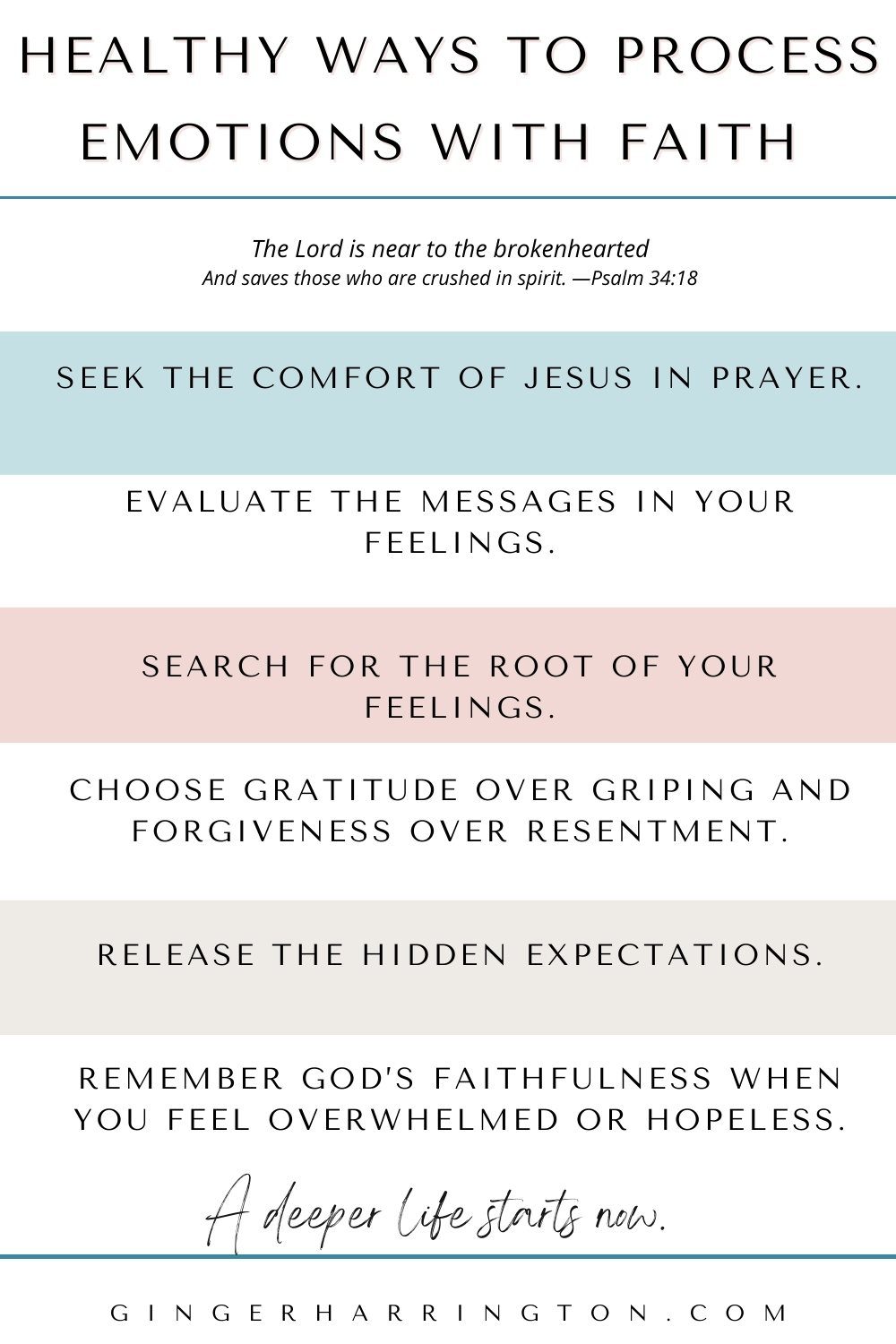
Process Your Feelings with Emotionally Healthy Faith
Releasing your rights is to be willing to feel the emotional pain as you choose to entrust your feelings and challenges to Christ.
Surrendering your expectation opens the door to receive God’s supply for your needs instead of being controlled by your emotions. Without recognition and surrender, it’s easy to hang onto the hurts, demands, and messages that drive vulnerable emotions.
Do you think you could try the sacred habit of attending to your emotions in the care of Christ, seeking the help of a godly mentor or faith-based, biblical counselor if needed? In the light of truth and forgiveness, wounds and fears lose power and we discover we aren’t alone in the struggle.
“God made my life complete when I placed all the pieces before him. . . God rewrote the text of my life when I opened the book of my heart to his eyes” (Psalm 18:20, 24 MSG).
Circumstances may not change, but processing our feelings brings inward growth and peace to settle our heart over time. In Christ, we can navigate our emotions in beneficial ways that mature our character, increase faith, and create emotional health.
As I explore my emotions with Christ, I experience peace in the midst of sadness, perspective in the face of challenge, and humility in my failures. I can honestly say, it is well with my soul, giving myself grace to be an imperfect person in this process of becoming holy and whole.
How about you, my friend? Are you struggling with your feelings? Which of these healthy ways to process your emotions are most helpful for you today?
Want More Content to Process Your Emotions in Healthy Ways?
Investing in your emotional health is worth the effort! This post has been adapted from an excerpt from the “Moments to Feel” chapter of Holy in the Moment. Each chapter of the book is packed with practical ideas to help you overcome the things that hold you back. Join thousands of readers who have discovered the value of trusting God to make us holy and whole, one moment at a time.
Purchase your copy today. (affiliate link at no cost to you)
Get Your Free Emotional Health Workbook
Download your copy of my free resource, Flourish: An Emotional Health Workbook to help you apply the ideas in this post. You’ll even find printable worksheets to help you work through situations that trigger difficult emotions. This short workbook provides a companion resource to live out strategies for emotional health from Holy in the Moment as well!
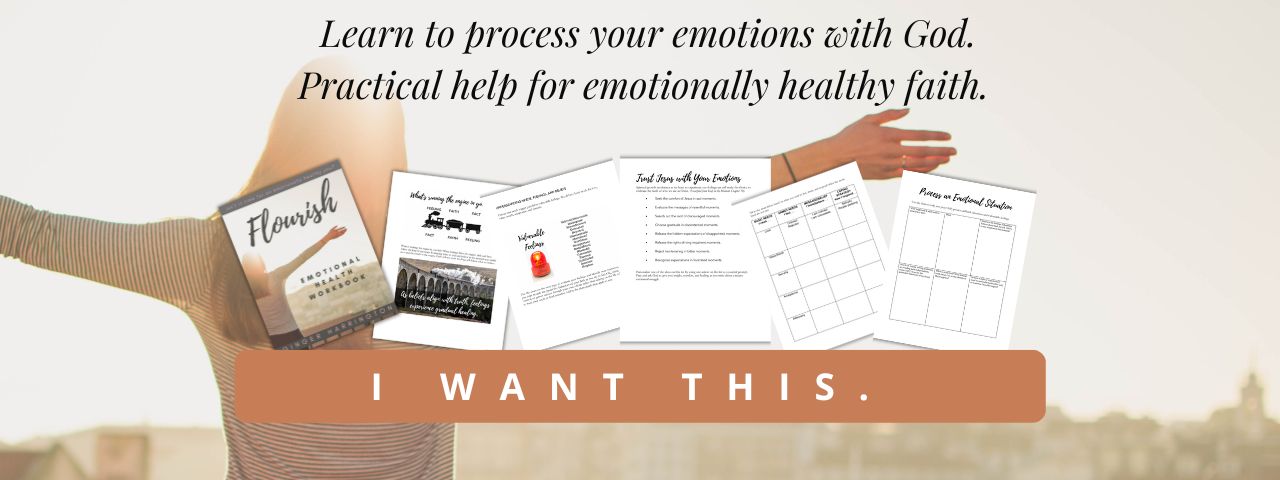
More Posts on Healthy Thoughts and Emotions
- Why Positive Thinking is Good for a Healthy Body, Soul, and Spirit
- Why You Should Stop Discounting Your Anxiety
- Are Your Feelings Defining Your Faith
- 10 Free Resources for an Emotionally Health You
- 20 Toxic Ways of Thinking That Will Poison Your Life
- 3 Reasons Why You Should Let Go of Negative Thinking
- Strategies and Scriptures to Combat Negative Thinking: With Free E-book
“The contents of this website, such as text, graphics, images, and other material contained on gingerharrington.com are for informational purposes only. The Content is not intended to be a substitute for professional medical advice, diagnosis, or treatment.”
[i] True Life Institute. Surrender and Brokenness Lecture, p. 5

Why God Calls Us to Give Thanks in Every Circumstance (and How to Do It)
Why does God call us to give thanks in all circumstances? Gratitude shifts our perspective, aligns our hearts with His presence, and strengthens our faith, even in life’s most difficult seasons. Giving thanks is more than a response to blessings—it’s a spiritual discipline that anchors us in hope and trust in God’s faithfulness. In this post, you’ll find options to watch, or listen to this content.
Have you ever been in a place where the last thing you wanted to do was give thanks? Maybe you’re in that place right now—facing financial stress, feeling overwhelmed with loss, or battling a health issue. As Thanksgiving approaches, it might feel counterintuitive to celebrate when so many hard things are happening in our world. But what if I told you that gratitude isn’t just for celebrating?
Giving thanks isn’t just for the good times; it’s an anchor that can help us hold onto hope, even in the most challenging circumstances. As Thanksgiving approaches, it’s a perfect time to reflect on how gratitude can be a powerful practice—even when life feels tough.
Thankfulness is a Habit of Hope
“Make gratitude your first response, not your last resort.”
Choosing gratitude, especially when life is hard, shifts our focus and opens us to God’s presence and peace. Gratitude becomes a lifeline that moves our hearts from despair to hope, reminding us of God’s faithfulness even in difficult moments. Rather than waiting for everything to be “right” before we’re grateful, we can make thankfulness an intentional choice in any situation.
As my co-host, Larissa says, “If we wait to feel grateful before we give thanks, we might be waiting a long time.” True gratitude, especially in difficult seasons, is gritty—it’s a choice to see God’s goodness even when life is hard.
The most popular quote from my book Holy in the Moment relates to this: “Not every moment is good, but God is good in every moment.” When we remember this truth, choosing this kind of “gritty gratitude” can make all the difference in transforming our hearts and minds when we feel overwhelmed.
Why God Calls Us to Give Thanks in All Circumstances
The Bible tells us in 1 Thessalonians 5:16-18: “Rejoice always, pray continually, give thanks in all circumstances, for this is God’s will for you in Christ Jesus.”
God is not asking us to pretend that everything is fine. This passage isn’t suggesting we should discount our problems or ignore our challenges. Instead, it encourages us to anchor our hearts in gratitude, shifting our focus from our problems to God’s faithfulness.
God invites us to be grateful not for every situation but in every situation. This passage expresses God’s will for believers, and it’s not just about circumstances, but how we respond to them.
God invites us to anchor our hearts in thankfulness because it realigns our focus from our problems to His presence and provision.
If we’re tempted to believe that gratitude has become cliché, it’s important to remember that the Apostle Paul wrote these words. His life was filled with hardships, and yet, we can read of his consistent thankfulness in every letter he wrote.
God’s will refers to all three of these instructions, to rejoice always, to pray continually, and to give thanks in all circumstances. The words “always,” “continually,” and “in all circumstances” point to a way of living—consistent practices or habits in our daily life.
When we practice these habits of hope, gratitude becomes a natural part of who we are not just something we do. Prayer is the connection that empowers us to choose joy and thankfulness. The key here is “in Christ.” In our own strength, it’s all too easy to let our emotions get in the way of choosing gratitude.
This call to thankfulness aligns our hearts with God’s presence and allows us to experience His peace. Gratitude shifts our focus from our problems to God’s promises, reminding us that we are never alone.
How might choosing gratitude as a “first response” impact the way you handle challenges?
The Science of Gratitude: How It Impacts Our Brains and Mental Health
Gratitude doesn’t just impact our faith; it transforms our minds and bodies as well.
Research shows that gratitude can reduce stress, lower symptoms of depression, and even rewire the brain for resilience.
According to cognitive neuroscientist Dr. Caroline Leaf, gratitude activates nerve growth factors in the brain, enhancing neuroplasticity and helping us reshape negative thought patterns into healthier ones. Here’s how gratitude affects us:
Lowers Cortisol: Research by Robert Emmons, a leading gratitude researcher and psychologist, indicates that practicing gratitude can reduce cortisol levels, the stress hormone, by up to 23%. Emmons’ studies on gratitude are widely cited, and his book “Thanks!: How the New Science of Gratitude Can Make You Happier” provides a deep dive into these findings.
Boosts Happiness: Studies show that gratitude can increase happiness levels by 25%, helping us feel more satisfied and fulfilled.
Improves Resilience: Trauma survivors who practice gratitude report fewer symptoms of PTSD and depression.
Rewires the Brain: Research by Dr. Caroline Leaf reports that practicing gratitude creates new neural pathways that reinforce positive thinking, making it easier over time to shift our perspective from what we lack to what we have.
And Much More! For a comprehensive list of the benefits of thankfulness, check out this article 35 Scientific Benefits of Gratitude: Mental Health Research Findings in 2024
This rewiring of our brains makes gratitude more than just a feel-good exercise. It’s a way to create new, healthy thought patterns that strengthen our mental and emotional resilience. Choosing to be thankful shifts our focus from waiting for a solution to thanking God during the challenge. By grounding ourselves in thankfulness, we experience renewed peace and strength.
A Real-Life Example of Gritty Gratitude
To illustrate gritty gratitude in action, let’s look at Larissa’s personal journey. After losing her husband, she continued her daily gratitude practice, choosing thankfulness even during one of life’s hardest seasons. She describes this journey as a choice that grounded her in God’s presence and became a source of strength in her grief.
“When we hold fast to hope, we can be thankful that God is with us, even if we’re not thankful for what’s happening.” Her story reminds us that gratitude can be a bridge to resilience. God has used her example to inspire more gratitude in my life, especially when I’m tempted to whine, complain, or worry.
Practical Ways to Make Giving Thanks a Daily Habit
Building a habit of gratitude doesn’t have to be complex or time-consuming. In our recent episode and blog post on the power of gratitude, we shared seven ways to practice gratitude. Here are some additional ways to cultivate thankfulness in your life:
Start a Gratitude Text Group: Connect with friends or family by creating a group text dedicated to sharing three things you’re grateful for each day. This practice not only encourages you to focus on what’s good but also creates a positive space to share encouragement with others.
Talk About What You Are Thankful For. Be intentional about bringing gratitude into your conversations. The more you practice gratitude, the more it will flow into your conversations. This is a natural way to bring God into your conversation, and it can serve as a powerful witness.
Focus on Philippians 4:8 at the End of Each Day: Reflect on one thing that is “true, noble, right, pure, lovely, or praiseworthy” at the close of your day. This practice brings peace and helps you sleep with a grateful heart.
Incorporate Gratitude into Prayer: Begin or end each prayer by thanking God for His presence and specific blessings. This small practice helps focus our minds on what’s good, even when life feels challenging.
Try the “5-Finger Gratitude” Technique: Hold up your hand and touch each finger, naming one thing you’re grateful for with each. This quick and simple technique is perfect for moments when you need a reminder of God’s faithfulness.
Choose one of these gratitude practices and put it into action today. Gratitude isn’t just a fleeting feeling—it’s a spiritual discipline that cultivates trust in God’s presence and faithfulness in every situation. By choosing to be thankful, we shift our focus from waiting for solutions to experiencing God’s peace during challenges.
This life-giving habit strengthens hope, deepens faith, and reminds us that even in difficulty, God is with us every step of the way.
For more insights, encouragement, and tools, I invite you to listen to the full podcast episode and sign up for the free gratitude resources to support your journey into a lifestyle of gratitude.
30 Days of Giving Thanks
Cultivating a thankful heart doesn’t just happen. It takes intention and practice.Enjoy this fun and interactive workbook to release the power of gratitude in your life.
Resources Mentioned in the Podcast
If you’re looking for tools to help make gratitude a daily practice, here are some helpful resources from the podcast:
Weekly Gratitude Sheets – A free download to help you keep track of daily blessings. Free with sign up for Larissa’s newsletter.
Social Media Inspiration from Larissa – Follow “Grateful Chick” on social media for daily gratitude encouragement.
Switch On Your Brain
Related Content
Why Gratitude Matters More than You Think: How to Be More Grateful
Gratitude Matters: 10 Truths and Tips for a Grateful Life
Celebrate Gratitude with Ginger and Larissa
Pondering Gratitude