

How to Start the New Year with God: From Reflection to Formation
There’s something about the start of a new year that makes us want a clean slate—new plans, new habits, new energy. But before we rush forward, what if we paused? Because some of the most meaningful growth doesn’t come from starting over. It comes from paying attention to what God has already been teaching us.
So, how do you start the new year with God? You begin by slowing down long enough to reflect on what you learned—both the joyful and the hard—and then you intentionally carry those lessons forward so they shape how you live, choose, and grow in the year ahead.
That kind of reflection isn’t nostalgia. It’s wisdom.
One of the verses that captures this mindset so well is Psalm 77:11–12:
“I will remember the deeds of the Lord; yes, I will remember your miracles of long ago. I will consider all your works and meditate on all your mighty deeds.”
This remembering isn’t just looking back—it’s a spiritual reflection practice that helps us move forward with hope.
What We’ll Explore in This Post
Why reflection matters more than a “clean slate” approach
A simple Christian New Year reflection practice you can actually do
How to learn from what was joyful and what was frustrating
Why preparation can be an act of grace—not striving
How small, consistent practices shape real Christian spiritual growth
What it means to plan well while holding things loosely
How to step into a new season with wisdom, presence, and sustainable rhythms
Why Starting the New Year with God Begins with Reflection
Without reflection, it’s easy to move on quickly—and forget what God has been faithfully teaching us. In the busyness of life, we can learn something meaningful and then lose sight of it as soon as the calendar turns.
Reflection helps you remember what God has done so you can grow from it.
That’s why Psalm 77 matters here. It’s not calling us into a sentimental rewind. It’s inviting us into the kind of remembering that produces wisdom—because when you notice God’s faithfulness, you carry it with you. And that changes how you step into the year ahead.
How Do You Do an End-of-Year Reflection With God Without Overthinking It?
One of the most freeing things Larissa said in our conversation was this:
There’s no right way to do this—only the honest way.
Here are a few simple approaches we talked about—each flexible, meaningful, and adaptable to your season.
Start with a simple list. Write words or short phrases about what you remember learning. Treat it like a rough draft. Don’t worry about grammar. Just get it on paper, then take it to the Lord and ask for clarity.
Review what God has been teaching you. Another way I do this is by reviewing my journal for the year. For a short season, I use this review as my quiet time and ask, Lord, will You help me notice what You’ve been teaching me? I look for repeated themes, topics God returned to again and again, and lessons that feel like preparation for what’s next.
Use what helps you remember. If you don’t journal, looking back through your camera roll can be a powerful way to remember where God met you. Let the memories prompt prayerful reflection: What do You want me to take away from this year?
There are many ways to reflect. The point isn’t the method—it’s pausing long enough to notice.
What Should You Pay Attention to When You Reflect With God?
Yes—look for what was joyful.
But also pay attention to what was frustrating.
This came up in our conversation in an important way. Sometimes the places you struggled most are exactly where God was meeting you with wisdom. Larissa shared how her therapist described frustration like an alarm—something that signals, Pay attention here.
As you reflect, you might ask:
What kept irritating me?
Where did I feel stuck or overwhelmed?
Because sometimes we keep pushing against the same thing until we finally realize God may be teaching us something there.
God’s lessons are often hidden inside your hard places.
Habit of Hope
Here’s the Habit of Hope we shared in Episode 65:
Pause each year to reflect—and intentionally carry lessons forward.
Starting the new year with God doesn’t begin with a checklist—it begins with reflection that turns into formation.
Practical step:
Set aside one unrushed hour this week to ask:
What did I learn this past year? What is God inviting me to carry forward into this new year?
Why Do New Year’s Resolutions So Often Turn Into Pressure?
Because for many of us, a new year quietly becomes a new attempt to fix ourselves.
I shared how the Lord convicted me of this years ago. I realized I was beginning each year trying to fix myself in new and fresh ways—and for me, that wasn’t walking in freedom in Christ. I remember sensing the Lord saying, in essence, How about we focus on some of the things I’ve been teaching you?
That shift changed everything.
Starting the year with wisdom is different from starting the year with self-improvement. One is rooted in striving. The other is rooted in noticing God.
How Do Small, Consistent Practices Shape Christian Spiritual Growth?
Larissa shared a powerful lesson: small, consistent practices matter more than big overhauls. They don’t fix everything overnight, but they create stability and hope over time.
One practice she shared was something she calls a looking forward to list. The night before, she would write a short list of things she was looking forward to the next day. It helped her focus on meaningful moments ahead—and by the end of the day, it often became a gratitude list.
Give it a try: Tonight, write three things you’re looking forward to tomorrow.
Small practices don’t just change your schedule—they shape your spirit.
How Can Preparation Be an Act of Grace, Not Striving?
One of the lessons I’m carrying forward is this:
Preparation is an act of grace. It gives us space.
This year required that in a new way. Working ahead protected consistency and created freedom—not pressure.
A question I’m keeping for this year:
What could I prepare ahead of time this month that would create space for presence later?
How Does God Use Creativity as Provision, Not Performance?
Another lesson Larissa shared is one I loved: creativity isn’t just for hobbies. God gives creative solutions to real problems.
For her, creativity became a form of provision—not productivity or performance, but practical wisdom for what was right in front of her. Sometimes God’s provision doesn’t arrive dramatically. Sometimes it comes as an idea at just the right time.
When you face a small problem this week, pause and ask:
Lord, is there a creative solution You want to show me?
How Grief Changes Over Time—and Why Noticing That Matters
One of the lessons that surfaced this year was quieter, but deeply significant: grief changes—and noticing that change matters.
Larissa shared that as she wrapped up year five as a widow and stepped into year six, things didn’t suddenly feel “better.” There weren’t dramatic markers. But something had shifted. And naming that shift mattered.
Healing doesn’t always announce itself loudly. Often, it shows up as steadiness—an increased capacity to carry hard things with a little more strength than before.
Another important truth we talked about is this: God may call us to do hard things while we are still in a hard thing.
Grief doesn’t pause life. And healing doesn’t mean the hard is over. But over time, God prepares us—quietly and faithfully—to live with courage and compassion in the midst of what still hurts.
Joy Is Still Possible—even in Hard Seasons
Right after grief, we talked about something that can feel surprising but deeply true: joy is still possible, even in hard seasons.
Joy is not denial. It’s not pretending things are fine when they’re not. Joy is a gift God gives us as we learn to trust Him more deeply.
This year brought a growing awareness that laughter and delight are not distractions from spiritual growth—they’re part of it. Joy loosens the grip of pressure and helps us stay present instead of rigid.
Joy doesn’t erase grief. But it can coexist with it. And over time, it becomes a quiet testimony of God’s faithfulness.
Why Noticing a Change of Season Helps You Live With Wisdom
One of the most helpful things we can do as we reflect on the past year is ask whether we’re stepping into a new season—and what that season requires.
When we recognize a season shift, we can adjust priorities, expectations, and schedules to better align with where God has us now. Instead of asking, What’s not working the way it used to? we can ask, What is God showing me in this season?
For me, this season has made one thing especially clear: presence matters.
There was also a very personal lesson wrapped into this season. I had a clear dream I worked toward for several months, believing it was time. And yet, as the year unfolded, it became clear it wasn’t going to happen in the way or timing I expected.
That could have felt like failure. Instead, it became an invitation to hold that dream with open hands—trusting God’s timing more than my own. In this season, being available to what God was doing right in front of me mattered more than pushing a personal goal across the finish line.
Recognizing a new season gives you permission to realign—not retreat. And when we do that, we’re not falling behind. We’re walking in step with God.
Why We’re Adjusting the Podcast Rhythm—and What You Can Learn From It
As we step into this new year, we’re adjusting the rhythm of the podcast slightly—not out of burnout, but out of wisdom.
Starting in January, the first week of each month will be an admin week with no new episode, followed by weekly episodes thereafter. The purpose is simple:
A sustainable pace
Space to serve well
Creating from joy rather than pressure
Practical step: Consider one small rhythm you could adjust this month—not to do less, but to live with more wisdom.
FAQ: How to Start the New Year With God
How do I start the new year with God if I feel behind or discouraged?
Start with a pause, not a plan. Ask what God taught you last year and what He’s inviting you to carry forward.
What is a simple Christian New Year reflection practice I can do in one sitting?
Make a short list of lessons—words or phrases—and pray over it for clarity.
What if I can’t remember what God taught me this year?
Use something that jogs your memory—journal entries, quiet time notes, or photos—and ask God to show you the themes.
How do I plan for the new year without striving?
Plan well, but hold your plans loosely. Preparation can be an act of grace when it creates space for trust.
Hope As You Begin This Year
As you step into this new year, don’t rush past what God has already been teaching you. Receive those lessons as gifts. Carry them forward with intention and trust.
The Habit of Hope: Pause to reflect—and carry the lessons forward with grace and freedom.
If you’d like to hear the full conversation, listen to Episode 65 of the Habits of Hope podcast. You’ll also find related resources linked in the show notes to help you turn reflection into growth that lasts.
Because the lessons you learned are not wasted—they’re wisdom.
And when reflection becomes formation, that wisdom becomes hope for the year ahead—hope rooted in trusting a faithful God to meet you, guide you, and sustain you in every season.

This Christmas…Choose to Believe, Part 1
A quiet Christmas reflection on choosing to believe God while waiting, holding faith through unanswered prayers, and trusting His work in ordinary days.
Note: This post has been updated to include episode 64 of the Habits of Hope Podcast. This episode revisits and gently weaves together themes from earlier writings, offering a quiet, reflective space to prepare your heart for Christmas.
Have you ever loved God faithfully for a long time…
served Him, prayed, trusted Him —
and still carried a deep longing He didn’t seem to answer?
Maybe you’ve wondered, quietly,
Why would God let this prayer go unanswered for so long?
Or felt the tension between faithfulness and disappointment.
If so, you’re not alone.
Some stories in Scripture are so familiar
that we stop listening for the nuances in the passage.
We know the ending.
We’ve read the miracle.
Sometimes the best gift we can give ourselves is time to slow down and let God speak.
Let’s step into the story together.
It was just a regular day.
No sign in the sky.
No whisper of anticipation.
Just faithfulness.
Just showing up.
And then — God stepped in.
Luke 1:5-25
5 In the days of Herod, king of Judea, there was a priest named Zechariah, of the division of Abijah. His wife Elizabeth was also descended from Aaron.
6 They were both righteous before God, living blamelessly in all the commandments and ordinances of the Lord.
7 But they had no child, because Elizabeth was barren, and both were advanced in years.8 Once, when Zechariah was performing his priestly duties before God, in the order of his division,
9 according to the custom of the priesthood, he was chosen by lot to enter the sanctuary of the Lord and burn incense.
10 At the hour of the incense offering, all the people were outside praying.11 Then an angel of the Lord appeared to him, standing at the right side of the altar of incense.
12 When Zechariah saw him, he was shaken and overcome with fear.
13 But the angel said to him,
“Do not be afraid, Zechariah, for your prayer has been heard. Your wife Elizabeth will bear you a son, and you are to call him John.
14 He will be a joy and a delight to you, and many will rejoice because of his birth.
15 For he will be great in the sight of the Lord. He must never drink wine or strong drink, and he will be filled with the Holy Spirit even before his birth.
16 He will turn many of the Israelites to the Lord their God.
17 He will go before Him in the spirit and power of Elijah, to turn the hearts of parents to their children, and the disobedient to the wisdom of the righteous—to make ready for the Lord a people prepared.”18 Zechariah said to the angel,
“How can I be sure of this? For I am an old man, and my wife is advanced in years.”19 The angel replied,
“I am Gabriel. I stand in the presence of God, and I was sent to speak to you and bring you this good news.
20 And now, because you did not believe my words—which will be fulfilled in their time—you will be silent and unable to speak until the day these things happen.”21 Meanwhile, the people were waiting for Zechariah and wondering why he stayed so long in the sanctuary.
22 When he came out, he could not speak to them, and they realized he had seen a vision in the sanctuary. He kept making signs to them but remained unable to speak.23 When his time of service was completed, he returned home.
24 After these days his wife Elizabeth became pregnant and kept herself in seclusion for five months.
25 “This is the Lord’s doing,” she said,
“now that He has looked with favor upon me and taken away the reproach under which I lived among people.”
One of the hardest parts of this story — and one of the most important —
is that Zacharias and Elizabeth were faithful before anything changed.
Scripture is careful to tell us they were righteous before God,
walking blamelessly in obedience.
And yet — they carried years of disappointment.
They prayed.
They waited.
And God did not answer the deepest longing of their hearts for a very long time.
That kind of waiting wears on you.
Especially when you’ve served God faithfully for years.
Especially when you’ve prayed the same prayer again and again.
Especially when the silence stretches on longer than you expected.
And in their culture, barrenness was not just painful — it was shameful.
It was something others noticed.
Something silently judged.
Something that could make you question what God was doing… or if He had forgotten you.
And yet — they remained faithful.
They didn’t walk away from God because they were disappointed.
They didn’t stop serving because the longing remained.
They didn’t quit trusting, even when the ache stayed tender.
This story matters because it reminds us:
Faithfulness is not measured by outcomes.
Sometimes faithfulness looks like continuing to follow God
even when the prayer you care most about remains unanswered.
And maybe that’s where this story meets you today…
Let’s ask God to let the story of Zachariah become a mirror:
- We are the ones who wait.
- We are the ones who pray prayers that feel unanswered.
- We are the ones who fear and wonder and hope and doubt.
- We are the ones who long to know: Has God heard me?
This Christmas, choose to believe. . . God is working in your ordinary days.
It all began with routine priestly service — nothing dramatic.
“Once, when Zechariah was performing his priestly duties before God…” (Luke 1:8)
He was simply being faithful.
Showing up where God had placed him.
Carrying both devotion and disappointment.
And that is where God broke in.
When the lots were cast, God made a sacred selection.
The moment priests hoped for and most never received.
Zachariah’s name was chosen.
A once-in-a-lifetime calling.
A doorway into holy ground.
He did not know that today, heaven would meet him in the middle of his ordinary obedience.
He was simply doing the work that was his to do.
God is not absent in your ordinary.
He is present there — moving, preparing, shaping, holding.
Have you missed God’s nearness simply because life feels ordinary or routine?
This Christmas…choose to believe prayer and worship make a difference.
“And the whole multitude of the people were in prayer outside…” (Luke 1:10)
The worship and prayer of the people is an important part of this story.
A turning of hearts toward God.
A holy expectancy.
A moment of reverence and seeking.
Every prayer and moment of worship matters.

This Christmas, choose to believe. . . has heard your prayers.
The angel speaks to the request Zacharias had prayed for years:
“Your prayer has been heard.” (Luke 1:13)
Not:
“You prayed the right way.”
“You prayed enough.”
“You prayed with perfect faith.”
Just:
Your prayer has been heard.
There are prayers you pray standing up, prayers you pray on your knees, prayers you whisper into your pillow, and prayers you stop praying out loud because they feel too tender to touch anymore.
God has heard every prayer of your heart.
You have not been overlooked.
You have not been forgotten.
The long ache that has lived quietly in your chest is not invisible to Him.
Do you have a prayer have you quietly stopped believing God listens and remembers — and could you bring it to Him again today?
This Christmas, choose to believe. . .God meets you in your longing.
The message touches the Zachariah’s deepest longing:
“Your wife Elizabeth will bear you a son…” (Luke 1:13b)
In this passage, God speaks to the exact place where the ache lives.
Where hope stretched thin.
Where disappointment has lingered.
This is not a story about getting what we want.
It is a story about God seeing us in the waiting, the grief, the surrender, the longing —and meeting us there.
Where have you been afraid to hope because disappointment has been real?
This Christmas, choose to believe. . .God can bring you joy.
“He will be a joy and a delight to you.” (Luke 1:14)
Sometimes joy feels far away.
Sometimes grief takes up space in us longer than we expect.
Sometimes we can even forget what joy feels like.
But God is the restorer of joy.
Not the forced, smiling, “make it look okay” kind of joy —
but the deep joy that rises quietly
like a warm light from within.
Joy that doesn’t deny sorrow —
but lives alongside it.
Joy that knows tears and still says,
There is goodness yet.
Where has joy felt out of reach — and could you trust Him to restore your joy today?
This Christmas, choose to believe. . .God will fill you with the Holy Spirit.
“He will be filled with the Holy Spirit…” (Luke 1:15)
John’s birth gave us a glimpse of what God was going to make possible for all of us. In ages past, the Holy Spirit was sometimes given to rest on individuals to empower them for a specific calling.
In goes deeper than on.
John was filled with the active presence of God working from within. One of the ongoing gifts of Christmas is that we can be filled with the Holy Spirit.
Holy God takes residency in the manger of our lowly hearts.
The extraordinary meets the mundane.
No longer in need of angels to convey messages, we can be filled with the Holy Spirit, the presence and purpose of God.
This is the great mystery of the gospel:
By faith, you do not live this life alone.
You do not carry your faith by your own strength.
You do not have to manufacture peace, hope, trust, or belief. It is a gift of God.
The Spirit breathes in you.
Fills what you cannot fill.
Strengthens what you cannot hold.
Sustains what you cannot carry.
Have you received the Holy Spirit by faith in Christ? Where do you need a fresh filling of the Spirit in your life?
This Christmas, choose to believe. . . God is still reconciling hearts.
“He will turn many… he will turn hearts…” (Luke 1:16–17)
Christmas is a story of God drawing near.
Softening what has become hardened.
Restoring what has been strained.
Bringing home what has wandered.
Lifting what has been heavy.
You may be carrying relational weariness.
A conversation that ended poorly.
A distance you don’t know how to close.
A wound that still stings.
God is still turning hearts today.
Is God inviting you to release something, forgive someone, soften something to prepare your heart for more of Him?
This Christmas, choose to believe. . . God will work in your wait.
“They had no child… and both were advanced in years.” (Luke 1:7)
The waiting was long.
The waiting was painful.
The waiting shaped them.
And yet —
God had been present in every year of waiting. And He is present in our waiting.
Your waiting has not been empty.
Waiting is not punishment.
Waiting is preparation.
How has waiting changed you — strengthened you — deepened you?
This Christmas, choose to believe God is bigger than your doubt.
“How can I be sure of this?” (Luke 1:18)
Zacharias didn’t reject God —
he simply didn’t know how to hold hope anymore. His questions were bigger than his faith in the moment.
I’ve been there. That very issue is the source of many moments of anxiety in my life.
Maybe you know that feeling.
Maybe you’ve tried to protect your heart.
Maybe you’ve learned to hope with caution.
Maybe belief feels tender.
God does not abandon Zachariah in this moment —
He stays.
He continues the promise.
Where is belief tender in your life — and can you allow God to meet you there?
Had I been standing beside the altar listening to the voice of an angel, would I struggle to believe?
The struggle to take God at His word is also part of the first message of Christmas. Will we believe the message? Will we accept the one before us, the miracle of God clothed in the skin of a baby?
Like Zachariah, we can point to logic and count our problems.
We can look back instead of forward.
We can lose sight of what can be in the face of what is.
Like Zachariah, we can get lost in our, “how can this be” questions.
And yet, Zachariah’s doubts did not disqualify him from God’s plan.
God still fulfills the promise.
God still brings the child.
God still writes the story.
God still speaks favor.
The same is still true today. Bring your doubts to God.
Your story is still unfolding with God’s faithfulness woven through it.
Clinging to our desire for certainties, we can cheat ourselves of the wonder of faith. We can let doubt silence faith, or we can ask for faith that silences doubt.
The choice is ours.
Maybe the greatest consequence of disbelief renders us unable to tell of the wonder of God. I count so many times I have struggled. What gracious blessing to see that our frailties of faith do not stop God.
Today’s Habit of Hope
Name the place where your heart needs God right now,
and choose to believe He is working there.
Try this simple prayer:
“Lord, this is where I need You.
I choose to believe You are working here.”
This Christmas, choose to believe in the favor of God.
The story of this first Christmas message continues with the rounding belly of a woman pregnant with longing fulfilled.
In quiet content with life growing strong within her, Elizabeth completes this first message of Christmas. With joy, she feels that sweet favor kick against her ribs.
“The Lord has looked with favor upon me.” (Luke 1:25)
Favor means:
God comes close.
Right where you are.
As you are.
You are seen.
You are known.
You are loved.
Let the story of Zachariah whisper to you in your ordinary days:
God sees you.
God hears you.
God is nearer than you think.
Let His peace settle over your questions.
Let His joy rise again in the places where you’ve felt weary.
Let His favor remind you that you have never been forgotten.
Before we end, take one more breath.
Let your heart open just a little wider.
Let the hope of this story settle into the places where belief has felt fragile.
Christmas is a season of sacred expectancy—
a reminder that God breaks into ordinary lives
with extraordinary grace through the redeeming gift of His son.
From my heart to yours, Merry Christmas, friend.
Get a free Christmas devotional. Enjoy this beautiful ebook to spark hope in your life this Christmas. This is my Christmas gift for you.

Get Your Free Chapter!

Read the story of a Christmas miracle I experienced in the first chapter of my award-winning book, Holy in the Moment. You’ll read a poignant story from one challenging Christmas in my life at the end of the first chapter. Read the story of what happened here. Give the gift of holy this Christmas–Holy in the Moment makes a wonderful gift to encourage faith in a practical way. Learn more about the book here.

How to Let Go of the Picture Perfect Christmas and Embrace Joy
Feeling pressure to create a picture-perfect Christmas? Discover how to release expectations, choose presence over perfection, and find true joy in Christ.
Christmas has a way of quietly stirring expectations—often without our awareness.
Have you ever hit December and felt like you were already behind?
Christmas music is playing, lights are twinkling, and yet something inside of you feels out of sync—maybe even heavy. I’ve had years where, instead of joy, I felt pressure. Instead of anticipation, there was anxiety quietly humming in the background. And I found myself thinking, Isn’t Christmas supposed to feel different?
As we talked on the podcast, one of the most surprising things about Christmas is this:
“How easily expectations can creep in. You don’t plan them, but suddenly you realize you’re holding a whole list you never meant to write.”
Most of us don’t intend to pile on pressure. We want the season to feel meaningful and peaceful, filled with family, festivity and traditions. But life doesn’t always cooperate just because the calendar says December. And when our reality doesn’t match the picture in our minds, the disappointment can land hard.
Letting go of a picture-perfect Christmas begins with recognizing the expectations we’re carrying and how they’re shaping our experience of the season.
When joy is tied to things going a certain way, it becomes fragile. But when joy is rooted in Christ, it becomes steady—able to meet us right in the middle of real life.
In Episode 63 of the Habits of Hope Podcast, Larissa and I talk honestly about how to navigate the season when Christmas feels different—and why that difference doesn’t disqualify us from joy.
We name the pressure, the disappointment, and the longing—and we gently return to the heart of the Christmas story, where joy was announced not to perfect lives, but to weary, ordinary people living real stories.
What We’ll Explore in This Post
- Why Christmas expectations form so quietly and carry so much weight
- How the pressure for a picture-perfect Christmas steals joy
- Why Christmas can feel different through grief, loss, conflict, and change
- How comparison and cultural images intensify disappointment
- What the Christmas story reveals about joy for real, imperfect lives
- Why joy grows through presence, not perfection
- How to choose presence over perfection when the season looks different
Why Do Christmas Expectations Carry So Much Weight?
One of the biggest stressors of Christmas is expectations.
They come from many places—culture, family, and often us—shaping how we think Christmas should look, feel, and move our hearts.
Recently I’ve been going through old photos—pictures from my own childhood and from when my kids were growing up. There were a lot of Christmas pictures mixed in, and it was meaningful to look back on those moments.
Those photos remind us of what we want Christmas to be. Happy families. Meaningful traditions. Warm emotions. Peace and harmony. We want Christmas to feel beautiful—not just visually, but emotionally.
And yet, real life often brings something very different.
- Schedules don’t line up
- Budgets feel tight
- Some loved ones are no longer with us
- Grief shows up
- Illness interrupts plans
- Houses feel quieter than expected
- Longing, emotional exhaustion, or the weight of feeling stretched thin
That space—the gap between what we hope for or long for and what we’re living right now—often shows up as disappointment. Sometimes it feels like stress. Sometimes it feels like overwhelm.
And that’s where expectations start to feel heavy.
Looking back at those photos also reminded me of how much pressure I sometimes put on myself as a mom. I wanted Christmas to be perfect for my kids—the presents, the experiences, the traditions.
There were years when the calendar was completely packed: It felt like rushing from one thing to the next, trying to keep everything together—winging it and hoping I didn’t drop the ball.
Whether those expectations came from outside us or from inside our own hearts, they created pressure. Pressure to make Christmas meaningful. Pressure to make everyone happy.
Pressure to keep things the way they used to be and recreate something beautiful—even when life was already demanding a lot.
When life interrupts with new seasons or hard things, those expectations don’t disappear—they collide with reality. That’s why Christmas disappointment can feel so heavy.
We’re not just facing changed plans; we’re grieving the loss of what we hoped the season would hold.
Naming unspoken expectations matters—because when they go unchecked, they quietly crowd out joy instead of leading us toward it.

When Christmas Feels Different Than You Expected
For many people, Christmas feels different not because something is wrong—but because life has changed.
The ups and downs of life add deep layers to the Christmas season. Wins and losses, transitions and ongoing challenges don’t pause just because it’s December. And when Christmas looks different from what we hoped or expected, that difference can be hard to carry.
There are many reasons Christmas may feel different this year:
- Someone is missing
- The kids are with the in-laws
- You’ve moved and everything feels unfamiliar
- Finances are tight, grief is fresh, or illness has interrupted plans
- Or the season simply feels lonelier than expected
And then there’s a layer we don’t always talk about enough—family conflict.
Strained relationships and tense gatherings can feel especially painful during a season filled with images of smiling, effortless, picture-perfect families. Seeing others post joyful moments can sting deeply when your own family feels fractured or complicated.
Christmas has a way of amplifying both what we long for and what we feel we’ve lost.
Larissa shared how December carries a different kind of ache after losing Bill. The sweetness of what was is still there—but so is the empty space. For those who have loved deeply and lost deeply, Christmas carries added weight.
I shared from my own life as well. As a military family, we’ve often experienced Christmas after major moves—arriving in unfamiliar places, missing previous homes and friendships. One year, when we moved to Okinawa, our youngest was heartbroken at the thought of Christmas without a tree. That Christmas was very different—but it also became sweet in its own way.
Sometimes difference shows up in quieter ways: navigating a more silent house when kids are grown, switching traditions because of illness, or facing unexpected budget challenges during the holidays.
All these changes carry emotional weight.
Many people are carrying more at Christmas than they ever say out loud.
Different doesn’t mean Christmas is ruined.
Different doesn’t mean joy is off-limits.
It simply means life is unfolding.
And it matters to say this clearly:
If Christmas feels different for you this year, you are not broken. Your story isn’t wrong. And your feelings don’t disqualify you from the joy of Jesus.
What Does the Christmas Story Teach Us About Joy for Real People?
At the heart of this conversation is a simple but powerful reminder: the Christmas story itself was never picture-perfect.
The words recorded in Luke 2:10–11 weren’t spoken into calm, ideal circumstances. Jesus entered a world marked by political tension, poverty, uncertainty, and fear. The people of Israel were living under Roman occupation, longing for rescue. Daily life was heavy with injustice and hardship.
The first Christmas wasn’t wrapped in sparkle and ease.
It was wrapped in tension, exhaustion, and longing.
And right into that reality, God spoke these words:
“Do not be afraid. I bring you good news that will cause great joy for all the people. Today in the town of David a Savior has been born to you; he is the Messiah, the Lord.” (Luke 2:10–11)
God did not wait for perfect conditions to announce joy.
Joy stepped into a weary world. A Savior arrived for people who were tired, strained, and stretched—much like we often are today.
And that tells us something important: God doesn’t reserve joy for people whose lives look put together.
Joy comes to the overwhelmed mom.
Joy comes to the military family far from home.
Joy comes to those living through disappointment, conflict, grief, or loneliness.
Christmas joy is for all people—because we all need a Savior.
When we think about Pinterest-perfect homes and curated holiday moments, it helps to remember where Jesus was born—not into comfort, but into simplicity, inconvenience, and humility. His parents were far from home, navigating circumstances that were anything but easy.
Maybe that’s intentional.
Maybe God wanted us to know this:
He meets us right in the middle of imperfect, unpredictable lives.
Jesus didn’t come for perfect stories.
He came for real ones.
That’s why joy doesn’t rise because everything is going right.
Joy rises because Christ has come.
This is the kind of joy that holds steady through change, loss, pressure, and longing—the kind that doesn’t require staging, only presence. God’s presence.
And that’s the beautiful hope of Christmas:
We don’t have to create a perfect season to experience true joy.
What Does It Look Like to Choose Presence Over Perfection?
With all the pressure, disappointment, changes, and longing that can surface at Christmas, it often comes down to one simple shift: choosing presence over perfection.
That invitation starts with an honest question:
What does it look like to be present right now instead of trying to make everything perfect?
Not present in the picture-perfect version of Christmas we imagined—but present in the real moment God has placed us in.
Here are some of the ways presence showed up in our conversation.
Choose One Meaningful Thing Instead of Everything
Sometimes presence means choosing one meaningful thing instead of ten.
Rather than trying to recreate every tradition from years past, presence asks what truly brings joy this year. Doing less can create space for deeper joy.
Loosen Your Grip on Expectations
Presence also looks like loosening your grip on expectations—both your own and everyone else’s.
When we release the pressure for Christmas to look a certain way, we’re able to enjoy the moments that are in front of us.
Expectations tighten our grip. Presence opens our hands.
Let Yourself Feel What You Feel
Choosing presence doesn’t mean ignoring hard emotions.
If the season stirs grief, loneliness, or disappointment, presence means honoring those emotions instead of assuming something is wrong.
Joy doesn’t require pretending everything is fine.
Build in a Pause to Be with God
For many of us, presence begins by creating intentional pauses.
That might be Scripture and prayer, a quiet cup of coffee, or a few still moments by the Christmas tree or a candle—space to breathe and refocus on Christ.
Sometimes presence is simply praying:
“Lord, show me what matters right now.”
Practice Presence Through the Christmas Worship Challenge
One simple way to practice presence this season is through daily worship.
I’ve created a Christmas Worship Challenge—one email with a linked list of short daily devotions to help you pause and be present with Christ throughout December. Each day includes Scripture and a Christmas song, offering a gentle invitation to worship instead of rush.
This isn’t about adding another task—it’s about creating space.
Trust God Instead of Trying to Fix Everything
Presence also shows up in relationships.
It may mean extending grace, releasing the need to fix everything, and trusting that God is working in places you can’t see.
Presence is often choosing trust over control.
Choose Simple Connection
Presence doesn’t have to be complicated.
If you have capacity, it may look like saying yes to an invitation or inviting someone into what you’re already doing. Even simple connection can ease isolation during the holidays.
Remembering Where Joy Grows
Presence is where peace settles and being fully present is where joy grows.
God meets us not in the ideal version of Christmas, but in the real one.
When we choose presence over perfection, we open ourselves to the unexpected ways God wants to bless us—in quieter moments, new rhythms, and imperfect stories. His presence becomes the anchor.
Frequently Asked Questions
What if my Christmas looks very different this year?
Christmas often looks different because life changes—through loss, transitions, illness, family dynamics, or unexpected circumstances. A different Christmas doesn’t mean a diminished one. According to the Christmas story, joy meets us in real life, not ideal conditions.
Why do unmet Christmas expectations hurt so much?
Because expectations are often tied to hope. When plans shift or traditions change, we aren’t just disappointed—we’re grieving what we hoped the season would hold. That ache is real and deeply human.
Does feeling grief, loneliness, or tension mean I’m missing the joy of Christmas?
No. Disappointment does not disqualify you from joy. Scripture reminds us that the good news of great joy was announced to people living weary, complicated lives. Joy and sorrow can exist together.
How can I experience joy without forcing myself to feel cheerful?
Joy doesn’t require pretending everything is fine. It grows through presence—being honest with God, honoring what you’re carrying, and allowing Christ to meet you right where you are.
Encouragement for Your Heart When Christmas Looks Different
If your Christmas looks different this year—quieter, lonelier, busier, more emotional, or simply more complicated—please hear this clearly:
Nothing about your story takes God by surprise.
Nothing about your story places you outside His love.
And nothing about your story disqualifies you from the joy of the season.
- Some years Christmas is loud and full.
- Some years it’s simple and quiet.
- Some years you’re surrounded by people.
- Some years you’re adjusting to a new normal.
Different doesn’t make Christmas less. It simply reflects the reality that life is changing.
And the beautiful truth of the Christmas story is this: God has always shown up in places and seasons that looked different than what people hoped.
Jesus came into tension, uncertainty, and longing—not perfection. He meets us in the middle of real moments, not staged ones.
So give yourself permission to breathe.
To slow down.
To loosen your grip on expectations.
Let presence—not perfection—shape this season.
Christmas may look different, but Christ is still your constant.
And where He is, there is hope.
📥 Download the Christmas Worship Challenge to help you build daily pauses of worship and presence throughout December.

Christian Hospitality and Loneliness: One Invitation Can Restore Hope
Discover how simple Christian hospitality can ease loneliness. One invitation can restore hope and build meaningful, faith-filled conversation with Sue Donaldson.
“Loneliness is at an all-time high.” I said those words as we opened this episode of the Habits of Hope Podcast, and I feel them deeply.
We are more connected digitally than ever—scrolling, liking, and DM’ing—but so many of us feel isolated and unseen, especially as the holidays approach. Underneath the full calendars and online noise, there’s a quiet ache:
Does anyone really see me?
What if one of God’s simplest answers to that ache is invitation?
Today I’m talking with Sue Donaldson—retreat speaker, author, podcast host, and hospitality mentor—about how Christian hospitality and loneliness are woven together, and how God can use our imperfect homes and ordinary meals to become a “never alone” kind of place.
Her new book, Never Alone: Stories of Invitation and Connection in an Isolated World, is packed with hope-filled stories and practical wisdom on living a life of welcome. In this conversation, she pulls back the curtain on her own loneliness, her first hesitant invitations, and the simple, doable ways we can practice hospitality as Christians—even when we feel tired, introverted, or insecure.
When You’re the One Standing Alone in the Parking Lot
Sue’s passion for hospitality didn’t begin in a picture-perfect home. It started in a church parking lot.
Single into her thirties—back when that was less common—she remembers standing alone after church while families packed kids into vans and headed home.
“I knew the people in my church loved me… and off they would go… and I thought, Why didn’t they invite me over for lunch? Because I needed a family to be in.” — Sue Donaldson
They liked her. They weren’t unkind. They just assumed she had an exciting single life. The truth? She was lonely and needed an invitation.
That ache became a holy nudge: What if I’m the one who invites?
Instead of waiting to be welcomed, Sue picked up the phone and called six women from church—each married, each with young children—to invite them to a Saturday brunch.
“I didn’t make very much money and I wasn’t Julia Child or Martha Stewart… but I could read. So I could read a recipe.” — Sue Donaldson
They were busy, but they came. Those simple brunches became a turning point. Those women became mentors. And Sue discovered that when you’re lonely, sometimes you have to make the first move.
That’s the quiet courage of Christian hospitality: not just waiting to be included, but asking God who you might invite.

Every Relationship Begins with an Invitation
As we talked, I returned to a line from my book Holy in the Moment that frames this entire conversation:
“Every relationship begins with an invitation.” — Ginger Harrington
An invitation doesn’t have to be complicated. It can sound like, “Hi, I’m Ginger,” or “Would you like to come for coffee?” Or even, “We’re having leftovers—want to join us?”
Sue shared how a simple question opened the door to lasting connection. After noticing a group of college students at church—and a college-age server she met at brunch—she asked about their lives and learned one young woman was a missionary kid who wasn’t currently attending church.
So Sue extended an invitation:
“Hey, you want to come for dinner a week from Tuesday?” — Sue Donaldson
All four young adults showed up. They shared their stories around her table, and one of those women became a close, long-term friend.
Sue traces moments like these back to the heart of God:
“God’s invitation to us was, Come to my table and you’ll find rest. And so our job is just to pass that along.” — Sue Donaldson
This is where Christian hospitality and loneliness meet—not in perfection, but at the table, in the story, and in the simple word come.
Loneliness as an “Unnecessary Disease” — and Hospitality as a Cure
At one point in our conversation, I referenced something Sue often says—that loneliness is an unnecessary disease, and simple hospitality can be part of the cure.
So what does God’s heart actually say about welcoming others?
Sue pointed us straight to Scripture:
“God’s word says, be hospitable without grumbling. And that’s not a command to a few—it’s a command.” — Sue Donaldson
Hospitality isn’t reserved for especially gifted believers or polished homes. In the New Testament, it’s a calling for all of us—not to impress, but to reflect God’s welcoming heart.
“You don’t have to go to seminary… You just have to go across the street and invite your neighbor over for banana bread that you didn’t even bake.” — Sue Donaldson
If you’re in a quieter season and wondering What now?, this may be one of God’s simplest answers:
Open your door.
You don’t need culinary skill or Pinterest perfection. You can buy dessert, host a potluck, serve leftovers, or invite someone for toast and coffee after church.
“You don’t have to like to cook to obey God… There’s one reason to do hospitality anyway—showing off God’s welcoming heart to someone who just needs to be invited.” — Sue Donaldson

Simple Christian Hospitality Ideas (That Don’t Require Perfect Anything)
One of the biggest barriers to practicing hospitality is perfectionism.
We tell ourselves, My house isn’t ready. The menu isn’t special enough. I’m too tired.
So I asked Sue how we push past those fears and open the door anyway.
Her answer began in the heart:
“We just take it to God… we surrender ourselves and ask Him for the courage and the guidance.” — Sue Donaldson
From that surrendered place, Sue shared simple ways hospitality can start right now:
- Use leftovers. She invited two women over for pulled pork, beans, and lemon cake—stored in baggies. They talked for nearly three hours and began a meaningful friendship.
- Serve toast and coffee. One hungry friend simply needed toast after church. That was enough.
- Welcome people into unfinished spaces. Even during a long home remodel—with lumber and no walls—Sue kept inviting people in. Hospitality didn’t wait for “after.”
- Invite teachers or neighbors for tea. Store-bought cookies, banana bread, and a pot of tea made space for connection.
“We’re all level in hospitality when we make mistakes in front of other people.” — Sue Donaldson
We don’t need marble countertops or homemade biscotti to be faithful—just willing hearts, imperfect homes, and the courage to say, Come sit at my table.
Hospitality vs. Entertaining: Who Is It Really About?
Part of what trips us up is confusing entertaining with hospitality.
Sue puts it plainly:
“There’s a huge difference between entertaining and hospitality. Entertainment is about the host, and hospitality is about the guest.” — Sue Donaldson
Entertaining says:
- “Look at my home. Look at my table. Look at my skills.”
Hospitality says:
- “How are you really doing?”
- “Tell me your story.”
- “I’m so glad you’re here.”
Hospitality is less about the strawberry shortcake and more about the soul across the table.
When we shift our focus from impressing guests to simply loving guests, the pressure slides off. We stop asking, Is my house good enough? and start asking, Who needs to feel seen today?
Mary, Martha, and Choosing the Better Part
When I think about hospitality, I often think of Mary and Martha.
Jesus is in their home. Martha is busy with preparations, “worried and bothered by many things,” while Mary sits at His feet, listening. When Martha complains, Jesus gently responds:
“Martha, Martha… Mary has chosen the better part.” (Luke 10, paraphrased)
It may not be a traditional hospitality passage, but the setting matters—a home, a meal, and service motivated by love. Martha is doing a good thing, yet missing the better one: being present with Jesus.
We can fall into the same trap, becoming modern-day Marthas—anxious about the menu, distracted by the mess, frustrated when things aren’t perfect.
But the goal of hospitality isn’t performance. It’s presence.
God uses our welcome, our listening, and our willingness to slow down so people encounter Him—not through a sermon in the living room, but through His Spirit at work in us.
“Through the power of the Holy Spirit, when we meet with people, they are experiencing Christ in us and through us.” — Ginger Harrington
When They Won’t Come to Church—but They’ll Come for Pancakes and Bacon
Some people aren’t ready to walk into a sanctuary.
Maybe they’ve experienced church hurt. Maybe they feel like they don’t know enough Bible. Maybe Sunday morning just feels like too much.
But they’ll come to your house.
“They may not come to a Bible study… or to church… but they’ll come to your house for chocolate chip pancakes and bacon on a Saturday morning.” — Sue Donaldson
Sue reminded us that you don’t have to cross an ocean to be a missionary. You can start with your own neighborhood, your own street.
The invitation itself is an act of love.

Encouragement for Introverts (and Tired Hosts)
Hospitality looks different for introverts—and for those of us whose energy changes with age and season.
I shared how, while my husband and I have always been “inviter” people, my energy in my 60s isn’t what it was in my 40s. I still love having people over, but large gatherings require more margin, communication, and grace.
Sue brings insight from the other side. She’s an extrovert married to an extreme introvert and a mom to an introverted daughter—and she’s learned that smaller gatherings often create deeper connection.
“Too many people dissipates the fellowship.” — Mark (quoted by Sue Donaldson)
For many introverts, hospitality works best when it’s simple and focused:
- One couple instead of a crowd
- A thoughtful conversation rather than constant small talk
- A few intentional questions instead of noise
That’s why Sue often uses conversation starters—sometimes even placing questions under plates—helping everyone feel seen and included.
She shared one small but meaningful insight:
“An introvert told me once, ‘I like having something in my hand when I walk in the door. It makes me feel more comfortable.’” — Sue Donaldson
So when an introverted guest offers to bring something, say yes. It’s a simple way to help them participate and feel at ease.
Learning Hospitality When You Didn’t Grow Up With It
What if you didn’t grow up in a hospitable home?
Maybe your family didn’t have people over. Maybe meals were functional, not communal. Maybe you don’t have a mental library of “how this goes.”
Sue’s mother is a beautiful picture of someone who broke the chain.
She wasn’t raised in a hospitable home, but as an adult, she started inviting people. She made mistakes (including memorable coffee mishaps!), but she kept going. She learned, grew, and modeled something new for her children.
“Breaking the chain of ungrace.” — Sue, referencing Philip Yancey
Now, all five of Sue’s siblings know how to make coffee, put on a pot of tea, and pick up a Costco pie.
That’s the hope for us, too. Even if hospitality feels foreign or intimidating, we can begin with small, awkward, imperfect steps—and our children and spiritual “children” will see something different.
When Dinner Goes Wrong (and God Still Uses It)
One of the gifts of this conversation was laughing over our kitchen disasters.
I shared my first attempt at stuffed shells—served completely uncooked because the recipe was unclear and “no-bake pasta” sounded convincing. I didn’t realize the mistake until the table went quiet and I heard it:
Crunch. Crunch.
Sue matched the story with her own early-marriage mishap: an undercooked stuffed meatloaf served to the pastor and his wife. She quietly reheated plates in the microwave while the pastor’s wife comforted her with stories of her own early failures. Mercifully, Sue remembers to this day—the pastor never used it as a sermon illustration.
The point isn’t the food. It’s what those moments teach us:
- You can survive hospitality mistakes
- Imperfection puts people at ease
- Laughter itself builds connection
“We’re all level in hospitality when we make mistakes in front of other people.” — Sue Donaldson
One Homeless Guest and a Lifetime of Impact
As we neared the end of our conversation, I asked Sue to share a story from her book Never Alone—one that captures how God uses hospitality to change lives.
She told us about Doug, a homeless man she met while working at a Catholic thrift store. He lived in his car, visited thrift stores daily, and often sang along with the Christmas music in a rich baritone voice.
At the suggestion of a coworker, Sue invited Doug to their Christmas Eve soup-and-bread potluck. He wasn’t sure his brother would invite him for the holiday—and when that invitation never came, Sue’s did.
He didn’t make it to church that evening, but he did come to her home—dressed in layers, carrying a small tray of crackers and American cheese. Sue made sure her children welcomed him, and in a full house, Doug was there—seen and included.
Later, Sue invited him to join the church choir. Though unsure at first, Doug came, met the choir director, and was warmly welcomed.
“He never stopped coming to church after that.” — Sue Donaldson
Over time, Doug found an apartment through the church, bought a suit to wear in the choir, and returned every Christmas Eve—his simple contribution improving a little each year. He became part of the family of God in a tangible, lasting way.
Doug passed away during COVID, and he is still deeply missed.
“It was a blessing to us.” — Sue Donaldson
That’s the quiet mystery of Christian hospitality and loneliness: what begins as an act of welcome often transforms not only the one invited—but those who open the door.
A Heart of Welcome Starts with Prayer
As we wrapped up, Sue shared a simple resource to help turn good intentions into action.
“There’s a prayer for a hospitality heart because it really does start with prayer. God may need to change our perspective—and He’s very good at changing me.” — Sue Donaldson
Along with that prayer, she offers a favorite recipe and mentoring worksheets designed to help you feel more confident sharing your life and faith around the table.
Sue’s reminder is simple and freeing: everyone has something to offer, and everyone belongs in a mentoring relationship—receiving hope from others and passing it along in everyday ways.
Resources & Links
You’ll find direct links in the show notes and on the podcast page, but here’s where to connect:
- Sue’s Website:
- welcomeheart.com — filled with free resources, stories, and speaking information
- Sue’s New Book:
- Free Hospitality Resource from Sue:
- A Prayer for a Hospitality Heart, a favorite recipe, and mentoring worksheets (link in the show notes)
A Closing Word of Hope: One Invitation at a Time
As we closed our conversation, one truth stood out clearly: hospitality isn’t about perfect recipes or picture-perfect tables. It’s about making space for God’s love to flow through ordinary lives.
One small invitation can open the door to connection, healing, and hope.
In a world where Christian hospitality and loneliness often exist side by side, we don’t have to fix everything. We simply have to notice, invite, and welcome—to offer coffee, leftovers, pancakes, or a place at the table.
A deeper life doesn’t begin with perfection. It begins with presence.
Sometimes all it takes is the simple courage to say, “You’re welcome here”.
And maybe, before the week is over, ask yourself:
Who is one person I can invite—to coffee, to my table, or into my everyday life—so they don’t have to feel alone?
Meet Sue Donaldson
 Sue Donaldson is a speaker, author, podcast host, and hospitality mentor passionate about helping others reflect God’s welcoming heart through everyday acts of invitation.
Through her ministry, Welcome Heart, Sue encourages believers to see hospitality not as entertainment, but as a simple, faith-filled way to combat loneliness and build meaningful connection. She has served as a missionary, teacher, and retreat speaker, and her own life experiences—including seasons of deep loneliness—have shaped her conviction that no one should feel alone. Sue hosts the podcast WELCOME HEART: Living a Legacy Life, and her new book, Never Alone: Stories of Invitation and Connection in an Isolated World, shares real-life stories of how God uses ordinary invitations to bring hope, healing, and lasting community.
Related Content on Hospitality and Community

Gratitude in Grief and Trauma: How to Anchor Your Heart
Discover how gratitude can anchor your heart through grief and trauma. Learn practical, biblical steps to find hope—even when gratitude feels impossible. Have you ever walked through a season so heavy that gratitude felt impossible? It’s...

7 Common Obstacles to Gratitude (and Simple Ways to Overcome Them)
Have you ever meant to practice gratitude—really meant to—but somehow the day passed in a blur? You had every intention of noticing God’s goodness, slowing down, paying attention…but then life happened. The laundry buzzer went off. Someone needed something. Dinner time arrived again. And before you knew it, the day was over.
There’s a question from Max Lucado that sticks wtih me:
“What if you woke up tomorrow with only the things you thanked God for today?”
Let’s just sit with that for a second.
When I first heard that question, my internal response was something like:
Oh boy. Okay. Well…that could get real sparse, real fast.
Not because we aren’t grateful.
Not because we don’t love God.
Not because we don’t see blessings in our lives.
But because life is full.
Full of responsibilities.
Full of people to care for.
Full of daily routines and repetitive tasks and the steady hum of “just keep going.”
And in the fullness of life—very often—it’s not our love for God that fades.
It’s simply our awareness.
In this post (and in the conversation from Episode 60 of the podcast), we’re talking about the real and very normal things that get in the way of practicing gratitude—not dramatic spiritual battles, but the subtle drift of ordinary life.
This is the quiet forgetting Scripture speaks to in Deuteronomy 8:11:
“Take care, lest you forget the Lord your God.”
Not because they stopped believing.
But because they stopped noticing.
And the instruction still applies:
Remember. Notice. Pause long enough to see what is already here.
Because gratitude doesn’t require a new life.
It invites us to see the life we are already living.

In This Post, You’ll Find:
- Why gratitude is so easy to lose track of (and why that doesn’t mean you’re doing anything wrong)
- A deeper look at Deuteronomy 8 and what it teaches us about remembering God in everyday life
- Common obstacles that make gratitude difficult when life is full and routine
- Simple, sustainable practices for weaving gratitude into your day without adding more to your schedule
- Gentle ways to begin again when you realize you’ve drifted from gratitude
- And a free printable to help you practice gratitude in small, consistent ways
What Does Deuteronomy 8 Teach Us About Remembering God?
When we look at Scripture, this drift isn’t new. God actually addressed it directly with His people in Deuteronomy 8—before they entered the promised land. They were about to move from a season of scraping-by survival to a life of stability, home, and abundance.
But right before the blessing comes, God gives them a very direct word:
“Be careful that you do not forget the Lord your God.”
—Deuteronomy 8:11
This isn’t soft language.
This isn’t a gentle suggestion.
This is a warning.
Because God knows the human heart.
He knows how easy it is—when life becomes normal, routine, and steady—to stop remembering the One who provided it.
He goes on:
“…when you eat and are satisfied, when you build fine houses and settle down… then your heart will become proud and you will forget the Lord your God.”
—Deuteronomy 8:12–14 (selected)
It’s not the hardship that threatens our gratitude.
It’s the comfort.
It’s the familiarity.
The “I’ve got this.”
The “I did this.”
The “This is just my life now.”
Not rebellion.
Just forgetting.
Gratitude doesn’t maintain itself automatically.
Without intention, we gradually shift into forgetting.
We said it this way in the episode:
Gratitude grows when we return to it on purpose — again and again.
That’s why this passage matters so much.
God isn’t shaming His people.
He’s calling them to a practice of remembrance.
Because remembering reorients the heart.
It keeps us grounded in truth.
It keeps us aware that everything we have has come from His hand.
Gratitude is how we keep God in view.
Forgetfulness is how He fades into the background.
How Forgetfulness Affects Our Relationship with God
Moses isn’t warning them because God is insecure — He’s warning them because forgetting always changes us. Ingratitude is not neutral. It slowly drifts us toward pride (“I earned this”), false security (“I can handle this myself”), and even idolatry (depending on created things instead of the Creator).
Gratitude interrupts that drift. It keeps our dependence on the Lord and our hearts humble.
It re-centers us in the truth that every ability, every opportunity, and every blessing has come from His hand.
So the question Deuteronomy 8 invites us to ask is:
Where might I be quietly forgetting God in my everyday life?
Not because we’ve turned away from Him—
but because our days are full, familiar, and fast.
And that is where the practice of gratitude becomes so life-giving.
Not as a performance.
Not as pressure.
But as a way to remember.
7 Common Obstacles to Gratitude
Even when our hearts are thankful, life has a way of crowding out gratitude. Most of the time, it’s not rebellion or lack of faith—it’s simply the reality of busy, ordinary days. Here are seven common obstacles that make gratitude harder and what you can do to overcome each one.
1) Getting stuck at the start (perfectionism + procrastination)
We wait for the “right” time—Monday, a new month, November—then never begin.
“We talk a lot about progress over perfection. We want to get started, not get stuck.” —Larissa
Try this: Identify your obstacle, write it down, and bring it to the Lord. Name your why (God calls us to it, and gratitude is transforming), then take one small step today.
2) “I don’t feel like it” (feelings as indicators, not drivers)
It’s all too easy to put off gratitude when we don’t feel particularly thankful.
“Choose gratitude even when I don’t feel like it… I’ve let it slip; I’ve been forgetting.” —Ginger
“If I waited to brush my teeth until I felt like it, it might not happen.” —Larissa
Try this: Treat gratitude like brushing your teeth—small, daily, regardless of mood.
3) Routine disruptions (seasons shift; practices adjust)
Illness, transitions, travel, big work projects—routines wobble.
“When you get out of routine… you just have to start again.” —Ginger
“Over 13+ years… the daytime/offline part shifted, but I’ve stayed grateful.” —Larissa
Try this: Adjust with the season. Move the practice to a different time/place. Use habit stacking (attach gratitude to something you already do).
4) “No time” vs. priorities (small but powerful)
Time feels scarce, but the deeper issue is intention.
“Gratitude doesn’t have to take long, but it does take intention… reframe it as small but powerful.” —Larissa
Try this: Replace “I don’t have time” with “gratitude is worth making space for.” Take baby steps. Notice any spiritual resistance and pray, “Holy Spirit, help me see what I’m holding onto.” (Ginger)
5) Simple forgetting (get-it-done mode)
We slide into task mode and gratitude falls off the radar.
“Forgetting is normal… the Holy Spirit often prompts when we’re slipping into whining or ingratitude.” —Ginger
Try this: Build “touch points”: Scripture art, a bracelet that says grateful, Post-it notes on the mirror/fridge/car, or phone alarms as nudge-cues. Let the Spirit help you return.
6) The mundane + rote repetition (when it feels stale)
Gratitude lists can get repetitive—“thank You for food, home…”—and feel stale.
“When I notice a rut, I ask, ‘Lord, open my eyes—give me a fresh vision of Your blessings.’” —Ginger
“Repetition isn’t bad—we learn by repetition. God brings more to mind over time.” —Larissa
Try this: Use the one-minute challenge: set a timer and name as many thanks as you can—serious or small—just to warm up your attention. Refresh with the Psalms when perspective needs renewing.
Gratitude begins with remembering, not feeling—and you can always begin again.
7) The Dippy Dailies (When Life Feels Mundane and Ordinary)
Real life is full of small tasks that repeat over and over—laundry, dishes, meals, schedules, emails, errands. None of it feels particularly sacred. But this is where gratitude is formed—not in the extraordinary, but in the ordinary.
This is where the conversation in the episode slowed down and we really leaned in. Let’s look more closely at what it means to find God in the everyday, repetitive moments of life.
Embracing Thanks the Mundane Moments of Life
In the episode, we talked about what Larissa and I jokingly call the “Dippy Dailies.”
These are the everyday tasks that repeat, over and over and over:
- Loading the dishwasher (again)
- Wiping the same kitchen counter
- Folding laundry that seems to multiply
- Running back out because you forgot one thing at the store
- Answering the same questions
- Managing schedules and meals and messes and routines
None of these are dramatic.
None of them feel spiritual.
They’re just… life.
And it’s exactly here—in the ordinary, repetitive, seemingly insignificant moments—that gratitude tends to fade. Not because we’re ungrateful, but because the familiar becomes invisible.
We stop noticing.
But here’s the thing we said together on the podcast, and I want to say it again here:
God is present in the Dippy Dailies, too.
If He is Emmanuel — God with us —Then He is with us in the kitchen, the laundry room, the carpool line, the grocery store aisle.
Gratitude isn’t about escaping real life.
It’s about noticing God in the middle of the life we’re already living.
And this is where we make the turn:
The mundane is not the enemy of gratitude.
It is the forge where gratitude is formed.
How Does Practicing Gratitude Help Us Remember God in Everyday Life?
If remembering God is the goal, then gratitude is the rhythm that keeps our hearts from drifting. Gratitude keeps our dependence on the Lord and our hearts humble.
Now that we’ve named the obstacles that get in the way of gratitude, let’s turn to what helps.
The next seven practices are simple ways to weave gratitude into everyday life—without adding pressure or complexity.Here are the practical ways we shared on how gratitude works in real, daily life:
1) Start even when you don’t feel like it.
Sometimes we wait for certain feelings before practicing gratitude.
Gratitude is a choice, not a mood.
Try: One simple sentence:
“Lord, thank You for _____.”
Small counts.
2) Attach gratitude to something you already do. (Habit Stacking)
This keeps the practice livable—not one more thing to schedule.
“When you brush your teeth, make that your cue.”
“When you wake up and get dressed, think of something you’re grateful for.” —Ginger
Other easy cues:
- First sip of coffee
- Buckling your seatbelt
- Turning on a light
- Laying down at night
Gratitude sticks when it has a place to land. Learn more about the power of Habit Stacking here.
3) Adjust with the season instead of quitting.
Life changes — routines will shift.
“You just have to start again.” —Ginger
“The practice has changed, but I’ve stayed grateful.” —Larissa
If mornings no longer work, try evenings.
If outside was your spot, move to the cozy chair in winter.
4) Reframe “I don’t have time.”
Time isn’t usually the real obstacle — intention is.
“Gratitude doesn’t have to take long, but it does take intention… small but powerful.” —Larissa
Two baby steps:
- One thanks before your feet hit the floor.
- One thanks when your head hits the pillow.
5) Ask the Holy Spirit to reveal resistance.
Sometimes the obstacle isn’t time — it’s pushback inside us.
“Lord, I’m sensing resistance—help me understand what this is about.” —Ginger
The Spirit gently surfaces what you’re holding onto,
so you can let go and return to thanksgiving.
6) Build “touch points” to interrupt forgetting.
Forgetting is normal — especially in get-it-done mode.
“The Holy Spirit often prompts when we’re slipping into whining or ingratitude.” —Ginger
Helpful touch points:
- Post-it notes on the mirror or fridge
- A bracelet that says grateful
- Scripture art placed where your eyes land
- Phone alarms as gratitude cues
These help gratitude rise to the surface again.
7) Refresh the practice when it starts to feel repetitive.
Repetition isn’t failure — it’s training the heart.
“Lord, I’m getting into a rut—open my eyes.” —Ginger
“We learn in repetition… God brings more to mind over time.” —Larissa
Try: The one-minute challenge.
Set a timer → list as many thanks as you can — big or small.
It warms your awareness back up.
Gratitude isn’t a feeling you wait for. It’s a way of remembering — and you can begin again at any moment.
Begin Again, Right Where You Are
You don’t have to overhaul your life to practice gratitude.
You don’t have to feel grateful first.
You don’t have to do it perfectly, consistently, poetically, or impressively.
You can simply begin.
Right now.
In the middle of your real day.
Just one moment of remembering.
Try This Today:
- Take a deep breath.
- Look around the room you’re in.
- Name one thing you are grateful for.
- Whisper:
“Lord, I remember You here.”
That’s it.
That’s a beginning.
Gratitude is not about getting it right—it’s about coming back.
If you’ve drifted, just return.
God is already here, waiting to be noticed.
A Few Questions You May Be Asking (FAQ)
- What if I just don’t feel grateful right now?
That’s okay. Feelings don’t have to lead the way.
Start with remembering — the feelings often follow later.
Gratitude is a practice, not a performance. - How long does it take to build a habit of gratitude?
Habits form slowly, through repetition in real life.
Start with one moment a day and trust that it grows over time.
Small is sustainable. Small is sacred. - What should I do when I forget again (and again)?
Expect the drift — everyone drifts.
When you notice it, simply begin again.
No guilt. No “catching up.” Just return to thanks. - Is it okay if my gratitude feels repetitive?
Yes — repetition is part of formation.
God uses repeated reminders to shape the heart over time.
As you show up, He will bring fresh things to notice.
Want a Simple Way to Start Your Gratitude Practice Today?
In the episode, Larissa shared how her own gratitude habit began with just one small step—writing down one thing she was grateful for each day. Over time, that simple practice became a rhythm that steadied her heart through seasons of joy, uncertainty, grief, and rebuilding.
To help you start (or restart) your own gratitude habit, Larissa has created a free resource you can download:
It’s small on purpose.
Simple by design.
Doable even on your busiest days.
You can get it here:
👉 Download Larissa’s Free Gratitude Guide:
https://www.gr8tfulchick.com/
This is the perfect place to begin again, or begin for the first time.
Let it be your gentle next step.
About Ginger Harrington
Ginger Harrington is a long-time writer and teacher who encourages women to live with intention, intimacy with Christ, and everyday joy. She is the author of Holy in the Moment, host of the Habits of Hope Podcast, and founder of The Deeper Life Co.—a soon-to-launch collection of guided journals, spiritual practice tools, and inspired products designed to help you deepen your walk with God in the midst of ordinary life.
This article was written by Ginger and shaped by the wisdom and lived experience Larissa shared in this episode.
About Larissa Traquair (The Grateful Chick)
Larissa Traquair is the Chief Inspirational Officer of the Grateful Tribe and a long-time live broadcaster who shares encouragement, faith, and the power of intentional gratitude. As a community-builder and founder of Cultivate Community, she helps women practice gratitude in simple, consistent, life-giving ways — especially through seasons of transition, loss, and rebuilding. Larissa co-hosts the Habits of Hope Podcast, bringing warmth, vulnerability, humor, and lived testimony to the conversation of hope and healing.
Download Larissa’s Free Gratitude Resource:
https://www.gr8tfulchick.com/

Why Gratitude Matters: How Giving Thanks Transforms Your Life
Discover why gratitude matters and how Psalm 92 invites us to start and end each day with thanksgiving. Simple daily rhythms to cultivate joy and peace.
If we’re honest, gratitude doesn’t always come naturally. We want to give thanks, but some days we’re distracted, disappointed, overwhelmed, or simply tired. Our intentions are good—but the struggle is real.
So why does gratitude matter—especially on the ordinary or difficult days?
Because gratitude shifts our perspective. It reorients our hearts toward God’s goodness and makes space for joy, peace, and hope—even when life feels uncertain or unfinished.
Habit of Hope for Today:
Start and end your day with gratitude.
This is more than a positive thinking practice. It’s a deeply spiritual rhythm grounded in Scripture and strengthened through repetition.
In this post, you’ll learn:
-
Why God calls us to give thanks (and why it’s good for us).
-
How gratitude reshapes your thoughts and emotional patterns.
-
Practical gratitude habits you can start today.
-
A reflection tool to help you cultivate joy in everyday life.

What Does Scripture Teach About Why Gratitude Matters?
“It is good to give thanks to the Lord, to proclaim his unfailing love in the morning and his faithfulness at night.”
— Psalm 92:1–2, NLT
This passage gives us a simple, beautiful model for gratitude:
-
Morning: Remember His unfailing love → begin your day grounded in grace.
-
Evening: Remember His faithfulness → end your day anchored in trust.
Gratitude is not merely a suggestion—it’s an invitation to align our hearts with the unchanging character of God.
And God invites us to gratitude because He knows what it does inside us:
Gratitude is a form of worship that leads us to gladness.
When we recall what God has done, is doing, and will do—we cultivate joy that is not dependent on circumstances.

How Does Gratitude Shape Our Perspective?
Sometimes we think gratitude means ignoring the hard things. But gratitude doesn’t pretend everything is perfect. It helps us see God’s presence in the middle of the mess.
As Larissa shared in our conversation, gratitude taught her to stop rehearsing what was wrong and begin noticing what was good, true, and evidence of God’s love at work. Even during her husband’s battle with cancer—and later, in widowhood—gratitude didn’t erase grief, but it helped her see beauty and blessing in the midst of it.
Gratitude reframes our internal story.
-
Complaining drains us.
-
Gratitude strengthens us.
-
Complaining magnifies problems.
-
Gratitude magnifies God’s provision.
Gratitude is the difference between being controlled by our circumstances and being renewed by God’s presence in them.
Why Gratitude Matters for Emotional & Spiritual Health
Psalm 92 continues:
“For You, O Lord, have made me glad by Your work; at the works of Your hands, I sing for joy.” (v. 4)
Notice the movement:
We give thanks.
God makes us glad.
That gladness overflows into praise.
Gratitude is transformative because it reorients our whole life with God. It fuels worship by shifting our focus from ourselves to who God is and what He’s done. It cultivates gladness, softening a heavy heart and lifting our spirit as we notice His work. It clarifies perspective, helping us see what God is doing instead of only what’s missing. And it builds resilience, strengthening us to endure hard things with steady hope and trust in Christ.
How to Practice Christian Gratitude in Daily Life
It doesn’t have to be big or impressive. In fact, the smaller and more ordinary, the better—because this practice trains your heart to notice the everyday blessings we often overlook.
Try one of these:
-
Morning: Thank God for one expression of His love.
-
Evening: Name one way He was faithful that day.
-
Out loud gratitude: Tell someone, “I’m thankful for you.”
-
Written gratitude: Write one blessing in a journal.
If you want to build the habit more intentionally, try habit stacking (Episode 21):
Attach gratitude to a routine you already do daily.
For example:
-
When you make coffee → thank God for His provision.
-
When you brush your teeth → recall one answered prayer.
-
When you end your day → speak one thing you’re grateful for.
Small things, repeated consistently, grow spiritual strength over time.
A Simple Tool: The “Looking Forward To” List
One of the most meaningful gratitude practices Larissa has been using recently is something the Lord gently gave her during a particularly tough stretch—not at the beginning of her gratitude journey, but right in the middle of it.
Even after years of practicing daily thanksgiving, she found herself needing a fresh way to recognize God’s goodness when the days felt heavy. That’s when the “Looking Forward To” List was born.
Here’s how it works:
Each evening, before going to bed, simply write down 1–3 things you are looking forward to tomorrow. These can be simple or meaningful—anything that sparks joy, hope, or even quiet anticipation:
-
Meeting a friend for lunch
-
A conversation with someone you love
-
A walk outside
-
Time in Scripture
-
Making your favorite cup of tea
-
Hearing from someone who makes you smile
It doesn’t have to be big or impressive. In fact, the smaller and more ordinary, the better—because this practice trains your heart to notice joy in the everyday blessings we often overlook.
This is especially powerful when life feels heavy or overwhelming.
It gives the heart something to reach toward.
Here’s the beautiful bonus:
At the end of the next day, your “Looking Forward To” List becomes your gratitude list.
What you anticipated becomes what you give thanks for.
Over time, this practice quietly shifts your internal soundtrack from:
-
“Nothing good is happening,”
to -
“God is here, He is working, and there is beauty in my life today.”
And it doesn’t have to stop with tomorrow.
You can make:
-
A weekly Looking Forward To list
-
A monthly list
-
Or even a quarterly or yearly list of joys, events, rhythms, and simple delights to anticipate
This creates space for hope to grow—especially in seasons when the future feels uncertain or the present feels heavy.
“Gratitude doesn’t erase the hard. It reveals God’s hand right in the middle of it.”
This practice becomes a gentle, steady reminder: there is always something to look forward to, because God is always with us.
How to Reflect and Practice Daily Gratitude
Before we rush into the next task or the next day, it’s powerful to pause and let what we’ve learned sink in. These questions can help you slow your heart, pay attention to God’s presence, and name the gifts already in your life:
-
What is one way God showed His love to me this morning?
-
Where did I see His faithfulness today, even in a small or quiet way?
-
What is something I have been complaining about that I can reframe with gratitude?
-
What blessing am I overlooking because it feels ordinary or familiar?
-
Who can I thank today—out loud—for their presence, kindness, or influence?
Take a moment to sit with your answers. Gratitude grows when we pay attention—and God meets us in the noticing.
Gratitude Becomes the Soundtrack of a Hope-Filled Life
Gratitude doesn’t erase the hard parts of life—but it does change how we walk through them. As we’ve seen in Psalm 92, giving thanks reorients our hearts toward God’s steady love in the morning and His faithful presence at night. It creates a holy rhythm—one that steadies us when life feels overwhelming and reminds us that we are held.
This is why Larissa’s pastor described gratitude as “the soundtrack of a Christ-centered life.” And it’s why John Acuff’s idea of internal soundtracks matters for our spiritual formation. We all have thoughts that play on repeat. Gratitude gives us a way to change the track—from worry to worship, from scarcity to abundance, from exhaustion to rest in Christ.
Gratitude is not pretending life is easy.
It’s recognizing that God is with us in all of it.
As you begin and end your day with thanks—as you notice blessings both ordinary and extraordinary—your heart will slowly attune to the presence of God in every season. Gratitude grows. It deepens. It reshapes how you see yourself, your circumstances, and your God.
So let’s practice together.
Let’s choose to notice.
Let’s choose to remember.
Let’s choose to give thanks.
And may the song that rises in your heart be one of grace, gladness, and hope.
FAQ
Q: Why gratitude matters even when life is hard?
Because gratitude doesn’t deny pain—it helps us recognize God’s presence within it.
Q: What are the benefits of gratitude for spiritual growth?
Gratitude softens the heart, strengthens trust, and shifts our focus from scarcity to abundance in Christ.
Q: How do I start a Christian gratitude practice if I struggle with negativity?
Start small. Thank God for one thing in the morning and one thing before bed. Consistency matters more than quantity.
About Ginger
Ginger Harrington is the author of Holy in the Moment and host of the Habits of Hope Podcast, helping women cultivate a deeper life with Christ through practical rhythms of faith, hope, and emotional peace. Connect at gingerharrington.com.
About Larissa (Gr8tful Chick)
Larissa Traquair—known as Gr8tful Chick—is a speaker, encourager, and co-host of the Habits of Hope Podcast. She is passionate about helping women cultivate joy and gratitude in the everyday moments of life.
After walking through her husband Bill’s battle with cancer and her journey of widowhood, Larissa has experienced firsthand that gratitude doesn’t remove the hard—it helps reveal God’s presence through it. Her gentle, practical wisdom helps others build a Christ-centered mindset and live with a grateful heart, one day at a time.
Connect with Larissa:
Instagram: @gr8tfulchick | Website: gr8tfulchick.com
Related Content on Gratitude

Finding Peace with Becky Keife | A Verse a Day for the Anxious Soul
What can we learn about finding peace from Becky Keife’s devotional, A Verse a Day for the Anxious Soul?
When faith meets anxiety, it can feel impossible to hold on to peace. In this conversation, author Becky Keife shares how naming anxiety honestly, breathing Scripture through simple “inhale truth / exhale trust” practices, and grounding our hearts in God’s presence can transform fear into deeper dependence.
Some seasons tug harder on our peace than others. Recently, I’ve been reminded that quieting anxious thoughts isn’t about fixing everything—it’s about trusting the One who holds everything. That’s why my conversation with Becky Keife, author of A Verse a Day for the Anxious Soul, resonated so deeply. Her gentle wisdom offers real help for the moments when calm feels out of reach.
Becky Keife is a writer, Bible teacher, and encourager of anxious hearts. Her newest book, A Verse a Day for the Anxious Soul, is a 100-day devotional filled with Scripture, stories, and practical peace practices for weary minds. Together we explored how faith intersects with anxiety, what it means to hear God’s voice in the middle of mental noise, and how peace becomes possible—one verse and one breath at a time.
If you’ve ever wondered whether anxiety disqualifies you from strong faith, or if peace is only for people who “have it all together,” this episode will meet you right where you are. You’ll discover hope, honesty, and habits that invite God’s peace into the everyday rhythms of your life.
Naming Anxiety: Why Words Become a First Step Toward Healing
“If we can’t name it, it feels like we can’t share it. And if we can’t share it, we stay stuck and often spiraling.” —Becky Keife
Those words resonated deeply. When anxious thoughts spin in our heads, perspective narrows and everything feels clouded. Speaking it aloud—to God, to a spouse or trusted friend—or even writing it down “lets the steam out of the pressure cooker,” as Becky put it. She encourages a compassionate reframe: What would I tell my best friend if she felt this way? Most of us are kinder to others than we are to ourselves.
Can Anxiety Be a Gift?
“Anything that heightens our awareness of our desperate need for Jesus is a gift. Anything that draws us into deeper intimacy with the Lord—and expands our compassion for others—is a gift.” —Becky Keife
As an achiever by wiring, Becky confessed that anxiety has become a pathway to dependence—less self-reliance, more God-reliance. I nodded hard here. In my own life, I’ve watched God redeem anxious places by meeting me in them, shaping tenderness for others who struggle. Redemption looks like fruit we couldn’t grow on our own.

Is Anxiety a Lack of Faith? Understanding the Continuum (and Losing the Shame)
Yes, Scripture invites: “Do not be anxious about anything… but in everything by prayer…” (Philippians 4). But as Becky noted, using that verse to shame someone navigating a clinical diagnosis is like telling a person with a thyroid disorder, “Just stop having it.” The Bible’s invitation isn’t a whipping post—it’s a hand extended.
“Shame off. That is not the voice of God.” —Becky Keife
The Spirit convicts; He does not condemn. Jesus cares about the fullness of our person—body, mind, and soul. Faithful response may include prayer, gratitude, counseling, therapy, or medical care. All of those can be grace.
Peace Is a Presence: Meeting Jesus in the Middle
For Becky, practicing God’s presence is both confessional and relational:
- Tell God the truth: “Lord, this is how I’m feeling. This is how I see my situation.”
- Receive God’s truth: “What do You want me to know? What do You want me to do?”
“The problems don’t disappear, but I’m aware I’m not alone. God is right here with me—and then I can take the one next step forward.” —Becky Keife

Learning to Hear God’s Voice (Even on a Busy Tuesday)
- Ask: “Lord, teach me to hear Your voice.”
- Get quiet (even five minutes).
- Open the Word and write unfiltered what comes to mind.
- Test it against Scripture; share with a trusted friend.
She shared a training analogy—learning to recognize your “call sign” like a rookie officer tuning to his number on a busy radio. At first, you may only catch it in silence. With time, you’ll hear it while you drive; eventually, even in the “high-speed chases” of life.
I’ve known that grace too. In a season when everything seemed to be unraveling after a move overseas, I told God, raw and unfiltered, “I feel like You set me up for failure.” What I sensed in return wasn’t my own pep talk: I didn’t set you up to fail. I set you up to grow. The Shepherd’s voice leads—never shames.
Breath Prayers that Calm and Center
One example she shared:
- Inhale truth: “The Lord is my shepherd.” (Ezekiel 34:12)
- Exhale trust: “He will rescue me.”
“Truth is our anchor, but if we don’t apply it, it stays as knowledge. In this moment I can’t control everything, but I can control my breath and fix my thoughts on Jesus.” —Becky Keife
Peace Practice #1: Move Your Body
“When I haven’t moved my body, my anxiety starts to increase. The walk isn’t about performance; it’s a pathway into God’s presence.” —Becky Keife

Come As You Are (Matthew 11:28–30)
“Come to me, all you who are weary and burdened, and I will give you rest… for I am gentle and humble in heart, and you will find rest for your souls.”
Becky hears Christ’s kindness here: Come as you are. He already knows the burdens you carry—grief, overwhelm, insecurity, depression, or anxiety—and He doesn’t say “fix yourself first.” He says, Come. Then: “Learn from me.” We are disciples in process. Whether you’ve memorized Scripture for decades or are opening the Bible for the first time, the invitation stands.
That same gentleness reframes usefulness—especially when anxiety makes us feel disqualified.
“God Can’t Use Me If I’m This Anxious”… or Can He?
“My grace is sufficient for you, for my power is made perfect in weakness.” (2 Corinthians 12:9)
Becky noticed that little preposition: in weakness, not despite it.
“God may not want us to stay spiraling, but right where we’re still in process, He shows up and shows off—so we know it’s Him.” —Becky Keife
Your lived story becomes comfort for others (2 Corinthians 1:3–4). Far from disqualifying you, your healing journey may be precisely the place your ministry is born.
With that hope, Becky shared a glimpse of the devotional’s heart and who it’s written for.

Inside the Book
- A single verse (clear, uncluttered Scripture focus)
- A brief reflection (real life, no gloss)
- A simple peace practice (e.g., breath prayer, movement, noticing)
It’s not fluffy, and it’s not intimidating. It’s a gentle guide into the presence of God—day by day, breath by breath.
“My words don’t change hearts, but God’s presence changes everything. I believe you’ll meet Him in these pages.” —Becky Keife
As we closed, Becky left a word for the one who’s certain their story is too heavy or too late.
For the One Who Wonders if It’s Too Late
“I don’t know if the Lord will fully heal me of anxiety this side of heaven—but I know He uses it to draw me back to His presence every day.” —Becky Keife
Friend, your anxious thoughts don’t scare God. He’s not waiting for you to “get it together”; He’s walking with you in the middle of it. As Becky reminds us, peace isn’t the absence of problems—it’s the presence of Jesus. Today, “inhale truth, exhale trust.” Then take the next right step with your Shepherd.
Resources and Links
- Book: A Verse a Day for the Anxious Soul: 100 Days of Peace for the Calm You Crave by Becky Keife
- Author Website / Social: Connect with Becky for encouragement and updates.
- Podcast Episode: Finding Peace with Becky Keife — listen to the full interview on the Habits of Hope Podcast.
- Related Recommendation: Living Fearless by Jamie Winship (helpful insights on discerning God’s voice).
*This post contains affiliate links at no cost to you.
FAQ
What does the Bible say about anxiety?
Scripture repeatedly pairs “Do not fear” with God’s presence (e.g., Isaiah 41:10; Philippians 4:6–7; Matthew 11:28–30). The invitation is to bring our anxious hearts to Him in prayer and trust.
Is anxiety a sin or a medical issue?
Anxiety exists on a spectrum—from common worry to clinical disorders. Christians can (and should) pray and pursue wise care (therapy/medical support) as needed.
What is a breath prayer?
A simple breathing rhythm paired with Scripture—e.g., Inhale: “The Lord is my Shepherd.” Exhale: “I trust You.” It calms the body and centers the heart on God.
Related Content
The Steady Heart Series
- Part 1: How to Choose Joy in Hard Times: A Study of Philippians 4:4-5
- Part 2: How to Shift from Anxiety to Peace: A Study of Philippians 4:6
- Part 3: How to Find God’s Peace That Guards Your Heart: A Study of Philippians 4:7
- Part 4: How to Filter Your Thoughts and Find Peace: A Study of Philippians 4:8-9

How to Filter Your Thoughts and Find Peace: Philippians 4:8-9
Discover the meaning of Philippians 4:8-9 and learn how these verses create a biblical thought filter that replaces anxiety and negative thoughts with truth to experience the peace of God.
When Your Mind Starts to Spiral with Negative Thoughts
Have you ever noticed how one anxious thought can pull you down before you even realize it? You wake up feeling fine, but one “what if” sneaks in—and suddenly your heart is racing and your peace is gone.
If you’ve ever wondered how to stop negative thoughts before they steal your peace, Philippians 4:8–9 gives us God’s plan for emotional steadiness. Many of us wrestle with: what does Philippians 4:8 really mean, and how can it help us find the peace of God when our thoughts start to spiral?
In this article, we’ll walk through Paul’s teaching in Philippians 4:8–9 and discover how right thinking and daily practice help us live steady in the peace of God. You’ll learn:
- What Philippians 4:8 really means about renewing your mind — how each word in Paul’s list becomes a spiritual filter for your thought life to stop negative thinking.
- How to guard your mind like a doorkeeper — practical wisdom from Holy in the Moment to help you shut the door on lies, fear, and shame.
- How discernment helps you recognize the source of your thoughts — learning to tell the difference between the voice of the Spirit, the flesh, and the enemy.
- Why peace is a practice, not a feeling — what Philippians 4:9 teaches about living what you believe.
- How progress, not perfection, shapes a steady heart — encouragement for when negative thoughts return.
- Practical ways to put truth into action — simple rhythms to help you replace anxiety with peace one thought at a time.
That’s what makes this passage in Philippians so powerful. It’s not just poetic encouragement—it’s God’s practical plan for emotional steadiness.
“Finally, brothers and sisters, whatever is true, whatever is noble, whatever is right, whatever is pure, whatever is lovely, whatever is admirable—if anything is excellent or praiseworthy—think about such things.”
— Philippians 4:8 (NIV)
Paul gives us a spiritual strategy for renewing our minds—a way to filter the noise of anxious thinking through the lens of truth.
This verse is also a reminder that mental discipleship is part of spiritual growth. Learning to think in alignment with God’s truth is not automatic; it’s a practice of the will. Just as we train our hearts to trust and our hands to serve, we also train our minds to dwell on what is good and true.
When we talk about “renewing your mind,” we’re really talking about discipling your thoughts—bringing them under the influence of Christ so that peace becomes the natural byproduct of faith.
Peace begins where your thoughts embrace truth.

What Philippians 4:8 Really Means for Everyday Life
This isn’t just “think positive” advice—it’s spiritual training for anyone learning how to stop negative thoughts with Scripture and replace them with truth.
The Greek word logizomai (“think”) means to dwell on, to meditate on with purpose. It’s the same root used for calculating or reasoning—meaning this isn’t passive reflection. It’s an active, ongoing decision about what we allow to shape our thoughts.
That’s the essence of mental discipleship: we train our minds to align with truth the same way we train our bodies for strength or our spirits for faith. It’s not something that happens once—it’s a practice that grows through repetition and awareness.
We can’t always control what thoughts show up, but we can choose which ones get to stay. That’s the invitation of Philippians 4:8—to decide your mental focus instead of drifting wherever anxiety or distraction leads you.
During our recording, Larissa said something that stuck with me:
“It’s amazing how quickly we can go from calm to chaos—all inside our own heads.”
She’s right. And yet God hasn’t left us powerless. Through this verse, He gives us a blueprint for forming a truth-based thought life—one that aligns with His peace instead of our fears.
When we choose to think differently, we begin to live differently. It’s a slow transformation, but over time, our emotional reactions start to mirror the stability of God’s Word rather than the volatility of our emotions.
How the “Thought Filter” of Philippians 4:8 Works
Once we begin to see our thought life as part of discipleship, Paul’s list in Philippians 4:8 becomes more than beautiful language—it becomes a practical filter for the peace of God.
These eight words aren’t just moral virtues; they’re spiritual checkpoints that help us evaluate what deserves space in our minds.
When a thought enters, we can hold it up to these standards and ask whether it aligns with God’s truth:
- True: Is this thought grounded in Scripture, or is it speculation and fear?
- Noble: Does it lift my heart toward what’s honorable, or does it pull me down into cynicism or shame?
- Right: Does this line up with God’s ways and character?
- Pure: Is it life-giving and free from bitterness or guilt?
- Lovely: Does it reflect the beauty of grace, kindness, and compassion?
- Admirable: Would I want someone else to think this about me—or hear me think it about them?
- Excellent or praiseworthy: Would this thought be worthy of repeating before God?
Larissa calls this “the thought filter,” and I love that. Because sometimes your thoughts don’t need need direction.
When you use this filter regularly, you’re creating a habit of peace. You’re teaching your mind to recognize the difference between thoughts that bring life and those that drain it. It’s a quiet form of spiritual strength that shapes both your inner calm and your outer responses.
The thoughts you feed become the feelings you follow.
Learning to Be the Doorkeeper of Your Thoughts
This truth reminded me of something I wrote in Holy in the Moment (chapter nine, Moments to Think) called “Shut the Door of Your Mind to Unwanted Thoughts.”
Your mind is the door to your soul—and you are the doorkeeper. Though there are many things in life you can’t control, God has given you the ability to open and shut that door. You get to choose what you will dwell on.
Imagine you’re home and there’s a knock at the door. You answer it, and a stranger says,
“You’re worthless. You’ll never amount to anything. You should quit now before you make a bigger fool of yourself.”
Would you invite that person in for coffee? Of course not! You’d shut the door.
And yet this kind of conversation plays out in our minds every day when we let shame, fear, and self-criticism speak unchecked.
This simple picture shows us how to stop negative thoughts before they take root—by closing the mental door to lies and opening it only to what is true, right, and good. That’s the heart of Philippians 4:8—learning to choose what stays, what goes, and what we let shape us.
Sometimes I’ll even pray out loud: “Lord Jesus, help me shut the door to this thought. It keeps coming back, and I don’t want to entertain it. This isn’t from You.”
It’s a simple act of spiritual discernment. When you recognize that a thought doesn’t reflect God’s truth, you can refuse it entry.
Larissa put it this way:
“This door image makes the thought filter so practical. You don’t have to chase down every thought—you just decide which ones get through the door.”
Over time, this practice becomes a habit—a rhythm of hope that strengthens both your faith and your emotional well-being.
Learning Discernment at the Door
Recognizing what stands at the door of your mind is part of spiritual maturity and a steady heart. Every thought has a source—and not every voice deserves credibility.
- Some thoughts come from the Holy Spirit.
They are good, lovely, and consistent with God’s character. - Some come from the flesh.
They’re rooted in insecurity, habits, and past wounds. They whisper, “Why did you think you could do this?” - Some come from the enemy.
The accuser loves to disguise his lies in first-person language so they sound like our own thoughts.
That’s why it’s vital to pause and ask, “What is the source of this thought? Is this thought from my flesh, the Holy Spirit, or the enemy?”
Understanding God’s nature helps us test every thought against His Word and experience more frequent peace.
Discernment at the door of your mind keeps your soul steady.
A 2 A.M. Wake-Up Call: Practicing Peace When Fear Takes Over
A few weeks ago, I woke up at 2 a.m. with my mind racing. A new project was stretching me, and a flood of what-ifs poured in:
What if this doesn’t work? What if I’m not capable?
In minutes I had talked myself out of something God had clearly called me to do. Finally, I got out of bed, opened my Bible, and whispered,
“Would peace allow this thought in?”
The answer was clear—no. Those thoughts weren’t lovely, pure, or true; they were steeped in fear.
So I replaced them with the truth: God is my strength. He is working in me.
This is important because not every thought deserves a second thought.
That night reminded me—this practice is daily. It’s the work of faith done one thought at a time-especially when our emotions and fears begin to spiral.
Progress, Not Perfection
If you’ve ever caught yourself thinking, “Why am I still struggling with this?”—you’re not alone. Renewing your mind is a lifelong process.
We don’t graduate from having negative thoughts.
We live in a fallen world with a built-in negativity bias. The goal isn’t to eliminate every wrong thought—it’s to recognize and move past them faster.
Some days this looks like catching a spiral before it starts; other days it means realizing mid-spiral that you can still shift direction. Either way, every time you bring a thought back to truth, you’re exercising spiritual muscle memory.
That’s the beauty of this practice: it’s not about perfection—it’s about progress. Over time, your reflex changes. Instead of following fear down the familiar path of worry, your heart learns to return to peace more quickly.
So be patient with yourself. Philippians 4:8 isn’t a checklist to master; it’s a mindset to practice.
Each moment of awareness, each prayer for help, each decision to focus on what’s true and good becomes another step toward steadiness.
Perfection isn’t the goal—practice is.
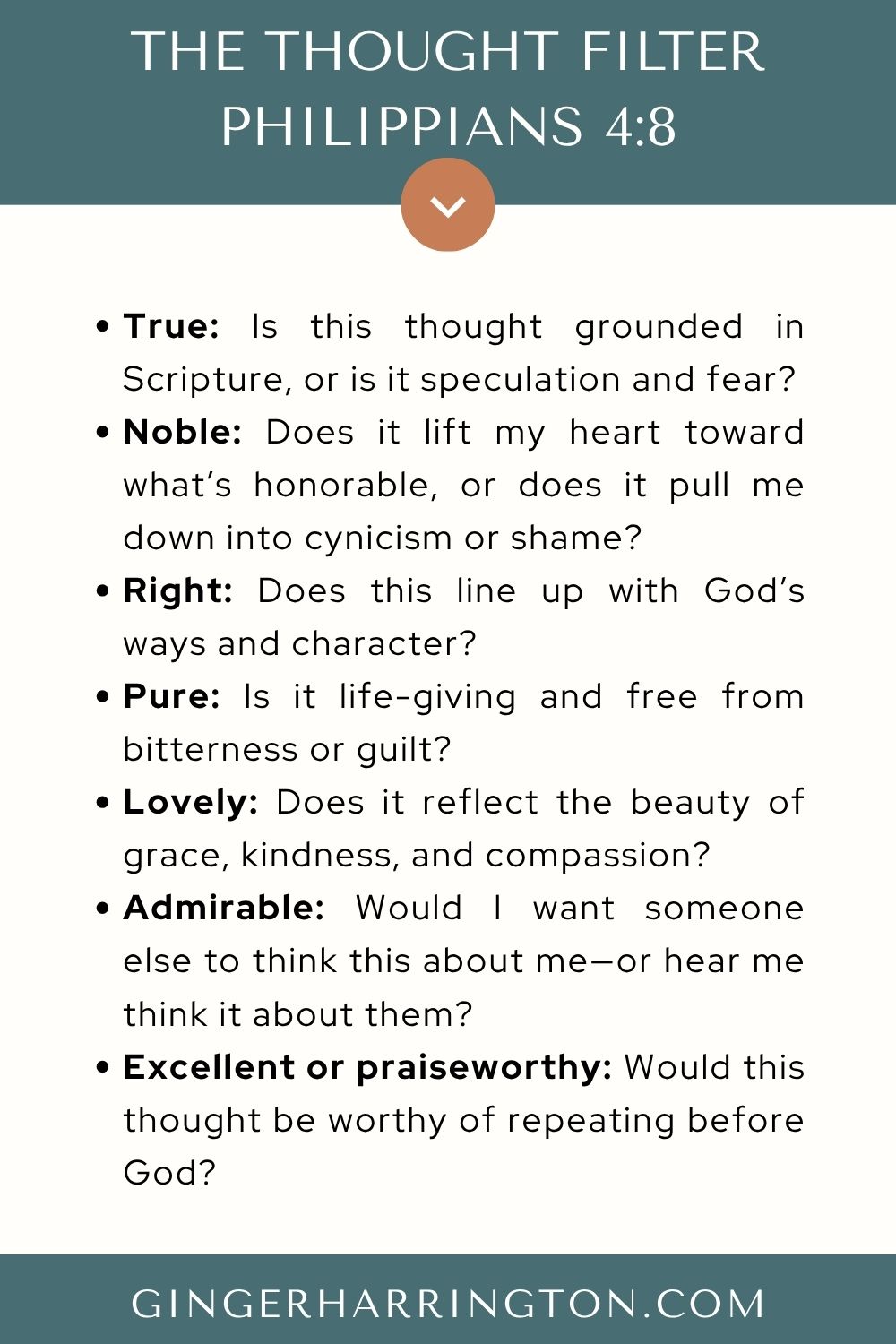
Putting Philippians 4:8 into Practice: Simple Habits for Daily Peace
When your thoughts start to spiral, these three steps show how to stop negative thoughts in the moment and redirect your mind toward the peace of God. If anxiety is driving the spiral, Philippians 4:6 shows us how to shift from anxiety to peace through prayer and thanksgiving.
- Pause and consider the source.
Ask yourself, Is this the Spirit, my flesh, or the enemy? Not every voice that enters your mind deserves your attention. - Filter the thought through Philippians 4:8.
Does it meet the test of truth, purity, and peace? If not, you have permission to close the door on it. - Replace it with Scripture.
Speak the opposite truth out loud or write it down. God’s Word reframes reality with what’s eternal and unchanging.
Here are a few examples:
- When fear says, “I can’t handle this,” respond, “The Lord is my strength and my shield.” (Psalm 28:7)
- When shame whispers, “I’ll never be enough,” answer, “God is still working in me.” (Philippians 1:6)
- When comparison bites, remember, “Nothing can separate me from God’s love.” (Romans 8:38–39)
Each replacement thought is a seed of truth. Plant enough of them, and peace begins to take root.
How Do We Practice What We’ve Learned? (Philippians 4:9)
Paul doesn’t stop at thinking—he calls us to practice.
“Whatever you have learned or received or heard from me or seen in me—put it into practice. And the God of peace will be with you.”
— Philippians 4:9
Right thinking leads to right living, and peace shows up in the doing—not just the believing.
When we take what we’ve learned and begin to live it, the peace of God guards our hearts and minds, and the God of peace goes with us.This is the heart of Habits of Hope: daily choices that shape a deeper life with God, one prayer, one thought, one practice at a time.
Every time you replace fear with prayer, lies with truth, or self-criticism with grace, you’re choosing peace on purpose.
Practice looks like:
- Paying attention to what enters your mind.
- Shutting the door on destructive thoughts.
- Rehearsing truth until it becomes your default.
- Extending the same grace to others that you receive from God.
Peace deepens through practice. It’s not perfection—it’s presence.
Peace grows stronger every time we live what we believe.
Why This Matters for a Steady Heart
This whole Steady Heart Series has been an invitation to live out the rhythms of Philippians 4: choose joy in hard times, pray, give thanks, receive peace, renew your mind, and practice what you’ve learned.
This is the heart of a steady life with Christ—and the heartbeat of Habits of Hope.
It’s not about pretending everything is fine; it’s about focusing on what honors God and letting His truth reshape the atmosphere of your thoughts.
When joy, prayer, gratitude, and truth work together, peace becomes more than a moment—it becomes your rhythm.
A steady heart is built one thought, one prayer, one truth at a time—and it’s strengthened by gratitude.
FAQ
We’ve covered a lot in this series, and Philippians 4:8–9 ties it all together. To help you put these truths into practice, here are a few frequently asked questions about what it means to renew your mind, guard your heart, and live with steady peace.
- What is the meaning of Philippians 4:8 and 4:9?
Together they form a guide for renewing your mind and living out God’s peace—testing your thoughts against truth and putting faith into practice. - How does this help with anxiety?
These verses redirect anxious thinking toward truth, helping you focus on God’s character instead of your fears. - Is this just positive thinking?
No. It’s truth-based thinking—anchoring your mind in what is real and right according to God’s Word.
Listen & Reflect
This article is based on Episode 57 of the Habits of Hope Podcast, part of the Steady Heart Series through Philippians 4. Listen to the full conversation with Ginger Harrington and Larissa Traquair to hear how to apply the Philippians 4:8 thought filter and practice the habits that grow peace. Listen to the full series below.
Want to Go Deeper in Learning to Guard Your Thoughts?
Discover simple, grace-filled ways to live moment by moment with God in Holy in the Moment by Ginger Harrington.
Learn how to overcome negative thinking, navigate anxiety and perfectionism, find peace in the present, and live with spiritual freedom. Get your copy of Holy in the Moment here.

The Steady Heart Series
- Part 1:How to Choose Joy in Hard Times: A Study of Philippians 4:4-5
- Part 2: How to Shift from Anxiety to Peace: A Study of Philippians 4:6
- Part 3: How to Find God’s Peace That Guards Your Heart: A Study of Philippians 4:7
- Part 4: How to Filter Your Thoughts and Find Peace: A Study of Philippians 4:8-9
About Ginger Harrington
Ginger Harrington is an author, speaker, and founder of the Habits of Hope Podcast and The Deeper Life Collection. A military wife and mom, she writes about spiritual growth and emotional well-being at GingerHarrington.com, where she helps women cultivate hope and a deeper life with Christ—for heart and home.
This post is for encouragement and inspirational purposes only. It reflects biblical insights and personal experiences related to faith and anxiety. It is not intended to diagnose, treat, or replace professional medical or mental health care. If you are struggling with anxiety or other mental health concerns, please seek support from a qualified counselor, physician, or mental health professional.
*This post contains affiliate links at no cost to you.