

What Is Holy Leisure? Finding Joy with God Instead of Quiet Time Pressure
Struggling with quiet time pressure? Discover how “holy leisure” transforms your time with God from duty into joyful, life-giving communion.
There are seasons when something meant to nourish our souls begins to feel like pressure.
We know time with God matters, and we truly want it. But somewhere along the way, it quietly shifts—from delight to duty, from relationship to routine.
That’s why this conversation with Cara Ray felt like such a deep exhale for me. Her message about “holy leisure” gently invites us back to something we often forget: God isn’t waiting for our performance—He’s inviting us into His presence. And that changes everything.
Why Does Quiet Time Start to Feel Like a Chore?
Before we dive into the heart of holy leisure, Cara shares how this tension first showed up in her own story.
Ginger Harrington:
You describe yourself as a former “quiet time checkbox checker.” Can you take us back to that season? When did you begin to realize your spiritual rhythms had shifted from delight to duty?
Cara Ray:
I became a Christian very early in life, around six or seven. But as a teenager, I really wanted to own my faith and grow spiritually. I was being discipled to have a daily quiet time, and all of that was very well-meaning.
But it became something I felt like a spiritual failure at.
If I wasn’t getting up early, I wasn’t doing it right. If it wasn’t an hour long, I wasn’t doing it right. If I didn’t have an emotional experience, I wasn’t doing it right.
And that mindset stuck with me for a long time.
Then about seven years ago, I was reading The Celebration of Discipline and came across a phrase—odium sanctum, or “holy leisure.” It described this restful, meditative way of life.
That phrase captured my attention. I realized, this is what I’ve been missing.
I wanted my time with God to feel like something I enjoyed—like going to coffee with a friend or watching a sunset. And I began to ask: Why can’t time in God’s Word feel like that?
I wanted my time with the Lord to feel leisurely… something I enjoy, not something I have to check off.
How Do You Enjoy God Without Pressure in Your Quiet Time?
As Cara began to unpack this idea, it revealed something deeper about how we relate to God.
Ginger Harrington:
I think many of us can relate to evaluating our quiet time—was it good enough? Did I get something out of it? That mindset can lead us into performance instead of communion.
Cara Ray:
Yes, exactly. And I think holy leisure frees us from that.
It becomes a habit—someth building a muscle.
Not every time in God’s Word is emotional or euphoric. Sometimes the Spirit speaks very gently. But as we continue returning, something deeper is being formed in us.
When we remove that checkbox mentality, it changes how we approach God’s Word—and what we receive from it.
“When we remove the checkbox mentality, it changes how we approach God—and what we receive from Him.”
What Is the Difference Between Union and Communion with God?
Before moving into how this plays out practically, Cara introduces a foundational truth that reshapes everything.
Ginger Harrington:
You talk about union with Christ versus communion with Christ. Can you explain that?
Cara Ray:
Our union with Christ is secure. It’s the relationship we have because of what Jesus has done—not anything we do. Nothing can interrupt that.
But our communion—our felt closeness with God—can fluctuate. Sometimes sin or distraction interrupts that flow.
Understanding that changed everything for me. I realized I’m not earning God’s favor by showing up—I already have His favor in Christ. And now I want to enjoy that relationship.
What Is Holy Leisure—and What Does It Actually Mean?
Now that we’ve explored the heart behind it, let’s define what holy leisure actually means—and what it doesn’t.
Ginger Harrington:
For someone hearing this phrase for the first time, what does holy leisure not mean?
Cara Ray:
It doesn’t mean doing nothing.
We often think leisure is passive—like watching TV—but that’s not what I’m talking about. True leisure is an engagement of the mind, the heart, and the will.
It’s a pursuit of what is good, true, and beautiful. And ultimately, that’s what leads our souls into rest.
So rest isn’t about doing nothing—it’s about rightly engaging with what nourishes your soul.
Why Does God Often Do His Deepest Work in Hidden Places?
As we begin to see holy leisure differently, it naturally reshapes how we think about our time with God.
Ginger Harrington:
Why do you think the hidden places—those quiet moments with God—are where He does such deep work?
Cara Ray:
Because that’s where formation happens.
That’s where it’s just you and the Lord. No one else sees it, but that’s where your heart is rooted in Him.
Over time, as you develop those patterns of prayer and Scripture, something steady is being formed in you. And that quiet work begins to shape everything else.
How Does Holy Leisure Help You Enjoy God Without Pressure in Everyday Life?
From those hidden places, Cara describes how this way of being with God begins to overflow into daily life.
Ginger Harrington:
How does holy leisure carry into everyday life without becoming another strategy for productivity?
Cara Ray:
We do have to fight that tendency—we’re wired for productivity.
But holy leisure is about overflow. It’s how your time with God begins to shape your interactions—your home, your work, your relationships.
Sometimes it doesn’t even feel like something you want to do in the moment. But as you step into it, you often discover the joy in it. That’s where the delight begins to grow.
“Holy leisure is not about doing less—it’s about enjoying God more in what you’re already doing.”
Can You Enjoy God Without Pressure Even in Hard Seasons?
This next part of the conversation moves into something we all face—seasons of dryness, suffering, and doubt.
Ginger Harrington:
How does holy leisure speak to hard seasons without offering shallow answers?
Cara Ray:
Those seasons are difficult, and sometimes we don’t even want to go to God’s Word.
But that’s exactly where we need Him most.
In those moments, He meets us. He gives us living water. He awakens our hearts and reminds us of what is true.
Sometimes those seasons of dryness are what draw us closer to Him. And holy leisure gives us a way to pursue God and even enjoy Him in the middle of suffering.
“Sometimes we avoid the very things we need most—but God meets us there.”
How Does God Produce Fruit Through Every Season?
As Cara shares, even the hardest seasons are not wasted.
Ginger Harrington:
How does this journey lead to fruitfulness?
Cara Ray:
I love the image of the vine and branches.
God prunes us—not to harm us, but so we’ll bear more fruit. And that process can be painful.
But over time, it leads to something beautiful—the fruit of the Spirit growing in us.
To bear fruit, we have to abide. We stay connected. We keep returning to God’s Word and prayer. And as we do, that fruit begins to grow.
“To bear fruit, we have to abide—stay connected and keep returning.”
An Invitation to Slow Down and Enjoy God
What I love most about this conversation is how gently it brings us back to what matters most.
Not more effort or better discipline, and not a perfectly consistent routine—but presence.
Because hope doesn’t grow through striving. It grows through communion.
And maybe the next faithful step isn’t to try harder, but simply to slow down and remember that God is already near—and He is inviting you to enjoy Him.
Habit of Hope
As you carry this conversation into your own rhythms this week, begin here:
Open your Bible not as a task to complete, but as a place to enjoy time with the God who is already with you.
Frequently Asked Questions About Quiet Time and Enjoying God
Why does my quiet time feel like a chore instead of something life-giving?
Quiet time often starts to feel like a chore when it becomes performance-driven instead of relational. When we focus on doing it “right” rather than meeting with God, it can shift from delight to duty. Reframing it as time with God—not a task for God—can restore joy.
What is “holy leisure” in the Christian life?
Holy leisure is the practice of enjoying God through unhurried, attentive time in His presence. It’s not about doing nothing—it’s about engaging your heart, mind, and spirit with what is true, good, and beautiful, especially through Scripture and prayer.
How can I enjoy time with God again if I feel spiritually dry?
Start small and simple. Instead of trying to fix everything, return to God’s Word with openness rather than expectation. Even in dry seasons, God meets us. Over time, consistency—not intensity—helps restore connection.
What’s the difference between union and communion with God?
Union with God is your secure relationship in Christ—it never changes. Communion is your experience of closeness with Him, which can ebb and flow. Understanding that your relationship is secure helps remove pressure and invites you to enjoy His presence more freely.
What is one simple way to reconnect with God today?
A practical step is to read a passage like Ephesians 1–3 and notice every phrase that says “in Christ” or “with Him.” This helps anchor your identity in truth and renew your desire to know God more deeply.
Meet Cara Ray
Cara Ray is a writer, Bible teacher, and host of the Writers Block Podcast. She encourages Christian women to slow down, savor Scripture, and enjoy God in everyday life. Cara is the author of The Pursuit of Holy Leisure: Enjoying God in Everyday Places and lives in Gilbert, Arizona, with her husband and family.
Resources & Links
The Pursuit of Holy Leisure: Enjoying God in Everyday Places by Cara Ray (Affiliate link)
Visit Cara Ray’s website for more information and content from Cara.
Related Content On Quiet Time and Listening to God
How to Hear God’s Voice: Simple Habits for Listening to God
Seek God First: How to Order Your Life Around What Matters Most
How to Scripture Journal: A Simply Rhythm for Everyday Quiet Time
How the Holy Spirit Guides You into Truth

How the Holy Spirit Comforts You in Hard Times
Discover how the Holy Spirit comforts you in hard times through truth, presence, and everyday moments. Experience biblical hope for when life feels uncertain.
One of the hardest parts of suffering is not always the pain itself—it’s the waiting.
When the circumstances don’t immediately change…
When prayer is still unanswered…
When grief is still heavy…
When questions are still there…
This is where the need for comfort becomes real.
It’s tempting to assume comfort will come when things resolve—but Scripture shows us something different:
God meets us in the middle of what hasn’t changed yet.
Something unexpected happens: a quiet peace, a remembered promise, or a sense that you are not alone.
This conversation felt especially meaningful to me because it reflects something I’ve seen many times in my own life—God doesn’t always remove the difficulty, but He meets us within it.
In this final conversation in our Holy Spirit series, we explore what it means to experience the Holy Spirit as our Comforter—not in theory, but in our real, lived moments.
This is the third post in our series on the Holy Spirit, where we’re exploring how God’s presence meets us in everyday life. In this conversation, we’re especially grateful to welcome Dr. Brenda Pace, whose wisdom and lived experience bring a beautiful depth to this topic.
If you’d like to explore the full series, you can also read:
- How the Holy Spirit Guides You into Truth (What the Bible Says)
- How the Holy Spirit Helps You in Your Weakness (What the Bible Says)

Who Is the God of All Comfort? (2 Corinthians 1:3–4)
We began with a passage that shapes this entire conversation:
“Praise be to the God and Father of our Lord Jesus Christ, the Father of compassion and the God of all comfort…”
Brenda Pace shared how this passage has shaped her understanding of God—not just as distant or powerful, but as deeply personal and present.
She explained that the word comfort in this passage comes from the Greek word paraklesis, which means far more than emotional soothing.
It means:
- Encouragement
- Strengthening
- Coming alongside someone in difficulty
“When I read that verse, I see God’s active and sustaining presence in the midst of hardship.”
This reframes everything.
Comfort is not passive.
It is not abstract.
It is God actively drawing near.
But this truth isn’t always easy for us to receive.
For some, this idea of God as a comforting Father doesn’t come easily. Depending on our experiences with parents or authority figures, we may not naturally associate God with comfort.
This passage invites us to see God as He truly is:
- Compassionate
- Near
- Personally attentive to our needs
And sometimes, receiving comfort begins with simply asking:
“Lord, help me see You as You really are.”
Once we begin to see comfort this way, it opens our eyes to recognize how God meets us in very real, everyday ways.
How the Holy Spirit Brings Comfort in Real Life
One of the most powerful parts of this conversation was hearing how God’s comfort showed up in a very tangible season.
Brenda shared about a time when her husband was deployed at the beginning of the Iraq War—a season filled with uncertainty and fear.
In response, she did something simple:
She bought a comforter.
“I went out and bought the fluffiest, most cozy comforter for my bed… and that space became where I met with God.”
Night after night, that place became a space where she:
- Read Scripture
- Listened to sermons
- Received difficult news
- Experienced God’s presence
And over time, she realized something deeper:
“That comforter was cozy, but that wasn’t where the true comfort was… it was God’s sustaining presence.”
What began as physical comfort became a picture of something far greater—God Himself drawing near.
God’s Comfort Is Sustaining, Not Just Immediate
Another moment that stood out was a simple but powerful image.
While playing the piano, Brenda pressed the sustain pedal—and suddenly understood what God was doing in her life.
“Just like that pedal sustains the note, this is what God is doing for me right now.”
That is the nature of God’s comfort.
It doesn’t always remove the pressure.
It sustains you within it.
This aligns with what we see throughout Scripture:
- God strengthens weary souls
- He steadies us when life feels unstable
- He sustains what we cannot
We began with a passage that shapes this entire conversation:
How the Holy Spirit Uses Truth to Comfort You (John 14:26)
Jesus gave this promise to His disciples:
“But the Comforter, even the Holy Spirit, whom the Father will send in my name, he shall teach you all things, and bring to your remembrance all that I said unto you.” (John 14:26 ASV)
In moments when life feels uncertain, the Holy Spirit does not leave us to figure things out on our own. He teaches us, reminds us, and brings truth back to mind—often right when we need it most.
As Brenda shared:
“Truth anchors us when circumstances are unstable… His truth steadies my faith.”
This matters because our perspective is easily shaped by what we’re feeling. Fear can distort what we see, grief can cloud our thinking, and anxiety can amplify uncertainty until it feels overwhelming.
But truth has a way of gently bringing us back to what is real.
It steadies our hearts and re-centers our thinking, reminding us of what has not changed:
- God is present
- God is faithful
- God has not abandoned us
And as Brenda so simply put it:
“Truth produces hope.”
As we receive that kind of comfort, something unexpected begins to happen—it doesn’t stop with us.

When the Holy Spirit Reminds You Who You Are
Sometimes the deepest comfort doesn’t come from changed circumstances.
It comes from changed perspective.
In our conversation, I reflected on how the Holy Spirit reminds us of what is most true about us.
- Who we are in Christ
- What is secure about our future
- What cannot be taken from us
Because what is spiritually true about us is what is most true about us.
And in moments of failure, fear, or discouragement, that truth becomes a powerful source of comfort—and hope.
Even when everything around us feels uncertain, these truths steady our souls.
Why God Comforts You So You Can Comfort Others
One of the most powerful truths in 2 Corinthians 1 is this: God comforts us so that we can comfort others.
That “so that” changes everything.
“The comfort we receive is not meant to remain private… it becomes a resource of ministry.”–Brenda Pace
In other words: Your hardest seasons are not wasted.
They become:
- A source of empathy
- A place of connection
- A way to come alongside others
I’ve seen this personally in my own life. Walking through seasons of caregiving and loss—especially caring for my sister during her battle with ALS—changed how I understand suffering and comfort.
There are some things you simply cannot fully understand until you’ve walked through them. And yet, those very places become the ones God uses most deeply.
What once felt like a test becomes part of your testimony. Our hardest seasons equip us to come alongside others with deep compassion.
Simple Ways to Experience God’s Comfort Daily
One of the most helpful parts of this conversation was how practical it became.
Brenda shared a simple truth:
“Comfort grows from awareness.”
Here are a few practices that can help you begin to notice God’s comfort:
1. Write Down What You Feel—and What Is True
- Name your emotions honestly
- Then ground your feelings with Scripture
2. Practice Noticing the Good
- Write down 1–10 “good things” each day
- Train your heart to recognize God’s presence
As Larissa shared in our conversation, this practice teaches us to become a “noticer of the good.”
It’s choosing to pay attention to what is:
- True
- Good
- Already present
3. Create a Daily “God Hunt”
- Look for small ways God is at work
- Pay attention to ordinary moments
4. Slow Down Through Journaling
- Capture thoughts, prayers, and Scripture
- Allow space for God to speak
“It trains our hearts to recognize that God’s comfort often arrives in ordinary ways.”
When we begin to notice, we start to see that God’s comfort is showing up more often than we realized.
And as Larissa reminded us, when we feel prompted to reach out to someone—to send a text, offer encouragement, or pray—we can trust that God is often using those small acts as part of how He comforts others.
As we slow down and pay attention, something surprising happens—we begin to see more clearly.
How to Recognize God’s Comfort When You Don’t See It
During our conversation, I described this like a connect-the-dots page.
At first, all you see are scattered points. Nothing seems connected.
Nothing seems meaningful.
As you start connecting the dots—a picture begins to emerge. What once felt random begins to reveal something intentional. The more dots you connect, the clearer the picture becomes.
God’s comfort often works this way.
It’s not coincidence.
It’s not accidental.
It’s His presence, quietly at work.

What the Comfort of God Can Look Like in Everyday Life
Sometimes we expect comfort to be dramatic. But often, it’s quiet. Here are some ways the Holy Spirit may be comforting you—even now:
- A deep, unexplainable peace
- A timely word from a friend
- A song that speaks directly to your heart
- A Scripture that meets you exactly where you are
- A shift in perspective that changes how you see your situation
“Those moments are not random… God is at work as our comforter.”–Brenda Pace
Sometimes, God’s comfort comes through people.
A timely message.
A thoughtful prayer.
An unexpected encouragement.
In our conversation, Larissa shared how even a simple text or prayer from a friend can become a moment of comfort—often arriving right when it’s needed most. And often, that begins with a simple prompting.
When you feel nudged to reach out, to encourage, or to pray for someone—pay attention. That may be the Holy Spirit inviting you to participate in how He comforts others. As Larissa reminded us, we’re not responsible for the outcome—we’re simply invited to be obedient.
Perhaps the most comforting truth of all is this: God’s presence is not dependent on your awareness of it.
But awareness does change your experience of it.
I’ve often thought of it like putting on glasses. When your vision is off, you don’t always realize what you’re missing. But the moment the prescription is corrected, everything comes into focus—the details, the clarity, what was there all along.
In the same way, practices like gratitude and noticing help us “see” more clearly. They don’t create God’s presence.
They reveal it.
And suddenly, what once felt ordinary begins to look like evidence of His nearness, His care, and His comfort in your life.
You Are Not Alone—Even When It Feels Like It
One of the clearest messages from this conversation is this:
You are not alone.
Even when:
- You feel overwhelmed
- You don’t understand what’s happening
- You can’t see how things will resolve
The Holy Spirit is present with you—bringing the comfort of God into your life, even in places that feel uncertain or heavy.
And when we pause long enough to see it, we realize that this comfort is not random—it’s part of the way God has been with us all along.

Seeing the Bigger Picture
As we close this series, it’s helpful to step back and see the whole picture:
• The Holy Spirit guides us into truth
• The Holy Spirit helps us in our weakness
• And the Holy Spirit comforts us in our suffering
This is not three separate works—it’s one beautiful expression of God’s presence in our lives.
A Prayer for the Comfort of the Holy Spirit
Father of compassion and God of all comfort, we come to you today aware that many hearts are carrying burdens. But I know that you see every sorrow, you know every anxious thought, you know every quiet grief that others may not notice. Nothing is hidden from your care. And so Lord today for those who feel overwhelmed,
I pray that you would draw near with your gentle presence. For those who are grieving, I ask that you would hold them in your mercy. For those who may feel alone today, I pray you would remind them that you have not left them. I pray, Lord, that your peace would settle troubled hearts and that your strength would steady weary souls. Teach us to receive your comfort. Teach us to receive the comfort you give and help us to become people who carry that comfort to others. May your compassion,
Lord, may it flow through our words, through our actions, through our prayers, Lord, through our presence. We trust you, you, the God of all comfort, to meet your people in every need. We pray this through Jesus Christ our Lord. Amen.–Brenda Pace
A Final Word of Hope
If you are walking through a difficult season right now, start here:
Look for one small way God showed His kindness to you today.
Just one.
Write it down.
Notice it.
Receive it.
Because often, that is where comfort begins.
And over time, those small moments become something more:
- A steady reminder that God is present.
- A growing awareness of His faithfulness.
- A deeper habit of hope.
And as you go into this week, remember:
The Holy Spirit doesn’t only guide you and help you—He comforts you with the presence of God.
Because hope isn’t just something we feel, it is the habit we can live.
About Brenda Pace
 Dr. Brenda Pace is a speaker and author who encourages women and strengthens Christian community. She has written and contributed to several books, including the Journey of a Military Wife series, and serves in leadership roles with Planting Roots and the Church of God Chaplains Commission. She regularly speaks in churches and military settings around the world.
Resources & Links
Enjoy the Full Holy Spirit Series
- 71.How the Holy Spirit Guides You into Truth
- 72. How the Holy Spirit Helps Your Weakness
- 73. How the Holy Spirit Comforts You in Hard Times
Books by Brenda Pace:
-
- Journey of a Military Wife series
- The Yellow Ribbon Devotional
- Medals Above My Heart

How the Holy Spirit Helps You in Your Weakness (What the Bible Says)
Discover how the Holy Spirit helps you in weakness—guiding your prayers, meeting your needs, and sustaining your hope through God’s steady, present help.
There are moments when life doesn’t feel dramatic or urgent—just heavy. Not overwhelming enough to call it a crisis. Not clear enough to know what to do next. Just tired. Uncertain. Weak in ways that don’t show on the outside. And in those moments, many of us quietly assume we should be able to handle things better by now.
We tell ourselves we should be stronger. More capable. Less affected. But Scripture speaks directly into that assumption.
When we hear the word help, we often imagine it as a backup plan—something we reach for after we’ve exhausted our own strength. Help becomes what we request when independence fails.
What a relief that Scripture doesn’t present help as a supplement to our competence. Scripture shows us about Holy Spirit help—God meeting us in our weakness with His presence.
It presents help as God’s nearness.
- Not because we’ve tried hard enough.
- Not because we’ve run out of options.
- But because God knows our limits—and meets us there.
This post is part of a 3-part series on the Holy Spirit and His work in our lives:
- How the Holy Spirit Guides You Into Truth
- How the Holy Spirit Helps You in Your Weakness
- How the Holy Spirit Comforts You in Hard Seasons (next week)

What Did Jesus Mean by “Helper”?
Before we talk about what help looks like, it’s important to hear how Jesus Himself introduced the Holy Spirit.
In John 14:16–17, Jesus says:
“I will ask the Father, and He will give you another Helper, that He may be with you forever… the Spirit of truth… you know Him because He abides with you and will be in you.”
This is not a small promise.
The Helper is:
- A gift given by the Father, not something we earn
- With us forever, not temporary or conditional
- Abiding with us and in us, not distant or external
God’s help is not something we summon—it is Someone who abides with us.
And this reframes everything.
Help is not something we achieve by doing life well. It is something we receive because God is near.
When Needing Help Feels Like Weakness
In the world around us, needing help is often seen as:
- Weakness
- Inadequacy
- Lack of qualification
It can feel uncomfortable—even exposing—to admit we need help.
But in God’s economy, the opposite is true.
The more we recognize our need, the more help we receive.
There is no shame in needing help from the Lord.
In fact, it is often the doorway into experiencing His presence more deeply.

How the Holy Spirit Helps You Pray When You Don’t Know How
Romans 8:26–27 says:
“The Spirit also helps our weakness… for we do not know how to pray as we should, but the Spirit Himself intercedes for us with groanings too deep for words.”
This meets us right where we live—because there are moments when we don’t know what to pray, what the right outcome is, or even what we truly need. Sometimes the situation is so confusing or overwhelming that all the options feel uncertain, and we are left without words.
And Scripture assumes that.
It assumes there will be times when we do not know how to pray.
But in that very place of uncertainty, we are not left alone. The Spirit knows what is in our hearts, He knows the will of God, and He intercedes for us in ways we cannot fully express.
Even when we cannot form the words, God is already at work.
When Prayer Feels Impossible
There are moments when even forming a sentence feels like too much.
You may want to pray—but feel completely unable to.
You may feel:
- Emotionally exhausted
- Spiritually dry
- Mentally overwhelmed
And in those moments, it can feel like you are failing.
But Scripture tells a different story.
God’s will is not threatened by your lack of words.
Even when you struggle in prayer:
- The Spirit is already interceding
- The Spirit is already helping
- The Spirit is already at work
This is not correction. It is provision.
- Not: “You should be doing this better.”
- But: “I know you need help—I am already helping you.”
Prayer Is Not a Performance
Many of us carry quiet pressure when it comes to prayer.
We wonder:
- Am I saying the right thing?
- Do I sound spiritual enough?
- Am I doing this correctly?
Prayer is not a performance—it’s a conversation.
And sometimes, the most honest prayer looks like a pause: “Lord, I need help right now. Give me words.”
Even that is enough, because help in prayer is not based on your ability, but on God’s presence.

The Holy Spirit’s Help Is Received Not Earned
Hebrews 4:16 brings this truth into focus:
“Let us draw near with confidence to the throne of grace, so that we may receive mercy and find grace to help in time of need.”
Notice what this invites us into.
We are not told to prove ourselves, fix ourselves, or prepare ourselves—we are invited to draw near and receive. Help is not something we achieve through effort; it is something we find in the presence of God.
And just as importantly, we are drawing near to a throne of grace, not a throne of scrutiny or judgment.
So when you feel unworthy, unprepared, or unsure, that is not a reason to stay away.
It is the very reason to come.
When You Feel Like You Don’t Deserve Help
There are moments when you may hesitate to come to God.
You may think:
- I’ve messed up too much
- I should have known better
- Why would God want to hear from me right now?
It’s important to embrace the truth that Hebrews 4:16 is an invitation and an instruction.
“Let us draw near with confidence.”
So you can come with it all:
- Your mistakes and regrets
- Your unmet expectations and question
- Your anger and your pain
Do not let these things keep you at a distance.
Because God’s help is not reserved for when you have it all together. It is given in your time of need.
God Is Your Helper
Psalm 54:4 says:
“Behold, God is my helper; the Lord is the sustainer of my soul.”
This is not abstract—it is deeply personal.
God is not just a helper—He is your helper, and His help is not occasional or situational. He is the sustainer of your soul, which means His help is ongoing, steady, and present in every moment, not just in times of crisis.
There are days when your soul feels dry:
- No motivation
- No clarity
- No strength
And in those moments, when you do not have what you need to keep going,
God sustains what you cannot.
When You Don’t See God’s Help Right Away
Sometimes, you can look back and clearly see how God helped you.
Other times, you are in the middle of it and you don’t see anything yet.
This can be really discouraging to say the least.
But God’s help is not limited to what you can see.
- He may be protecting you in ways you don’t recognize
- He may be working ahead of you
- He may be sustaining you quietly
God’s help is not occasional intervention—it is a sustaining presence.
God’s Help When Anxiety Rises
Isaiah 41:10 says:
“Do not fear, for I am with you… I will strengthen you, surely I will help you, surely I will uphold you…”
Notice how many times God repeats Himself:
- I am with you
- I will strengthen you
- I will help you
- I will uphold you
This is not uncertain language.
This is promise.
And this promise becomes especially powerful when anxiety rises.
Because in those moments, it’s easy to look around for solutions.
But this verse gently redirects us:
“Do not anxiously look around you… I am your God.”
God’s help does not depend on your ability to stay steady.
He is the one holding you steady.
A Habit of Hope
The habit we are practicing is simple—but deeply countercultural:
Release the habit of carrying things alone and rest in the reality of God’s help.
So often, we carry things as if it all depends on us:
- Figuring it out
- Holding it together
- Finding the right answers
But God’s help was never meant to be a last resort.
It is meant to be our starting place.
And part of releasing what we were never meant to carry is learning how to think differently in the middle of need.
Take Doubt Out of the Conversation
There is a powerful shift that happens when you choose to believe what God has already said.
Instead of thinking:
- Maybe God won’t help me
- Maybe I just need to try harder
You begin to say:“Lord, I believe You are my help. Help me see it.”
This is not ignoring reality.
It is anchoring yourself in truth.
Scripture says God is:
- Your helper
- Your refuge
- A very present help in trouble
Will you let doubt define the conversation…
or will you let truth lead it?
Because when you take doubt out of the conversation, something shifts.
You stop striving to prove your strength…and start resting in God’s presence.
God Is a Very Present Help in Trouble
Psalm 46:1 says:
“God is our refuge and strength, a very present help in trouble.”
This is not a distant promise or a future possibility—it is a present reality.
God does not say He might help, or that He will help eventually. He says He is a very present help, right in the middle of trouble, not just after it passes.
And that matters, because trouble is not avoided or minimized in Scripture—it is acknowledged as part of life. Yet in the midst of it, God’s presence is not reduced or delayed.
He is near, active, and already at work.
When Help Doesn’t Look Like What You Wanted
Sometimes God’s help does not look like the outcome we hoped for, the timing we expected, or the resolution we imagined.
Instead, His help often meets us in a deeper way—by sustaining us within the very circumstances we wish would change. While we tend to focus on what is right in front of us, God is working with a much broader perspective, shaping not only the situation but also our hearts within it.
And in that place, His help is not absent—it is active, steady, and sufficient for what we are walking through.
A Real Picture of God’s Help
There are moments in life where you can see this clearly.
Moments when:
- You had no strength
- No clarity
- No ability to hold yourself together
And yet—you were held.
There are times when God gives:
- Strength you did not have
- Joy that has no visible source
- Peace that does not match your circumstances
Not because everything is fixed…
but because He is present.
The Connection Between Help and Hope
All of this leads to one steady truth:
Hope is not built on clarity—it is sustained by presence.
You do not have to:
- Understand everything
- See how it will work out
- Have the answers
Because even when you feel:
- Unsure
- Tired
- Wordless
- Out of options
God is actively at work on your behalf.
He is not waiting for you to get it right.
He is not standing at a distance.
He is present. Helping. Interceding.
Practical Ways to Rest in God’s Help
These are not steps to make God act.
They are ways to respond to the help He has already given.
1. Ask the Holy Spirit to Help You Pray
When you don’t have words, say so.
Silence and sighs are not prayer failures.
2. Draw Near with Confidence
Not because everything is resolved…
but because help is promised in your need.
3. Remind Yourself: “God Is My Helper”
When you feel overwhelmed:
“Lord, You are my helper.”
4. Remember God Is with You
Especially when anxiety rises.
Even if fear doesn’t disappear right away.
5. Rest in God as Your Refuge
When life feels unsettled:
You are held, even when nothing feels stable.
Ask for Help in the Moment
Simple prayers like:
- “Lord, help me love right now.”
- “Help me respond with wisdom.”
- “Help me experience Your peace.”
Frequently Asked Questions
What does it mean that the Holy Spirit helps us?
It means God meets you in your weakness. The Holy Spirit actively intercedes, guides, and strengthens you—even when you don’t know what to do.
What if I don’t know how to pray?
That is exactly when the Spirit helps. Scripture says He intercedes for you when you don’t have the words.
Does God only help when I ask?
No. The Spirit helps your weakness—even when you don’t think to ask. He is already at work.
Why doesn’t God’s help always change my situation?
Because sometimes His help is not about changing your circumstances—but sustaining you within them.
How can I trust God is helping when I don’t feel it?
God’s help is based on His promise, not your feelings. He is a very present help—even when you don’t feel it.

A Final Word of Encouragement
God has not left you to figure things out on your own.
He has not asked you to carry your weakness by yourself, nor has He stepped back to see how well you can manage it. Instead, He has given you His Spirit—present, helping, interceding, and actively at work on your behalf.
You are not failing at faith because you feel needy.
In many ways, need is the very place where we begin to recognize God’s help most clearly, not because everything suddenly changes, but because we become more aware of His presence within it.
And as you release the habit of carrying things alone and begin to rest in the reality of His help,
you may discover that hope has been holding you all along.
If you want a quiet way to practice this—learning to draw near, notice God’s presence, and receive grace for each day—you might begin with a simple rhythm of reflection and prayer.
Not striving.
Not performing.
Just receiving what God has already given.
About the Author
Ginger Harrington is the host of the Habits of Hope Podcast and creator of resources designed to help you build rhythms of faith for everyday life. Through her writing, speaking, and teaching, she encourages women to grow deeper in hope, resilience, and spiritual formation—one small habit at a time.
Related Content
This post is part of a 3-part series on the Holy Spirit and His work in our lives:
- How the Holy Spirit Guides You Into Truth
- How the Holy Spirit Helps You in Your Weakness
- How the Holy Spirit Comforts You in Hard Seasons (next week)
How the Holy Spirit Guides You Into Truth (What the Bible Says)
What does the Bible say about Holy Spirit guidance? Learn how the Spirit guides believers into truth, conviction, wisdom, and hope.
Have you ever wanted God’s guidance and felt unsure what that is supposed to look like?
Not because you doubt that God leads, but because the conversation around guidance can sometimes become confusing—especially when personal stories, methods, and expectations add to the uncertainty rather than bring clarity.
So instead of beginning with experiences, we start with a better question:
What does Scripture plainly say about Holy Spirit guidance and how the Spirit leads believers into truth?
That’s the question we explore in this episode of the Habits of Hope Podcast.
And the place to begin is with the words of Jesus Himself.

What Is Holy Spirit Guidance?
Holy Spirit guidance is the work of the Spirit of truth, helping believers understand Scripture, recognize what is true, grow in wisdom, and walk in alignment with Christ.
This guidance is not about discovering secret information or following a formula. The Holy Spirit leads believers into truth by illuminating God’s Word, bringing conviction, confirming our identity in Christ, and giving wisdom for everyday life.
In This Article
In this article, we’ll explore:
- What the Bible says about Holy Spirit guidance
- A Habit of Hope to practice this week
- How the Holy Spirit guides believers into truth
- Why guidance is rooted in truth rather than formulas
- What the Spirit’s guidance can look like in everyday life
- Key Scriptures about the Holy Spirit’s guiding work
What Does the Bible Say About Holy Spirit Guidance?
One of the clearest promises about the Spirit’s guidance comes from Jesus in John 16.
“But when He, the Spirit of truth, comes, He will guide you into all the truth.”
— John 16:13
Jesus calls the Holy Spirit the Spirit of truth.
This sets the foundation for understanding how the Spirit guides believers. The Spirit’s guidance is not centered on circumstances, feelings, or techniques. It is centered on truth.
The Spirit speaks what He receives from the Father and reveals what is true. His guidance is always aligned with God’s character and God’s Word.
The Holy Spirit’s guidance is always anchored in truth, never detached from it.
In a culture where people often speak about “your truth” or “my truth,” Scripture reminds us that truth is not defined by personal perspective. Truth is grounded in God Himself.
And when we understand that the Holy Spirit is the Spirit of truth, we can trust Him to help us understand what is real and reliable.
Habit of Hope
Trust the Holy Spirit to guide you into truth.
Often, when we seek guidance, we immediately try to solve the problem ourselves. We analyze the situation, replay scenarios in our minds, or search for the perfect answer.
But Scripture points us toward a different starting point: trust.
Instead of striving to figure everything out first, we begin by acknowledging that the Spirit of truth is already at work—guiding, teaching, and revealing what is true in God’s time.
One practical way this trust shows up is learning to rely on the Spirit’s guidance before relying on our own understanding.
Guidance Begins with Trust Rather Than Understanding
One of the most familiar verses about guidance is Proverbs 3:5–6:
“Trust in the Lord with all your heart and do not lean on your own understanding. In all your ways acknowledge Him, and He will make your paths straight.”
This passage reminds us that God guides us into truth by leading us onto the straight path He intends for us. But notice where the verse begins: trust. Guidance doesn’t start with figuring everything out. It begins with trusting God rather than leaning on our own understanding.
If I’m honest, when I come to God asking for guidance, I’m usually looking for a solution. I want to decide, fix something, or solve a problem. And certainly, God’s guidance helps us with those things.
Guidance is not something we manufacture through effort or achieve by becoming smart enough or spiritual enough to hear God correctly. Scripture presents guidance as something the Spirit provides..
God does invite our participation in the process, but ultimately, guidance is something the Spirit does. And that means we can trust Him to guide us—even when discernment feels difficult. There will be days when our thinking feels tangled, when we’re not quite sure what God is doing, or when we simply don’t understand.
Yet even then, we have a Father who understands us and a Holy Spirit who is with us.
We are not trying to figure life out alone.
How Does the Holy Spirit Teach Believers Truth?
Another way the Holy Spirit guides believers is by teaching them truth that comes from God, rather than from human wisdom.
“Which things we also speak, not in words taught by human wisdom, but in those taught by the Spirit.”
— 1 Corinthians 2:13
Scripture makes a clear distinction between human wisdom and truth taught by the Spirit.
Human wisdom can accumulate knowledge, information, and opinions. But the Spirit teaches truth in a different way.
Spirit-taught truth is received, not achieved.
In other words, spiritual understanding is not something we manufacture through effort. It is something God reveals.
Sometimes we can read Scripture simply as information—knowing the facts but remaining unchanged.However, when the Holy Spirit teaches us, truth moves deeper than information. It reaches the heart. It shapes how we think, how we grow, and how we respond to God.
How Does the Holy Spirit Reveal What God Has Given Us?
Scripture also tells us that the Holy Spirit brings clarity by revealing what God has already given to us.
“Now we have received not the spirit of the world, but the Spirit who is from God, so that we may know the things freely given to us by God.”
— 1 Corinthians 2:12
This is such a beautiful reminder of the Spirit’s role. The Holy Spirit reminds us what God has already given us.
We can read the information in Scripture, but learning to believe it, live in it, and walk in it happens as the Spirit gives revelation, wisdom, and understanding.
There is often a gap between what we know in our heads and what we truly understand in our hearts. That distance may only be a few inches, but it can make a profound difference in how we live. The Holy Spirit bridges that gap.
This is one reason it is so important to spend time in Scripture. When we study God’s Word, we put tools into the toolbox.
Then the Holy Spirit helps us understand how to use those tools. He brings truth to mind, helps us recognize when we need it, and shows us how it applies to our lives.
The Spirit also reveals what God has already given us in Christ:
- Salvation through Christ and new life in Him — something we receive by grace, not something we earn.
- Truth and understanding about God — the Spirit reveals what is true about God, Christ, and our standing before Him.
- Identity in Christ — understanding who we are in Christ and learning to live from that identity.
- Access to God through Jesus — nearness to God is a gift we receive, not something we achieve.
These truths are not things we must earn or accomplish–they are things God has already given. Through guidance, the Holy Spirit helps us recognize them, understand them, and grow into them over time.
The Spirit gives wisdom and understanding as we grow in our relationship with Christ. We may not understand everything immediately, but we can trust that the Holy Spirit will continue to teach and reveal truth as we walk with Him.

How the Holy Spirit Guides Through Conviction
Another way the Holy Spirit guides believers is through conviction.
“And He, when He comes, will convict the world concerning sin and righteousness and judgment.”
— John 16:8
When we hear the word convict, we often think about a legal process—someone being convicted of a crime. In Scripture, the meaning is broader, including the ideas of exposing, refuting, or convincing.
The Holy Spirit brings truth to light.
Sometimes He convicts us of sin. He also reminds us of righteousness—what is true about God and about who we are in Christ.
One way to understand this is that sin reveals the truth about our human condition, while righteousness reveals the truth about God. And when the Spirit convicts us, He is helping us see clearly what is true.
For example, one morning during my quiet time, I read a passage that included the phrase, “Be angry and do not sin.” The words seemed to jump off the page. I paused and began asking the Lord what He wanted me to understand about anger in that moment.
At first, I assumed there was a problem with sinful anger in my life. As I continued to reflect on it over the following weeks, another layer became clear.
Sometimes anger itself is not the issue.
Sometimes the issue is avoiding something that needs to be addressed.
I tend to avoid conflict, and it was as if the Spirit was gently showing me that there was a situation in my life that needed to be addressed—but it needed to be done in a godly way rather than a sinful one.
This is one way the Holy Spirit guides us: by bringing truth to the surface and helping us respond to it.
Conviction is not the same thing as condemnation.
Scripture reminds us in Romans 8:1 that there is no condemnation for those who are in Christ.
When the Holy Spirit convicts us, it moves us toward repentance and growth. It helps us see truth clearly so we can bring things before God honestly and move forward in our spiritual life.
Condemnation, on the other hand, sounds very different.
Condemnation says things like:
- “You’ll never change.”
- “You messed up again.”
- “You’re hopeless.”
The Holy Spirit does not speak that way.
One of the reasons God gives us the Holy Spirit is so we can learn to recognize the difference between those voices and discern what is truly from Him.
The Spirit Bears Witness to Truth
Another way the Holy Spirit guides believers is by bearing witness to who we are in Christ.
“The Spirit Himself testifies with our spirit that we are children of God.”
— Romans 8:16
The Spirit bears witness to truth and identity.
He reminds us that we belong to God. He confirms that we are loved, forgiven, and saved by grace. He continually points us back to what is true about Christ and about our relationship with Him.
Jesus also described this work of the Spirit.
“He will testify about Me.”
— John 15:26
The Holy Spirit’s guidance always centers on Christ. The Spirit’s witness confirms truth rather than competing with it.
This means that when the Spirit is guiding us, He is helping us understand Jesus more clearly, trust Him more deeply, and live in the reality of who we are in Him.
Being Led by the Spirit Is an Ongoing Relationship
Another key verse on guidance appears in Romans.
“For all who are being led by the Spirit of God, these are sons of God.”
— Romans 8:14
Being led by the Spirit is not a one-time experience. It is an ongoing relationship.
Scripture describes believers as children who are led by the Spirit rather than performers trying to earn approval.
We are led as children, not driven as performers.
This is freeing, especially for believers who have been shaped by performance-driven faith.
The Spirit’s leadership is relational, not forced. We can respond to His guidance, grow in discernment, and learn over time to keep in step with the Spirit.
How the Holy Spirit Guides Us Through Wisdom and Revelation
Scripture also connects the guidance of the Holy Spirit with wisdom.
In Ephesians 1, Paul prays a beautiful prayer for believers:
“That the God of our Lord Jesus Christ, the Father of glory, may give you a spirit of wisdom and of revelation in the knowledge of Him.”
— Ephesians 1:17
Wisdom flows from knowing God.
The Holy Spirit gives wisdom and revelation as we grow in our knowledge of Him. Guidance is not simply about receiving instructions for decisions. It is about deepening our relationship with God.
Paul continues this prayer with an even more remarkable request. He asks that the eyes of our hearts be enlightened so that we can understand what God has already given to us.
- the hope of God’s calling
- the richness of what belongs to us in Christ
- the greatness of God’s power at work in those who believe
Paul asks the Spirit to open our eyes to the reality of what God has already done and what already belongs to us in Christ. This is part of how the Holy Spirit guides us. The Spirit’s work of wisdom and revelation does more than give us information. It opens our understanding to what is true.
And as our understanding deepens, something else grows as well.
Hope grows.
When the Spirit enlightens our hearts, we begin to recognize the hope of God’s calling, the richness of what we have received, and the power of God at work within us.
Guidance, then, is not primarily about finding perfect certainty.
It is about growing in our understanding of God and learning to trust Him more deeply over time.

What Does Holy Spirit Guidance Look Like in Everyday Life
The Spirit’s guidance often appears in quiet, practical ways.
It might look like:
- Scripture coming to mind and steadying your thoughts in moments of stress or confusion.
- Recognizing what is right in a confusing situation, not because of pressure but because clarity emerges.
- Becoming more secure in your identity as a child of God and learning to live from that identity.
- Hope returning as your understanding of God deepens in a difficult situation.
- Wisdom in conversations, trusting the Spirit to guide your words and responses.
- Conviction that reveals truth, helping you recognize sin or respond in a godly way.
- Insight while reading Scripture, when a verse seems to stand out and invite reflection.
- A wise or godly thought that comes to mind, prompting a next step aligned with truth.
When these moments lead you back to truth and hope, you are experiencing the guidance of the Holy Spirit.
The Spirit guides us into truth—and truth leads us into hope.
How Can We Practice Trusting the Holy Spirit’s Guidance?
Consider three simple ways to practice trusting the Spirit’s guidance.
- Begin with trust: Pause and acknowledge that the Spirit of truth is already at work guiding you.
- Return to what Scripture makes clear: Instead of replaying uncertainty, anchor your thoughts in God’s Word.
- Ask for open eyes over perfect solutions: Like Paul’s prayer in Ephesians, ask God to enlighten your heart so you can see the hope that is already yours in Christ.
When we trust the Holy Spirit to guide us into truth, something remarkable happens.
Our understanding deepens.
Our confidence grows.
Our hope becomes steadier.
Hope is not something we manufacture by solving every problem. It grows as we experience the Holy Spirit’s faithful guidance.
Because when the Holy Spirit guides us into truth, we begin to recognize the hope that is already ours in Christ.
A Prayer Guide for Seeking God’s Guidance
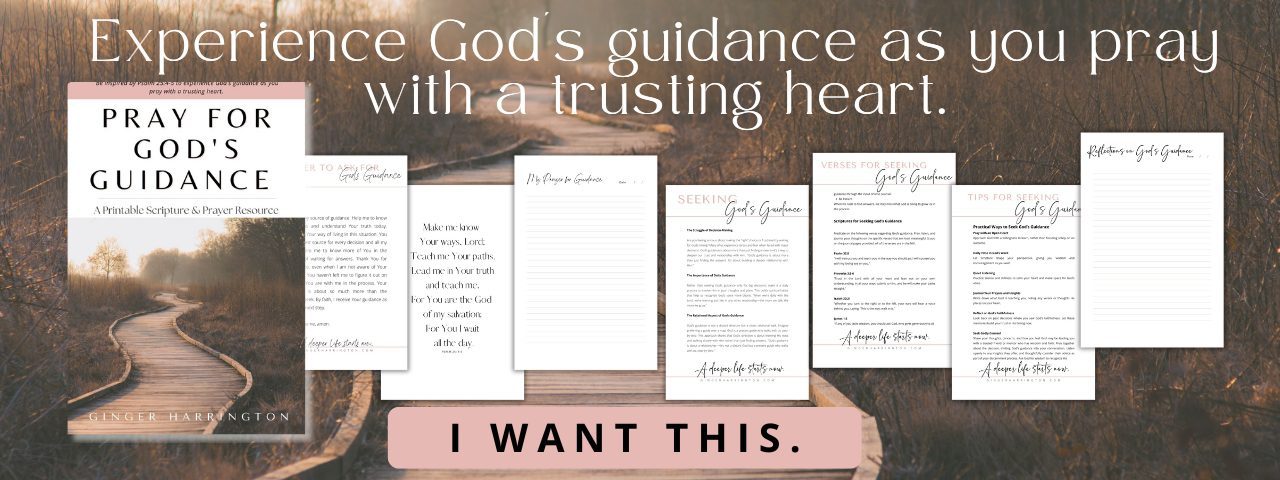
When you’re seeking God’s direction, prayer is the place to begin.
Download my Pray for God’s Guidance PDF—a simple resource to help you ask for wisdom, discernment, and clarity as you follow the Spirit’s leading.
Get your free copy and begin praying for God’s guidance today.
Related Content
- 5 Things You Need to Know About God’s Guidance
- 4 Powerful Ways to Peace in Decision Making
- What to do When You Long for God to Speak to You
- How to Scripture Journal: A Simple Rhythm for Everyday Quiet Time
- Seek God First: How to Order Your Life Around What Really Matters
- How to Find God’s Peace That Guards Your Heart: A Study of Philippians 4:7
How to Stop Letting Your Work Define Your Worth (A Biblical Perspective)
In a world that measures success through metrics, results, and productivity, it’s easy for our work to start defining our worth. When work begins to define your worth, it creates pressure that God never intended you to carry.
*As an Amazon Associate, I earn commission from qualifying purchases.
We track numbers.
We measure progress.
We evaluate whether what we’re doing is making an impact.
And somewhere along the way, a subtle pressure creeps in—the pressure to prove ourselves.
We may not say it out loud, but the question begins to linger beneath the surface:
Am I doing enough?
For many of us, work quietly becomes a place where we look for validation, identity, and reassurance that we matter.
But Scripture offers a different order.
Not work before worth.
Worth before work.
Understanding that order changes everything about how we approach our calling, our productivity, and the results we’re striving to achieve. When we stop letting our work define our worth, we begin to experience the freedom Scripture offers.

When Does Work Begin to Define Your Worth?
Most of us don’t set out to tie our identity to our work. It happens gradually.
- A project succeeds and we feel valuable.
- A goal falls short and we feel discouraged.
- A season is productive and we feel confident.
- A season is slow and we start questioning ourselves.
Without realizing it, identity and productivity become intertwined.
Sometimes we begin asking our work to answer identity questions it was never meant to answer.
Work can express our gifts. It can reflect our calling. It can be a place of stewardship and service.
But it was never designed to tell us who we are.
When it does, every outcome becomes personal. Every result becomes a verdict on our value.
And that’s a burden God never intended us to carry.
Why Do We Feel Pressure to Prove Ourselves Through Work?
Most people don’t consciously decide to measure their worth by their work. The pressure builds slowly through cultural expectations and internal comparisons.
We live in a world that celebrates outcomes.
Productivity is praised.
Results are rewarded.
Visibility is often equated with value.
Over time, it becomes easy to assume that our work is what makes us valuable.
But Scripture points us back to a different foundation. Our worth is not earned through productivity. It is received through relationship with Christ.
When we forget that truth, work becomes exhausting. But when we remember it, work becomes an opportunity to serve from a place of security instead of striving for approval.
What Is the Difference Between Working For Your Worth and Working From It?
One of the easiest ways to recognize whether we’re working for our worth or from it is by listening to our internal language.
When our identity feels unsettled, our thoughts often sound like this:
“I have to make this work.”
“I have to prove myself.”
“I have to get results.”
But when our identity is rooted in Christ, something shifts. The language changes.
“I get to do this work.”
“I get to serve.”
“I get to steward what God has given me.”
“I have to” is the language of insecurity.
“I get to” is the language of identity.
This small shift reveals something deeper about what we believe.
Working for our worth means we’re trying to earn validation through what we produce.
Working from our worth means our identity is already settled, and our work becomes an expression of gratitude, stewardship, and calling.
The work itself may look the same. But the heart behind it is completely different.
Why Identity in Christ Changes the Way We Approach Work
One of the clearest examples of this order appears at the very beginning of Jesus’ public ministry.
In Matthew 3:17, at Jesus’ baptism, the Father declares: “This is my beloved Son, with whom I am well pleased.”
What’s striking about this moment is when it happens.
Jesus had not yet begun His ministry.
He had not performed miracles.
He had not preached sermons or gathered disciples.
Yet the Father speaks identity first.
Beloved before performance.
Worth before work.
This order matters.
Before the assignment comes the affirmation. Before the ministry comes the identity. And the same principle applies to us.
Our worth is not established by our productivity.
It is established by our relationship with Christ.
When we understand that, work stops being a place where we chase approval and becomes a place where we live out the identity we’ve already received.
Your work can express your worth, but it should never determine it.
What Changes When Our Identity Is Secure in Christ?
When our identity is secure, the entire posture of our work changes.
We still pursue excellence.
We still care about the work we’ve been given.
We still want to steward our gifts well.
But the pressure to prove ourselves begins to fade.
Instead of striving for validation, we begin working with freedom.
Failure becomes information rather than identity.
Success becomes gratitude rather than proof.
Faithfulness becomes the measure of a life well lived.
When identity is secure, work no longer carries the burden of defining who we are.
How Do We Trust God With the Results of Our Work?
Another place where we easily confuse worth and work is in how we think about results.
We assume outcomes belong to us.
If something succeeds, we take responsibility.
If something fails, we feel personally responsible.
But Scripture gives us a very different framework.
In 1 Corinthians 3:6, Paul writes: “I planted, Apollos watered, but God gave the increase.”
Paul understood something essential about stewardship.
Our role is participation.
God’s role is multiplication.
We plant.
We water.
God brings the growth.
Faithfulness is our role. Increase belongs to God.
When we confuse these roles, work becomes heavy. We start carrying responsibilities that were never meant to be ours. But when we return the increase to God, work becomes lighter.
We focus on what we’ve been asked to do and trust Him with what only He can accomplish.
Learning to trust God with the results of our work frees us to focus on faithfulness rather than outcomes.
How Do We Release the Results to God?
Jesus speaks directly to this burden in Matthew 11:28–30:
“Come to me, all who labor and are heavy laden, and I will give you rest.
Take my yoke upon you, and learn from me, for I am gentle and lowly in heart, and you will find rest for your souls.
For my yoke is easy, and my burden is light.”
Notice that Jesus does not promise the absence of work. He promises a different way of carrying it. An easy yoke means we are working alongside Him rather than striving on our own.
Dallas Willard reflected on this idea in Living in Christ’s Presence: Final Words on Heaven and the Kingdom of God. (affiliate link) He described how we often carry the results of our work long after our part is finished.
To illustrate this, Willard used the example of bowling: When you roll a bowling ball down the lane, there is a moment when the ball leaves your hand. After that point, the outcome is no longer in your control.
You cannot run down the lane and steer the ball.
You cannot adjust it mid-roll.
Your role ended the moment you released it.
Yet spiritually, many of us continue trying to control the outcome long after our work is finished.
We replay conversations.
We analyze results.
We try to mentally steer what has already been released.
But faithful work requires a moment of release.
We do our part.
Then we let go.
Just like the bowling ball leaving your hand. Once the work has been offered, the outcome belongs to God.
When our worth is settled, excellence becomes worship. Instead of striving to prove ourselves, our work becomes something beautiful—an offering placed in God’s hands.
Returning to the Right Order
If you’ve ever felt the pressure to prove your value through what you produce, you’re not alone.
It’s one of the most common struggles for people who care deeply about their work.
But the gospel invites us back to a different order.
Worth before work.
- Before the productivity.
- Before the results.
- Before the outcomes.
Your identity is already secure in Christ.
And from that place of security, your work becomes something beautiful—an expression of calling rather than a test of your worth.
Write from your worth, not for it.
Frequently Asked Questions
What does it mean to work from your worth?
Working from your worth means your identity is rooted in Christ rather than in your productivity or results. Instead of trying to earn validation through what you accomplish, you approach your work as an expression of stewardship, gratitude, and calling.
How does the Bible connect identity and work?
Scripture consistently places identity before assignment. In Matthew 3:17, God declares Jesus beloved before His ministry begins. This pattern shows that our worth comes from our relationship with God, not from our performance.
Why do Christians struggle with performance and productivity?
Many Christians sincerely want to honor God with their work, but cultural messages about success and productivity can blur the line between faithfulness and performance. Without realizing it, we begin measuring our worth by our outcomes rather than by our identity in Christ.
What does “God gives the increase” mean in everyday life?
In 1 Corinthians 3:6, Paul explains that while people participate in the work—planting and watering—God is responsible for the growth. In everyday life, this means we focus on being faithful with what we’ve been given and trust God with the results.
How can I trust God with the results of my work?
Trusting God with results begins with recognizing the difference between stewardship and control. We pursue excellence and faithfulness in our work, but we release the outcomes to God, remembering that growth and impact ultimately belong to Him.
A Simple Next Step for Your Work
If this message about worth before work resonates with you, one of the most practical ways to live it out is by building small rhythms that help you stay rooted in truth.
That’s exactly why I created a free resource called:
15 Habits of Hope for Your Work
This guide will help you:
- Start your workday with the right perspective
• Release results to God instead of carrying the pressure
• Build rhythms that keep your identity anchored in Christ
These simple habits can reshape the way you approach your work, your calling, and even the expectations you place on yourself.

You can download it here:
[Download 15 Habits of Hope for Your Work]
And if you’d like to explore this topic further, listen to the Worth & Work Series where Larissa and I talk more about the difference between working for your worth and working from it.
Worth & Work Podcast Series
*As an Amazon Associate, I earn commission from qualifying purchases.
About Ginger Harrington
 Ginger Harrington is an author, speaker, and host of the Habits of Hope Podcast, where she helps women cultivate daily rhythms that strengthen faith and deepen trust in God. With over 15 years of experience in Christian blogging, teaching, and women’s ministry, Ginger combines biblical insight with practical application to help readers grow spiritually in real-life seasons.
She is the author of Holy in the Moment and the creator of numerous devotional resources and spiritual growth tools designed to help women engage Scripture thoughtfully and live it faithfully. Through her writing, speaking, and podcasting, Ginger equips women to build habits of hope rooted in God’s Word.

How to Scripture Journal: A Simple Rhythm for Everyday Quiet Time
Learn how to scripture journal using a simple rhythm for everyday quiet time. Write Scripture, meditate, and respond to God—without pressure or perfection.
Have you ever opened your Bible, read a few verses, and then wondered, What do I do now?
That moment—when you want to meet with God, but your mind is racing and you’re not sure how to stay with the text—is more common than we admit. And it isn’t failure. It’s an invitation.
Scripture journaling is a simple way to slow down with God’s Word—by writing it, meditating on it, and responding to God in prayerful conversation.
It’s not a method to master or a system to follow. It’s a gentle rhythm that helps turn Bible reading into a real relationship.
What follows is a simple, approachable practice you can return to again and again—one that meets you where you are, no matter how much time you have or how long you’ve been walking with the Lord.
What We’ll Explore in This Post
- Why scripture journaling is about relationship, not performance
- A simple three-part rhythm you can use anytime
- How writing Scripture helps you slow down and listen
- What biblical meditation actually looks like
- Practical ways to respond to God—without pressure
- How to carry Scripture into your day
- Gentle permission for real-life, imperfect quiet times
What Is Scripture Journaling—and What Is It Not?
Scripture journaling isn’t about filling pages or doing something impressive—although those things may happen.
It isn’t about getting it “right” or producing something meaningful to look at later.
Instead, scripture journaling helps us stay with the text—long enough to notice, listen, and remain present with God rather than rushing on. Writing, spacing words out on the page, or even lingering over a single phrase can become simple ways of giving Scripture our full attention.
We often approach Scripture for information—and that matters. But in our day-to-day devotional life, Scripture is also meant to be read for relationship, not just knowledge. God’s Word isn’t only something we study; it’s something we engage.
Scripture journaling helps turn Bible reading into a conversation, not a task.
Why Is Scripture Journaling About Relationship, Not Performance?
It’s easy to become task-oriented in our spiritual lives.
Read. Pray. Journal. Check the box.
But spiritual disciplines aren’t about doing for doing’s sake. They’re about what God does through them—how they create room for connection, attentiveness, and response.
Rather than measuring output, scripture journaling invites us to:
- Connect with God
- Receive from Him
- Respond honestly
- Allow the Holy Spirit to teach, guide, and comfort
This practice isn’t about producing something polished or proving our devotion.
God is not grading your journal.
He’s listening to your heart.
When this practice becomes part of your life, it becomes a habit of hope—a way of returning to God when life feels rushed or loud.

What Is the Simple Scripture Journaling Rhythm?
This rhythm is intentionally simple and repeatable:
Write Scripture.
Meditate on it.
Respond to God.
That’s it.
Scripture journaling isn’t about doing more.
It’s about slowing down enough to listen and respond.
How Do You Start by Writing Scripture?
Writing Scripture helps us stay with the text instead of rushing past it. Many of us want to read thoughtfully, but time pressure, distraction, or a busy mind can make it tempting to move too quickly. Writing gives us a way to pause and engage more fully.
You don’t have to write an entire chapter. Ask the Lord to show you one thing to pause on—a verse, a phrase, or even a single word. That small act of attention creates a place to begin listening.
Writing slows us down. It engages our attention in a different way and helps the words of Scripture settle more deeply. When we take the time to write, we often notice things we might otherwise skim past.
Often God speaks not through something new, but through something we finally notice.
Practical Ways to Write Scripture
- Write the verse by hand—slowly, without rushing
- Read the verse aloud, emphasizing a different word each time
- Use visual cues—circling, underlining, spacing, or emphasis—to notice what stands out
These simple, tactile practices help us engage Scripture with both mind and body. This isn’t about reverence through rigidity or doing it the “right” way. God created us differently, and engaging Scripture in personal, attentive ways can be a meaningful gift
What Does Biblical Meditation Really Mean?
Biblical meditation is not about emptying your mind or trying to silence your thoughts.
It’s about gently focusing your attention on God’s Word—allowing Scripture to linger long enough to reflect on its meaning and notice what God may be highlighting.
Rather than analyzing everything or trying to uncover a perfect insight, biblical meditation invites us to stay with the text and listen. It creates space to pay attention—to what stands out, what stirs, and what invites a response.
At the same time, biblical meditation isn’t about making Scripture revolve around us. God’s Word has meaning and authority on its own. We aren’t reading to make the passage say whatever we want it to say. Instead, we come with openness—trusting that the Holy Spirit is active as we read and reflect.
As you meditate, you might ask simple, grounded questions:
- What word or phrase is standing out to me today?
- Why might this matter right now?
- What does this reveal about God—His character, His heart, His ways?
- What is being stirred in me—comfort, resistance, hope, conviction?
These questions aren’t meant to force meaning or produce quick answers. They help us remain attentive—listening for how God may be instructing, preparing, or inviting us to respond through His Word.

Biblical meditation is about staying open. Staying curious. Staying present.
Sometimes God uses Scripture to prepare us for something ahead. Other times, He uses it to speak into something we’re already walking through. This isn’t about centering ourselves—it’s about engaging with a living God who meets us through His Word.
When Scripture speaks directly into something we’re walking through, it builds our faith—because we begin to recognize that this isn’t a coincidence, but an invitation to trust God’s nearness and care.
Hope grows when Scripture moves beyond information and becomes a place of faithful, grounded conversation with God in real life.
How Do You Respond to God Through Scripture Journaling?
Relationships grow through communication—not one-way listening.
When we respond to God, we close the loop and turn Scripture into conversation rather than something we simply read and move on from.
Responding doesn’t have to look one particular way. It can take many forms, depending on the day, the season, and what God is doing in your heart.
Response might look like:
- Silent reflection—simply sitting with God and letting the words sink in
- Praise or gratitude for what you’ve noticed in Scripture
- Honest prayer, including questions, struggle, or need
- Writing thoughts, observations, or short bullet points
- Asking God how He wants you to apply what you’ve read right now
If you don’t love journaling, bullet points are enough.
If you feel stuck, simply writing the verse and stopping is enough.
There have been seasons in my own life where my journal looked very different than it had in years past. As I reviewed it, I noticed that many days—maybe even most days—I had only written a Scripture verse and little else. At first, I found myself quietly grading that. Was I slacking? Was I not paying attention? Was God not speaking as much this year?
Instead of letting those questions turn into assumptions, I brought them to the Lord. I asked Him to show me what He was doing rather than jumping to conclusions about what I was doing wrong. What He showed me was both simple and freeing.
It had been a year filled with travel, activity, and much more doing than sitting. And rather than asking me to write more, God was inviting me to listen more—to give space for prayer, presence, and quiet attentiveness in ways that didn’t always show up on the page.
That moment reminded me of something important: the amount you write is not a measure of God’s nearness or your faithfulness. God is always speaking, and when we bring our questions and concerns to Him, we can trust Him to lead us in what we need most in each season.
Some days response is full.
Some days it’s quiet.
All of it counts.
Responding to God through Scripture journaling isn’t about producing something meaningful—it’s about remaining connected, attentive, and open to a living conversation with Him.
What If Scripture Journaling Feels Messy or Inconsistent?
Here’s some permission you might need:
- Some days are a full page
- Some days are one sentence
- Some days are silence
This isn’t about perfection—it’s about faithfulness.
Messy journals are allowed. Honest prayers are welcome.
God meets us right where we are.
And sometimes, silence itself is part of listening.
Continue the Conversation
Scripture journaling doesn’t end when you close your Bible or your journal. One of the most meaningful parts of this practice is allowing what God highlighted to travel with you into the rest of your day.
Often, as we write, meditate, and respond, one word, phrase, or theme rises to the surface. That’s not something to rush past. Holding onto that one thing helps keep the conversation open and invites God’s Word to continue shaping us beyond our quiet time.
One helpful practice is intentionally choosing one word or theme God highlighted and finding a simple way to remember it.
Ways to help yourself remember:
- Write a word or short phrase at the top of your journal page
- Use a sticky note or index card
- Place it somewhere you’ll naturally see it—your planner, to-do list, or workspace
This isn’t about testing your memory or trying harder to be “spiritual.” Remembering is about attentiveness. When we pause later in the day and recall what God impressed on us, it reopens the conversation. The Spirit may prompt us to pray again, reflect, or ask for help applying what we noticed earlier.
Sometimes it’s as simple as remembering a word during a conversation, a decision, or a moment of stress and quietly saying, Lord, help me live this out right now.
It’s hard to live out what we don’t remember—but when Scripture stays with us, it begins to shape how we love, how we respond, and how we pray. Carrying God’s Word with us helps move it from the page into our everyday lives, where faith is actually lived.
FAQ: Scripture Journaling
What if I don’t know what to write when scripture journaling?
Start by writing the verse. That alone is enough. You can also write one observation or ask God a simple question.
Is scripture journaling the same as Bible study?
No. Bible study focuses on understanding Scripture deeply. Scripture journaling focuses on relationship—listening and responding.
How long should scripture journaling take?
There’s no set time. Some days it’s minutes. Some days it’s longer. Faithfulness matters more than length.
Do I need to journal every day for it to count?
No. Scripture journaling isn’t about consistency as perfection—it’s about returning.
Try Scripture Journaling This Week
Scripture journaling isn’t about becoming better at quiet time.
It’s about becoming more attentive to the God who is already present.
When we slow down with God’s Word—when we write it, meditate on it, and respond—we’re building a rhythm of hope.
Listen to Episode 69, How to Scripture Journal, and download the simple one-page printable to help you begin. Don’t aim for perfect—just come back to the habit.
Scripture journaling doesn’t deepen when we rush ahead—it deepens when we stay long enough to listen.
The Spiritual Growth Pack: Simple Tools to Deepen Your Relationship with God
Tip sheets, prayers, and practical truths to help you listen, focus, pray, and grow in your walk with God—one small step at a time.
Download the Spiritual Growth Pack and begin strengthening your faith today.

Related Posts for Your Time with God
-
- When You Long for God to Speak to You
- Simple Ways to Meditate on God’s Word
- 8 Powerful Ways to Connect with God When He Is Silent
- Ignite Your Faith with Simple Truths for Listening to God
- Do You Struggle with Listening to God?
- Moments to Pray, Listen, and Think Bring Us Closer to God
- 15 Simple Ways to Overcome Distraction to Focus Your Attention on God (with printable)
- 10 Benefits of Reviewing What We Learn from God
- Simple Ways Silence Can Deepen Your Faith
- Discover Six Important Truths About Listening to God
About Ginger Harrington
 Ginger Harrington is an author, speaker, and host of the Habits of Hope Podcast, where she helps women cultivate daily rhythms that strengthen faith and deepen trust in God. With over 15 years of experience in Christian blogging, teaching, and women’s ministry, Ginger combines biblical insight with practical application to help readers grow spiritually in real-life seasons.
She is the author of Holy in the Moment and the creator of numerous devotional resources, guided journals, and spiritual growth tools designed to help women engage Scripture thoughtfully and live it faithfully. Through her writing, speaking, and podcasting, Ginger equips women to build habits of hope rooted in God’s Word.

How to Keep Hope Alive While Praying for a Prodigal Child
In this episode of the Habits of Hope podcast, I sat down with Monica Schmelter for a conversation that so many parents, grandparents, and loved ones need.
Monica is the host of the TV show Bridges (aired weekly on Christian Television Network in over 50 million homes, and streaming on Roku), and she also hosts the Hope for the Journeypodcast—which recently made a top 10 list for Christian women’s podcasts.
This topic is personal for Monica. She’s walked the road of loving a prodigal, asking hard questions, and learning what it looks like to keep trusting God while you wait.

Why is hope for the prodigal so personal to you?
Monica Schmelter:
Yes—like you said, I’m no stranger to that journey. My son is a prodigal, and we’ve had other prodigals in the family. So there’s been a lot of tears and a lot of prayer—and all the questions. Did I do something wrong? Did I not pray hard enough?
As moms, we’re looking at all the things. So it’s been a heartfelt journey. And it’s been one that I’ve learned so much about faith and prayer—that while I’m waiting, and regardless of how dark it might seem, to trust that God is always working.
What has helped when you’ve second-guessed yourself as a parent?
Monica Schmelter:
The enemy is not all-powerful, but he is relentless at tormenting us if we don’t have habits of hope. We really have to discipline our minds and our hearts to not linger in those kinds of places.
For me, one of the things the enemy—and my own flesh, because I allowed it—would bring back were times from the past when our son was growing up.
Even though I was a Christian and I loved Jesus and loved our son so much, I really struggled with anger and rage, and I would do a lot of yelling and screaming.
I didn’t yell or scream at our son, but he heard that, and I felt that the mistakes I had made had wounded him and damaged him. And the enemy would bring that time and time again, and I would think, Gosh, if I could take that back, I would.
Finally, I came to a place of being really honest with God:
Okay, I absolutely messed up in that area. And I poured that out before God. And I went to our son and I said, If you would forgive me, I realized that I set some bad examples. And I gave some specific things that I said.
He did tell me that he loved me and offered me that forgiveness.
I wrote down the date that I talked to God about that and the date that our son forgave me. Whenever those thoughts would come back, I would go back to those dates and I would say, We’ve taken care of this.
Trusting God with my mistakes:
I’ve learned that He’s more than enough to make up for my deficiencies, because no mom is perfect.
We all have moments.
I call mine “Monica meltdown moments.”
The enemy can bring those back to torment us.
I reminded myself that He makes up for those deficiencies. And I have the power of prayer on my side.
Rather than being all down in the mouth about real things that happened, I could commit myself to prayer.
That’s something practical and productive and spiritual—pray for your child and pray for God’s kindness to lead them to repentance.
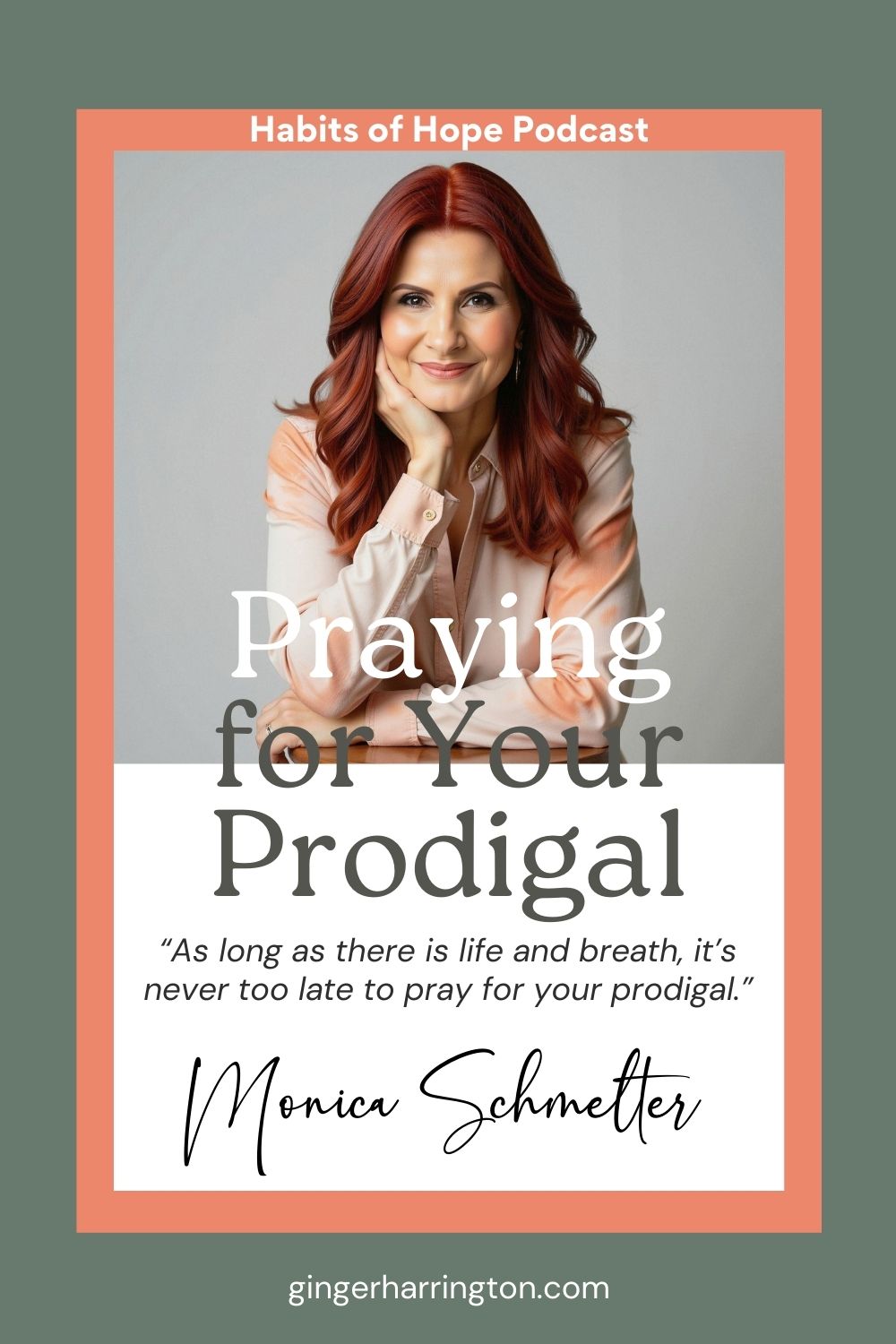
What does it look like for you to pray for your prodigal?
Monica Schmelter:
One of my favorites is in the book of Peter where it’s God’s heart—where He says He’s not slack concerning His promises, because we look at it and it’s like, God, I’m waiting.
In God’s timetable, He’s not slack or slow in keeping His promises—He’s patient. He’s long-suffering because He wants none to perish.
Sometimes I would say things as simple as:
God, I’m just agreeing with You. You say that You wish that none would perish—and God, I pray that.
I want my son to come to faith in Christ. I want that love and commitment that used to be there to return—to be that fire shut up in his bones.
I also stand on the scripture that says we can be confident. . .
that if what we’re asking is His will, we can be confident that He hears us, and if He hears us, then He answers.
A mom of a prodigal—or anybody that’s praying for a prodigal—we can be confident that them coming to Christ or coming back to Christ is absolutely God’s will.
- I steep myself in those kinds of verses.
- I’m praying what God says.
- I’m agreeing with what God says.
- And it may take a long time for me to see that answered.
- It might not be answered in my lifetime.
But I do believe He’s faithful to His word and that He’s going to answer.
Praying Scripture and believing God’s promises helps combat discouragement and impatience in times of waiting.
What if I don’t know what to say when I pray—or I’m out of words?
Monica Schmelter:
People can get hung up on: What should I say when I pray? What does this look like? And you’re exactly right—sometimes it’s heavy-duty warfare prayer. Sometimes it’s bringing God into remembrance of His word—finding a verse and putting your child’s name in there and saying that prayer.
And there are times when, in my journey, I just don’t have any words and I just cry. And I know that He hears my heart because I’m out of words and I’m out of tears.
It’s our honesty before God and our faith in Him above and beyond what we’re going through.
The story of Monica’s prayer box
Monica Schmelter:
I came to Christ at 13. After hearing my pastor talk about praying for your family and they could be saved, I started writing my prayers. I put them in a Charlie perfume box.
There are literally hundreds and hundreds of names in here. At that time, my dad was an atheist, my mom didn’t know exactly what she believed, and my grandfather—my mom’s dad—was a Muslim.
I didn’t know how or what to pray. But you can see in my little girl teenage handwriting—I wrote some days in purple, some days in red, some days in green. I drew flowers, all those crazy things.
I want to encourage moms to not give up on prayer:
God brought every one of those people to Christ—every single one.
It took 25 years for my parents.
I don’t want it to take 25 years for anybody, but I will say this—regardless of how long it takes, it’s worth it.
It doesn’t have to look beautiful. You don’t have to be a Bible teacher or recite scripture perfectly.
The box is all torn up now. This little box is my most treasured possession, because it’s my heart.
That’s what prayer is. It’s sharing our heart with God and trusting Him in the wonderful things, the things we don’t understand, and the things where it seems like it’s taking forever.

How has God ministered to your heart in the middle of a hard season?
Monica Schmelter:
I can recall one very specific instance. Our son at that time was very far from the Lord, making decisions that concerned me.
I was at work. I went into the studio and I sat in a metal folding chair—and I remember the chair was really cold. It was cold in the studio. I bowed my head to pray.
And in that still small voice in my heart, I heard the Holy Spirit say, I see you.
That held me. It was like—okay, this has been forever, but God sees me. I needed to know that at that moment.
I think we all know that conceptually, but there are times life seems so hard and so bad that we need that reminder—that He sees us, and He hasn’t abandoned us on this journey. He’s with us.
I had that knowing that He was with me, and He was going to work somehow, some way—work all of that out.
How do you balance loving your prodigal with boundaries—especially with addiction or destructive behavior?
Monica Schmelter:
It has to be very painful when a prodigal is completely estranged from the family. If that’s the case and the child doesn’t want contact, we pray.
However, if that’s not the case—we can always love our children. Loving them and talking to them and enjoying their company is important.
We don’t have to make that contingent on their behavior. I’m not talking about letting your kids do something illegal in your house.
- You can be totally loving
- Go out and enjoy meals.
- Have them over.
- We can model the love of Christ.
We don’t have to make everything a sermon to them. If God opens the door, go through that door. But if not—love them right where they are, model that example of Christ loving us where we are.
Realize that even God respects our free will. There’s nothing we can do to make our prodigal’s heart change—only God can do that.
But we can do everything possible to build and sustain a good relationship so that when they do come to Christ, they can see how you love them unconditionally and you still kept that contact and celebrated their victories.
And I would say—every victory your prodigal has, every wonderful thing—celebrate that. Don’t always come back to what you know: They need to come back to the Lord. They do—but celebrate the good, and don’t lose all of that, because God’s working on the part that we can’t change.
The ache of dealing with addiction.
And I’m so glad you brought up addiction and tough love, because that is the case with a lot of parents of prodigals.
There are things you absolutely cannot allow in your home. There are boundaries you have to set.
- You cannot continue to give money.
- You cannot continue to do those things when there are substances, reckless behavior, that sort of thing.
- Pray for God to give you the grace to let go—but not give up.
- You can still continue on in prayer, but you’ve got to totally give that prodigal to the Lord.
Do not feel guilty for setting boundaries.
You have to—for your own good, for their good, for other family members’ good.
That’s painful. And I would encourage everybody—if you have a friend who is the mom or dad of a prodigal and they’ve had to set boundaries, don’t judge them. Don’t tell them all the things they need to do. It’s hard enough already.
If they ask for advice, by all means share your wisdom. Otherwise, pray—and just listen without judgment. If we’ve not walked that road, we don’t know.
Giving each other grace matters.
If I haven’t been down that road, I want to keep my heart open. This mom, this dad is suffering. They’ve had to make hard decisions—decisions that probably break their heart.
I don’t want to cause any more angst. I can just pray and be a friend.
What would you say to someone who feels like it’s too late—or they’ve failed?
Monica Schmelter:
As long as there’s breath and life, there’s hope. It’s never too late.
We’ve all made mistakes. Some are bigger mistakes than others. But He is more than enough to make up for our deficiencies.
It’s not like once we made those mistakes, God thought, Well, my plan of salvation for that one is totally gone and out the door. It’s not like that.
If we can recognize that those thoughts are not coming from God—they’re coming from the enemy and from our own flesh and fears—the things we know and remember.
If there’s something we need to repent about, by all means do that. But once we’ve done that, live in the joy of the Lord and the joy of your salvation—expectantly waiting, like the prodigal father did, watching for his son from a long ways away.
The story of the prodigal son…
- We don’t know a lot about that father, but we know he had to be concerned because he’s watching for the child’s return.
- We know he continued whatever his work and business was—because he still had food and servants. Life was continuing, and yet he was waiting.
- Those sound like two opposite messages, but they’re not. Life continues and we wait—and that happens together.
Never ever ever ever say it’s too late, because it’s not.
Nobody is too far gone.
The Bible says His arm is not short and His ear is not deaf.
I have a good friend who always says, God has more than a trillion ways to deliver your children.

If you’re in the waiting today—praying for someone you love, carrying questions, and trying to keep showing up—this conversation is a reminder that you’re not alone. And it’s a reminder that prayer doesn’t have to be perfect to be real.
If this episode encouraged you, I hope you’ll listen to the full conversation—and consider sharing it with someone who may need hope for the waiting too.
Connect with Monica

Seek God First: How to Order Your Life Around What Matters Most
Learn what it means to seek God first (Matthew 6:33) and how to order your life around what matters most with trust, wisdom, and hope.
Have you ever noticed how easily good intentions can quietly turn into pressure?
You begin a new year—or a new season—wanting to live faithfully. You want to use your time well. You want to make thoughtful choices. You want to carry forward what God has already taught you.
And then, almost without realizing it, that desire can start to feel heavier.
Instead of wisdom, there’s urgency.
Instead of trust, there’s pressure to figure everything out.
A plan for provision. A plan for the future. A plan for what comes next.
Into that anxious swirl, Jesus doesn’t step in with a checklist or a warning—but with an invitation:
“Seek first the kingdom of God.”
Not strive.
Not secure.
Not solve.
Seek.
This invitation from Matthew 6:33 shows us how to order our lives around what matters most, especially when the future feels uncertain.
What We’ll Explore in This Post
In this post, we’ll walk through:
- Why Jesus’ invitation to seek first is a response to worry, not a spiritual platitude
- What Matthew 6:33 really means in the context of everyday provision and anxiety
- What it looks like to seek God’s kingdom instead of living from fear
- How seeking God’s righteousness is about identity, not performance
- How “seek first” becomes a simple, repeatable habit of hope
- Practical ways to apply this verse to decisions, conversations, and daily life

What Does It Mean to Seek God First in Matthew 6:33?
“Seek first the kingdom of God and His righteousness, and all these things will be added to you.”
—Matthew 6:33
This verse comes at the end of a longer teaching where Jesus addresses very real concerns: food, clothing, work, daily provision, and the fear of not having enough.
Jesus isn’t speaking to people chasing luxury.
He’s speaking to people wondering how they’re going to get by.
Throughout Matthew 6, Jesus contrasts two ways of living:
- A life organized around anxiety—focused on securing needs, chasing outcomes, and living in constant “what if”
- A life organized around trust—shaped by God’s kingdom and God’s ways
When Jesus says, “But seek first…”, that small word but matters.
It signals a turning point.
A change of pattern.
A different way of ordering your life.
When God is first, you don’t have to carry the full weight of provision on your own.
This isn’t a promise of ease or abundance—it’s the assurance that God is faithful and present, and that you can trust Him.
Why Seeking First Is Jesus’ Practical Answer to Worry
It’s easy to think of Matthew 6:33 as a beautiful verse that sounds good—but doesn’t quite touch real life.
But this is Jesus’ practical response to anxiety.
Seeking first isn’t abstract. It’s how we reorder our lives when the future feels uncertain.
Instead of beginning with fear, Jesus invites us to begin with God.
Not after we plan.
Not once we feel secure.
But first.
What Seeking First Is Not
Before we go further, it’s important to name what Jesus is not saying.
Seeking first is not:
- A productivity strategy
- A formula that guarantees specific outcomes
- A way to eliminate responsibility
- A method for controlling results
Jesus isn’t saying, “If you do this right, everything will go the way you hope.”
He is saying this:
When your love is rightly ordered, you can trust God with what follows.
Seeking first is about ordered love—loving God above all else so everything else finds its proper place.
What Does It Mean to Seek God’s Righteousness?
When Jesus invites us to seek His righteousness, He isn’t calling us to perform better or try harder.
He’s not adding something else to your already-full schedule.
He’s inviting you to live from a different center.
God’s righteousness is revealed in His character—
His faithfulness.
His mercy.
His truth held with love.
It’s God’s way of doing and being right—pure, holy, and good.
And when we belong to Christ, righteousness becomes something we live from, not something we strive to achieve.
We aren’t seeking righteousness to earn God’s love.
We seek it because we’re already loved.
This matters because anxiety has a way of shaping how we respond.
Fear influences our tone, our timing, and our choices.
Seeking God’s righteousness invites a different question:
Not “What do I need to get?” but “What does it look like to reflect God’s heart here?”
Righteousness becomes practical when it shows up in everyday moments:
- How we speak when we’re frustrated
- How we listen when we feel misunderstood
- How we respond when things don’t unfold the way we hoped
Sometimes the most honest prayer is simply:
“Lord, would You express Your righteousness through me right now?”
There have been seasons in my life where anxiety shaped far more of my thinking and decision-making than I realized. I wasn’t always aware of it at the moment—I was just trying to stay ahead, trying to manage what might come next, trying to keep things from unraveling.
Over time, I began to see how often fear was driving my emotions and my need for control. Learning to seek God first—again and again—became one of the ways the Lord gently reoriented my heart. I still have moments where anxiety surfaces, but it no longer defines the direction of my life the way it once did.
When we live from identity rather than anxiety, seeking first becomes less about effort and more about trust.
Righteousness isn’t just about getting it right.
It’s about living from who we already are in Christ—secure, provided for, and held by grace.
Why Seeking First Is About Direction, Not a Task
Seeking first isn’t something to add to your to-do list—though sometimes writing it at the top of your list can help orient your heart.
When Jesus says seek, He’s talking about direction and focus.
- What has the first claim on your attention?
- What shapes your yes or your no?
- What steadies you when you feel unsure?
Seeking first is less about what you do and more about who you depend on.
It’s choosing to begin—not with outcomes—but with God.
How Does Seeking First Reveal Our Motivations?
We don’t often pause to analyze our motivations—but they’re always influencing us. I know that’s true for me. Most days, I’m not stopping to ask, Why am I doing this right now? I’m just moving forward, responding, deciding, reacting. And yet, underneath it all, something is always driving those choices.
That’s where seeking first becomes such a gracious gift. It gives us a simple filter for discernment—without requiring endless self-analysis.
It invites honest questions like:
- Am I seeking God first here—or myself?
- Am I trusting God’s provision, or trying to secure my own?
- Am I acting from trust—or from the need to protect, prove, or control?
That last one can sting a little. I know it does for me. There are moments when that question feels like a bullseye—when I realize my urgency isn’t coming from faith, but from fear. And none of us gets this right all the time. That’s one of the reasons this practice needs to become a habit, something we return to again and again.
Often the issue isn’t what we’re choosing—but why we’re choosing it. We might say the same words, take the same action, or have the same conversation, but everything shifts depending on what’s driving our heart.
When God is first, our motivations are shaped by faith instead of fear.
We may still do the same things—but we do them differently. Our tone softens. Our urgency eases. Our responses are guided more by trust than by the need to control the outcome.
Seeking first helps us name what’s really going on inside—and then gently reorient our hearts toward God’s way instead.
How Seeking First Grows Out of Wisdom, Not Urgency
This invitation to seek first doesn’t come from a soft aside—it comes from Jesus’ clear, instructive teaching about worry and misplaced focus.
In Matthew 6, Jesus names what we actually struggle with. He asks direct questions that expose the futility of anxiety:
- Why do you worry?
- Why exhaust yourself over what you cannot control?
- He points to the flowers and the grass—not sentimentally, but decisively—to show how little our worry accomplishes.
Worry does not provide. It does not secure the future. It does not add wisdom. It only multiplies pressure.
Jesus contrasts anxious striving with a wiser way of living. Those who do not know God run after provision as if everything depends on them. But His followers are called to live differently—grounded in the knowledge that their Father already knows what they need.
This is where wisdom comes in.
Psalm 90:12 reminds us, “Teach us to number our days, that we may gain a heart of wisdom.” Wisdom doesn’t rush. Wisdom pays attention. Wisdom recognizes limits—and refuses to pretend it can carry tomorrow today.
Seeking first grows out of that wisdom.
Instead of asking, What do I need to make happen?
We begin asking, Where is God already at work—and how do I align with that?
Seeking first is not avoidance or passivity. It is the wise reordering of our lives in light of what worry cannot do and what God has already promised to do. Jesus doesn’t deny that each day has trouble of its own—He simply refuses to let tomorrow’s trouble dictate today’s faithfulness.
Wisdom acknowledges reality.
Urgency tries to outrun it.
Seeking first chooses wisdom.

How Seeking First Addresses Anxiety Without Ignoring It
Even knowing what Jesus says about worry, anxiety can still show up. It certainly does for me. What seeking first has given me is not the absence of anxious thoughts, but a way to respond when they rise.
Remembering to seek first helps dial down my tendency to worry because it interrupts the urgency. It reminds me that anxiety is not something I have to obey or fix before moving forward. Instead of letting fear set the agenda, seeking first reorients my attention back to God—His kingdom, His care, His faithfulness.
Jesus acknowledges that each day has trouble of its own. Seeking first doesn’t deny that reality. It simply keeps today from being dominated by tomorrow. When I return to that question—What does it look like to seek God first right here?—the weight shifts. I’m no longer carrying provision on my own. I’m choosing trust over control, one moment at a time.
Trusting God with “All These Things”
For me, seeking first when anxiety shows up often comes down to the promise Jesus attaches to this invitation: “and all these things will be added to you.” That phrase pulls my attention away from everything I’m trying to manage and back to the heart of the issue—who am I trusting to provide?
Seeking first is a choice to trust that God knows what I need and will be faithful with it. It doesn’t mean disengaging from responsibility or pretending needs don’t exist. It means I don’t have to secure provision before I obey. I don’t have to carry the full weight of outcomes to move forward in faith.
When worry starts to take over, returning to that promise steadies me. It reminds me that provision is received, not chased—that my role is faithfulness, not control. Seeking first reorders my confidence, shifting it from my own effort to God’s care. And in that shift, anxiety loses its authority, one decision at a time.
How Seeking First Looks in Everyday Life
Trusting God with provision doesn’t stay theoretical for long. It shows up in ordinary moments—real decisions, real conversations, and real limits on our time and energy. When we ask, What does it look like to seek God first right here, today? these practices give us a simple place to begin.
- With Time and Daily Work
Begin the day with this posture of trust:
“Lord, order my day. Help me do what You want me to do today.”
- In Decision-Making
Begin with a simple prayer:
“Lord, help me seek You first in this decision.”
Ask: What does God’s kingdom look like here? How does His righteousness apply?
- When Anxiety Surfaces
Instead of spiraling forward, pause and ask:
What would it look like to trust God with this outcome?
- When Priorities Feel Crowded
Return to this grounding question:
What matters most in light of God’s kingdom?
- In Difficult Conversations
Before responding, pray:
“Lord, help me express Your righteousness here.”
When our hearts and our choices are aligned with God’s leading, urgency loosens its grip—and faith takes its place.

How These Episodes Fit Together
These episodes were sequenced intentionally:
- Reflection helps us pay attention to what God has been teaching and discern what to carry forward
- Numbering our days forms a wise awareness of time—shaping how we live with gratitude, intention, and humility
- Seeking first reorders our motivations around trust instead of fear or selfishness
Jesus isn’t asking us to do more.
He’s inviting us to live from a deeper center.
Frequently Asked Questions About Seeking God First
What does “seek God first” really mean?
It means ordering your life around trust in God rather than anxiety about outcomes. It’s about direction, not perfection.
Is seeking God first a productivity strategy?
No. While it can bring clarity to how we use our time, its purpose is spiritual alignment, not efficiency.
How does Matthew 6:33 help with anxiety?
It shifts the burden of provision from your shoulders to God’s care, reminding you that He is faithful with what follows.
Can seeking first become a daily habit?
Yes. When practiced consistently, it becomes a default posture—a habit of hope that shapes decisions and responses.
Living from Trust, One Day at a Time
You don’t have to carry tomorrow today.
When your heart is aligned with God’s kingdom, you can trust Him with what comes next.
Seek first—and rest in the God who provides.
Because a deeper life begins when we trust God—first.

Practice “Seek First” in the Moments That Matter Most
If today’s message about seeking God first resonated with you, Holy in the Moment: Simple Ways to Love God and Enjoy Your Life was written for this exact journey.
This book isn’t about striving harder or adding spiritual pressure. It’s about learning how to return to God right in the middle of real life—when anxiety rises, decisions feel heavy, and trust feels hard.
Holy in the Moment offers simple, practical ways to live from a steadier center, so faith becomes something you practice moment by moment—not something you postpone until life feels easier.
👉 Get Holy in the Moment and start choosing “seek first” in the ordinary moments that shape your days.
Related Content

How to Number Your Days with God for a Heart of Wisdom
Have you ever reached the start of a new year with a long list of goals and resolutions—things you want to do better, manage better, finally get under control—and yet still feel unsure where God fits into all of it?
I’ve been there. Many of us plan our time with good intentions, but Psalm 90 invites us to something deeper than planning. It invites us to seek God’s wisdom before we decide how to use the days He’s given.
How do you number your days? Psalm 90:12 shows us that numbering our days isn’t about getting more organized—it’s about asking God to teach us how to live with wisdom, gratitude, and an eternal perspective, one day at a time.
This is a follow-up to Episode 65, where we talked about reflecting on what God has taught us in the past year and carrying it forward. But reflection isn’t the end goal—Psalm 90 reminds us the goal is wisdom.
“Teach us to number our days that we may gain a heart of wisdom.” (Psalm 90:12)
What We’ll Explore in This Post
- Why Psalm 90:12 is a prayer for wisdom—not a plan for productivity
- What “numbering your days” really means (and what it doesn’t)
- How an eternal perspective brings clarity to your priorities
- How to value the season you’re in without rushing ahead
- How gratitude changes the emotional weight of your days
- How to choose what to carry forward—and what to release
- Why wisdom looks like trust, not control
What does Psalm 90:12 mean by “number your days”?
When we hear “number your days,” it’s easy to think calendars, schedules, goals—especially at the beginning of a new year. I even said in the episode that I had my calendar out and was literally counting days between deadlines for planning purposes.
But Psalm 90:12 is pointing to something deeper.
To number your days is not mainly about planning efficiently—it’s about asking for God’s guidance in how you live within your time and keeping an eternal perspective.
It’s an honest awareness that your time is limited, that you have boundaries, and that God alone knows how many days any of us have.
Why does this matter? Because we want to accomplish the God things, not just the good things.
And this verse begins with a word we can’t miss: “Teach us…”
That means we need help. Left to ourselves, we don’t do this well. So Psalm 90:12 becomes a simple, steady prayer: “Lord, teach me.”

Why isn’t this verse about better time management or getting more done?
Because the verse doesn’t say, “Teach us to number our days so we can manage them better.”
It says:
“Teach us to number our days that we may gain a heart of wisdom.”
That distinction matters.
It’s easy to live with a split—your “real life” over here and your “God life” over there. But wisdom brings it together. Wisdom is lived alignment with God’s ways and His heart.
Wisdom is letting God set the pace and the priority before we make our plans.
Instead of planning first and praying later, we seek God’s wisdom before we decide how to live in the time we’ve been given.
And this isn’t just theoretical—it changes how you carry your life. When you know you’re living in alignment with what God wants, there’s a deep sense of purpose, fulfillment, and hope.
And really, isn’t that what we all want? Isn’t it good to know that this is God’s desire for us as well?
How does wisdom actually grow over time?
In the episode, I said it plainly: wisdom grows when we reflect. This isn’t the only way to wisdom, but it is an important part of the journey.
Wisdom grows when we:
- reflect on what we’ve lived
- notice patterns
- invite God to interpret our experiences
- align ourselves with what God’s Word says and how He wants us to live
Experience alone doesn’t make you wise. Reflection guided by God turns experience into wisdom.
That’s why looking back isn’t just nostalgia. It’s an invitation for God to shape how we live going forward.
How does an eternal perspective change your priorities and pressure?
One of the big themes in the episode is that numbering your days is a clarifying awareness—not a fearful one.
When you remember time is limited and eternity matters, your perspective shifts:
- Not everything deserves the same weight.
- Not every demand deserves your energy.
- Not every distraction deserves your attention.
You stop reacting to every urgency as if it’s ultimate.
And honestly? This is where we bump into what I called “the tyranny of the urgent”—that feeling of chasing urgent things while missing the important things. When we live with eternity in view, it helps us step out of autopilot and ask better questions:
- What is God calling me to actually focus on right now?
- What has lasting value?
- What does faithfulness look like with the time God has given me right now?
Living this way doesn’t make life smaller. It makes it clearer.
Habit of Hope
Receive each day as a gift while seeking God’s wisdom for how to honor Him with your time.
This isn’t about squeezing more into your days. It’s about how you hold the days you’ve been given.
When you receive time as a gift, gratitude shapes your attitude.
When you seek God’s wisdom, faithfulness shapes your choices.
Together, they help you live wisely without pressure.
What are practical ways to live this out each day?
Here are the practices we named in the episode—simple, but powerful. I’m putting them in a numbered list so you can come back to them easily.
- Begin the day with a simple prayer.
Begin with a prayer like, “Lord, thank you for this day. Help me to honor You with the time You’ve given me today.” Starting here shifts your day from control to trust. - Pause before making a commitment.
Pause and ask, “Lord, is this something You want me to do right now?” Before you say yes, take one breath and ask the question. Sometimes the wisest “yes” begins with a surrendered pause. - End the day by releasing unfinished things to God.
Entrust the unfinished things to the Lord, remembering faithfulness is not measured by how much you accomplish. You can trust Him with what didn’t get done—not just what did.
And here’s the heart beneath these practices:
Wisdom grows not through control, but through trust—and not through striving, but through attentiveness.
How do you value the season you’re in without rushing past it?
Numbering your days means valuing each season for what it is.
Psalm 90 was written with a long view of life—wilderness years, loss, faithfulness over time. And that matters, because numbering your days doesn’t mean rushing through a season just to get to the next one.
It’s easy to mentally fast-forward and tell yourself: Life will be better when…
- when the kids are older…
- when things slow down…
- When I retire….
- when this season passes…
But when we appreciate the season we’re in, we allow it to shape us.
Different seasons require different rhythms, priorities, and responsibilities. My time looks very different now than it did 30 years ago. So the question isn’t, “How do I live like I did in another season?” Instead, ask yourself, “What does faithfulness look like here and now?”
Instead of planning our way out of a season, we seek God’s guidance within it.
How does gratitude reshape the way you carry time and responsibility?
Numbering your days also means receiving time as a gift and living with gratitude.
When you recognize your days are given by God, gratitude becomes more than a feeling—it becomes a way of living. It helps you stop taking your days (and the people in them) for granted.
And it changes the emotional weight you carry:
- less pressure to prove yourself
- less need to make every moment impressive
- more patience with those around you
- more ability to trust God with what you cannot finish or control
Larissa said something in the episode that’s worth repeating because it’s such a strong reframe:
It shifts us from “I’ve got to get all of this done” to “I’ve been entrusted with this day.”
Gratitude doesn’t deny difficulty. It reframes it.
When you’re overwhelmed, it can give you a pause instead of a spiral.
When you’re frustrated, it can soften you instead of harden you.
When you’re disappointed, it can keep you grounded instead of resentful.
Gratitude helps anchor us in the present without denying the hope of what’s ahead.
How do you choose what to carry forward into the new year?
When your days are numbered, you stop trying to carry everything into the future.
Instead, you begin to live with discernment instead of default.
That means you pause and ask:
- What is God inviting me to keep?
- What might He be asking me to release?
- What lessons from this season are meant to guide my choices now?
And when it comes to goals, we can ask different question. Instead of:
- What do I want to accomplish this year?
Ask:
- What is God calling me to prioritize with the time He’s given me?
We let God set our priorities before we set our plans.
Numbering your days empowers you to choose wisely. And when you live this way, your pace becomes lighter, your choices become clearer, and you carry less pressure into the days ahead.
Why does numbering your days require trust instead of control?
This is where Psalm 90:12 can bring real rest.
Because no matter how wisely we live, there are things we cannot control:
- how many days we’ll have
- what each day will bring
- how this year will unfold
Wisdom isn’t certainty. (And yes—I would love the roadmap some days.)
But the wisdom Psalm 90 points us to is dependence: seeking God’s plan rather than just making ours.
We don’t number our days to master them. We number them to walk with God one day at a time.
That’s where wisdom settles—when we stop trying to grip time and start entrusting it.

5) Short FAQ Section
How do I number my days as a Christian?
Numbering your days starts with prayer: “Lord, teach me.” It’s living with an awareness that time is limited, eternity matters, and God gives wisdom for how to live faithfully today.
Is Psalm 90:12 about time management?
Not primarily. Psalm 90:12 isn’t a prayer for better organization—it’s a prayer for wisdom. It invites you to seek God’s guidance before you set your agenda.
What does it mean to gain “a heart of wisdom”?
In this episode, we talked about wisdom as lived alignment—bringing your “real life” and your “God life” together, letting God shape your choices, pace, and priorities.
How can I live wisely when I don’t know what this year will bring?
Psalm 90:12 reminds us wisdom doesn’t mean certainty—it means dependence. You walk with God one day at a time, with open hands, trusting Him with what you can’t control.
Cultivating the habit of numbering our days.
Psalm 90:12 calls us to more than managing our time. It calls us to seek God’s wisdom. It invites us to listen before we decide, to receive our days with gratitude, and to let God shape how we live within the time we’ve been given.
And as you step into this year, you don’t have to have everything figured out to live wisely. You don’t need a perfect plan for your year. You need a heart that’s attentive to God—one that receives each day as a gift and listens before deciding.
Receive each day as a gift while seeking God’s wisdom for how to honor Him with your time. This is a habit that is worth cultivating.
As you begin this year, let’s step into it with hope—not rushing, not striving, but walking toward wisdom one day at a time.
Resource Mentioned
Article: Tyranny of the Urgent
Related Content
- How to Start the New Year with God
- How to Build the Habit of Trusting God with Your Work
- 4 Powerful Ways to Peace in Decision Making
- Finding Soul Rest from the Burdens that Weigh You Down