

Ginger Harrington
Hello! I’m Ginger. Looking to nurture hope and live with deeper faith? Together, we’ll explore habits that help you grow, thrive, and find joy in God’s unique plan for your life. Don’t miss our new podcast!
Ginger Harrington
Hello! I’m Ginger. Looking to nurture hope and live with deeper faith? Together, we’ll explore habits that help you grow, thrive, and find joy in God’s unique plan for your life.
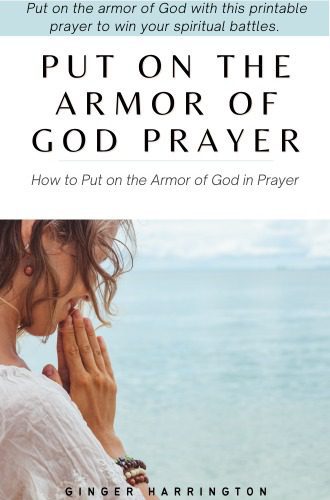
A Practical prayer resource
Prayer is a vital part of putting on the armor of God. Stand firm in God’s strength with this printable prayer, quote, and journal page to put on God’s armor. Win your spiritual battles as you depend on God’s power with Ginger’s most popular freebie.
A practical prayer resource
Prayer is a vital part of putting on the armor of God. Stand firm in God’s strength with this printable prayer, quote, and journal page to put on God’s armor. Win your spiritual battles as you depend on God’s power with Ginger’s most popular freebie.
THE PODCAST
Listen to the Habits of Hope Podcast
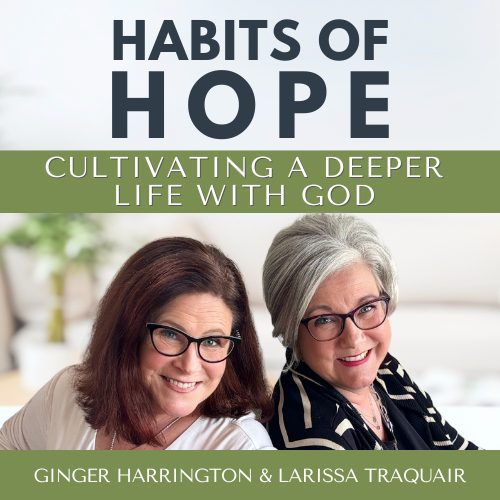
Habits of Hope is your guide to building everyday habits that nurture faith, strengthen hope, and deepen your connection with God. Join the conversation as we explore practical steps for lasting spiritual growth and resilience, offering inspiration and biblical wisdom to help you thrive—even in challenging seasons.
THE PODCAST
Listen to the Habits of Hope Podcast
Habits of Hope is your guide to building everyday habits that nurture faith, strengthen hope, and deepen your connection with God. Join the conversation as we explore practical steps for lasting spiritual growth and resilience, offering inspiration and biblical wisdom to help you thrive—even in challenging seasons.

HOLY IN THE MOMENT
Simple Ways to Love God And Enjoy Your Life
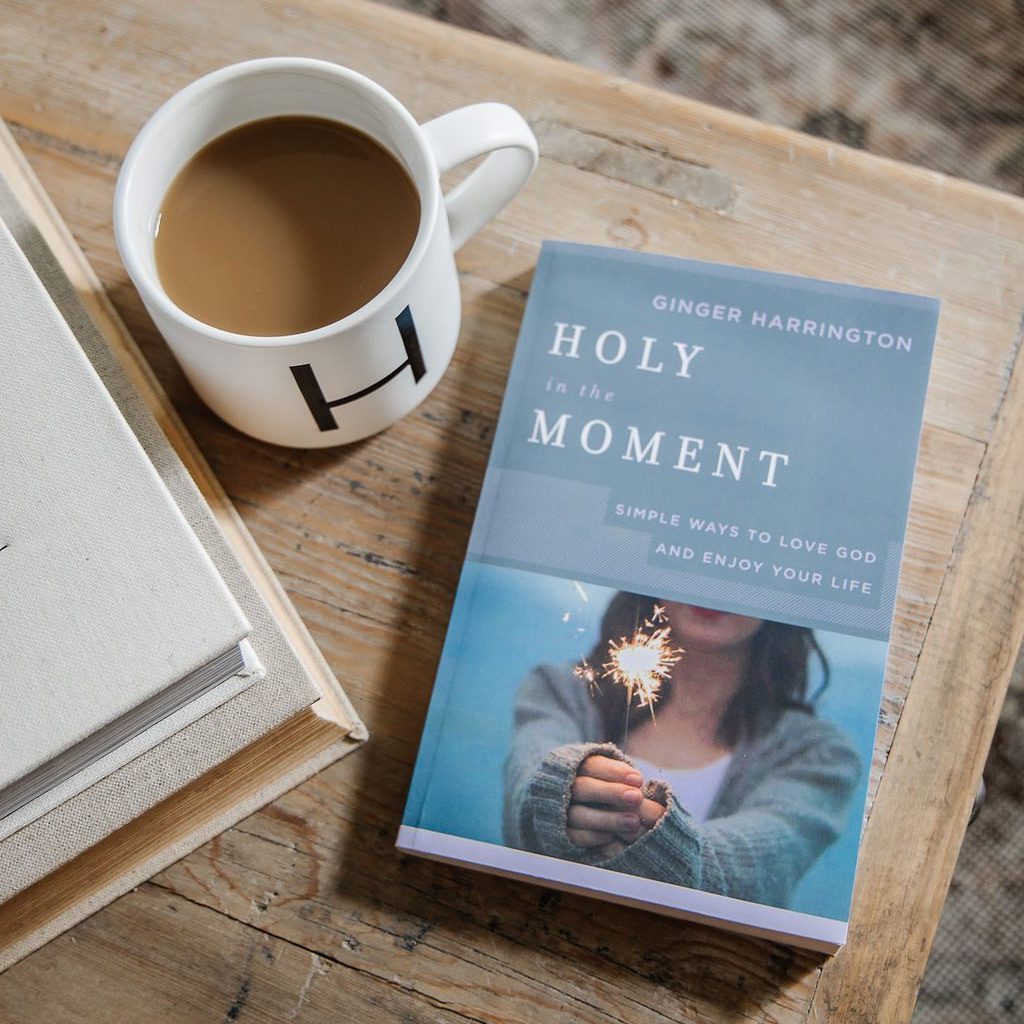
My award-winning book will give you actionable ways to strengthen your faith and overcome the struggles that roadblock spiritual growth. Discover the transforming power of choosing to rely on Christ in this holy moment.
HOLY IN THE MOMENT
Simple Ways to Love God And Enjoy Your Life
My award-winning book will give you actionable ways to strengthen your faith and overcome the struggles that roadblock spiritual growth. Discover the transforming power of choosing to rely on Christ in this holy moment.

SPEAKING
Cultivate a deeper life with biblical wisdom and practical steps to strengthen faith, inspire hope, and transform daily living with healthy choices for body, soul, and spirit. Ginger will help you live fully in your identity in Christ so you can thrive in your beautiful purpose. Learn how to be your best so you can give your best: holy, healthy, and whole.
THE LATEST
THE LATEST

How to Find Friendship When You Feel Lonely (Biblical Hope for Hard Seasons)
Struggling to find friendship when you feel lonely? Discover biblical encouragement and practical steps for making friends as an adult.
Have you ever tried to find friendship when you feel lonely—and wondered why it still feels so hard?
Surrounded by people, you still feel disconnected, unsure where you belong, or hesitant to reach out again. If you’ve wrestled with how to deal with loneliness as a Christian, you’re not alone. Many women struggle with loneliness and finding friends, especially in seasons of transition, loss, or change.
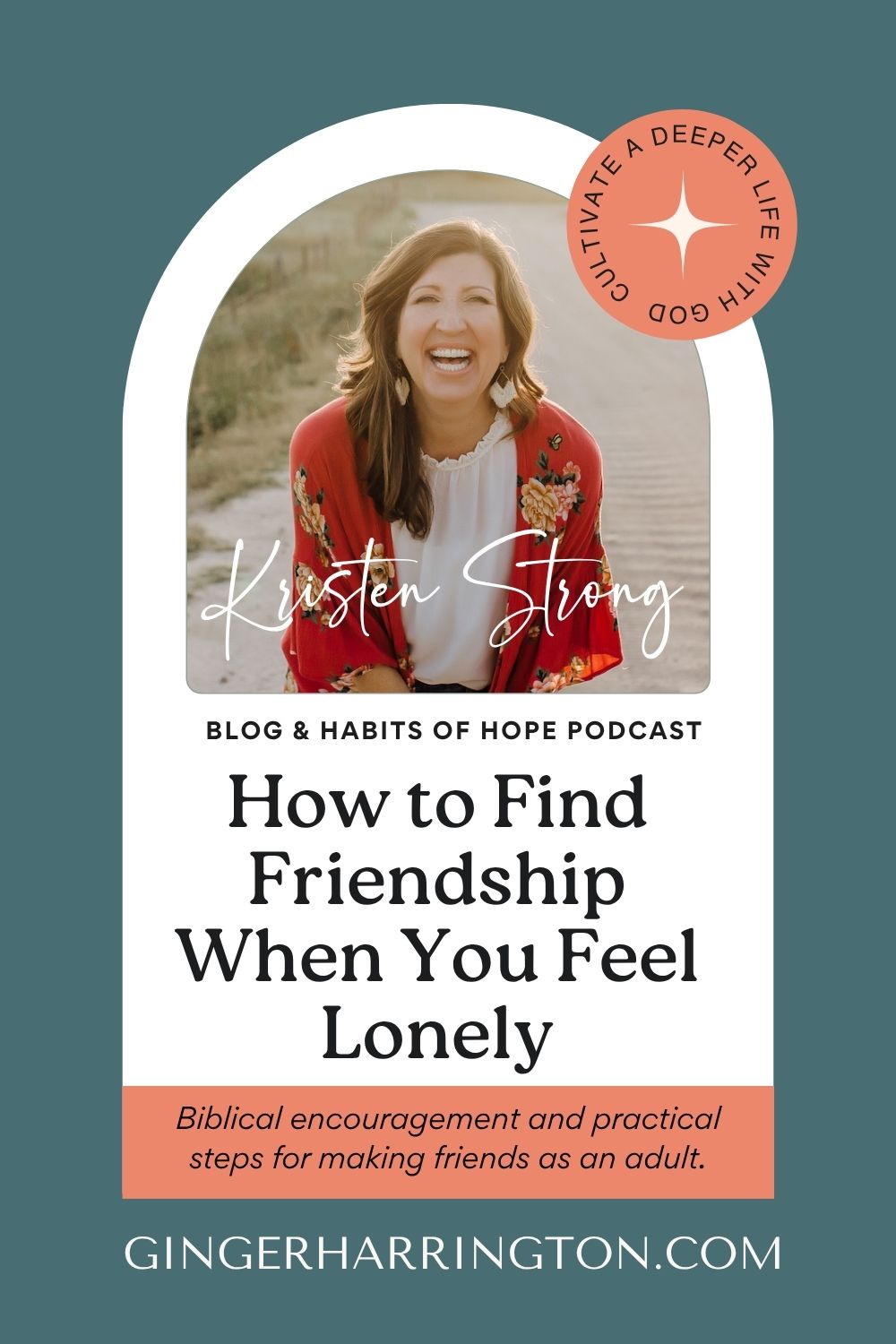
In this conversation, we’re talking with Kristen Strong, author of Desperate Woman Seeks Friends. Join us for an honest look at loneliness, belonging, and what it looks like to build meaningful connection in real life.
Why Is It So Hard to Find Friendship When You Feel Lonely?
Before we go deeper into this conversation, it’s worth naming something many of us experience: loneliness is far more common than we realize—and it’s exactly why this conversation matters so much.
Kristen, what prompted you to write Desperate Woman Seeks Friends?
Kristen Strong:
Honestly, friendship is something I’ve been fascinated with since I first started writing. My very first paid article was on friendship, and it’s always stayed with me.
But this book came from a deeper place. For much of my life, I didn’t feel like I had “my people” in a consistent way—especially locally. Whenever I wrote about friendship, people responded. They were wrestling with it too.
At the same time, research was confirming what many of us already felt—that we’re living in a loneliness epidemic. It really felt like the book I was always supposed to write—it just wasn’t the right time until now.
How Do You Deal with Loneliness as a Christian?
Before we talk about friendship on the outside, we need to look at what’s happening on the inside—because how we understand loneliness and the role our faith plays in it shapes how we respond.
Q: How has your faith shaped the way you think about loneliness and belonging?
Kristen Strong:
My faith has been everything in this. The Lord has taught me that loneliness itself isn’t always a bad thing.
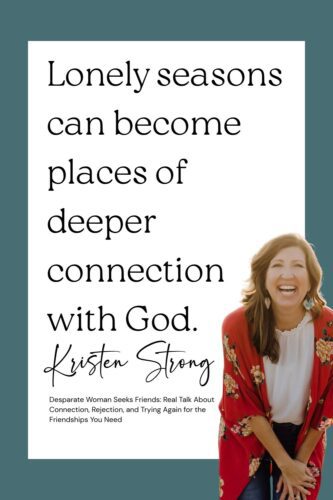
Isolation for long periods isn’t healthy—but seasons of loneliness are part of life. Instead of being afraid of them, I’ve learned to become curious. What is God trying to teach me here?
There was a season when I couldn’t seem to make friends no matter how hard I tried. I even joked that I should stand in my yard holding a sign that said, “Desperate Woman Seeks Friends.”
During that time, the Lord showed me something I didn’t expect. I realized He removed the distraction of friendships so I could go deeper with Him.
And that changed everything.
Because even when friends weren’t there—Jesus was. He is the friend who never fails.
“Sometimes loneliness isn’t just something to fix—it’s a place where God is inviting us to a deeper connection with Him.”
Are We Expecting Too Much from Friendship?
As we move into the realities of friendship, this next part of the conversation brings gentle clarity to something many of us feel, but don’t always recognize. Sometimes the struggle isn’t just finding friends. It’s what we’re expecting those friendships to carry.
Q: Sometimes we depend on friendships for things the Lord wants us to depend on Him for. Can you speak to that?
Kristen Strong:
That’s been absolutely true in my life. I’m a doer, and I like to fix things. For a long time, I looked to friendships to fill emotional gaps that really needed to be filled by God.
I’d finally make one friend—and then expect her to be everything. That’s a lot of pressure for one person, whether we realize it or not.
Over time, I began to see what was happening. I skipped over God, depending on friends to meet my needs. While God works through friendships, He was teaching me to come to Him first.
And I want to say this clearly, because it matters: if friendship feels hard, it doesn’t mean you’re doing something wrong. It’s hard simply because it’s hard.
God uses friendships in our lives—but He also wants to be our first place of connection, the One we return to again and again.
“If friendship feels hard, it doesn’t mean you’re doing something wrong. It means you’re human.”
Why Is Making Friends as an Adult More Difficult Than It Used to Be?
At some point, many of us notice a shift. Friendship doesn’t happen as easily as it once did. The built-in rhythms of school, shared environments, and everyday proximity change—and suddenly, connection requires more effort than it used to.
Q: Friendship seems to be a challenge across every season of life, but it does feel different now. What are you seeing today?
Kristen Strong:
It really is harder in many ways—especially now. We’re more connected digitally, but often less connected personally.
It’s not just about being busy. There are deeper shifts in how we live, communicate, and relate to one another that make friendship feel more complicated in this season of life.
We spend so much time interacting through screens that we’re losing some of the natural, interpersonal skills that used to help friendships form more easily.Starting conversation or reading social cues don’t come as naturally when most of our interaction happens online.
Younger generations especially have grown up this way. They’re often called “digital natives,” meaning they’ve had fewer opportunities to practice face-to-face communication. But honestly, it’s not just them—it’s affecting all of us to some degree.
And then you add in the realities of adult life. We’re no longer in environments where we’re surrounded by peers every day. We’re managing full schedules, responsibilities, families, work. All of that makes connection slower and more intentional.
So yes, it’s harder. But harder doesn’t mean impossible.
It just means we have to approach friendship differently. We have to be more intentional and more patient. We need to be more willing to take small steps toward connection than we may have needed to in earlier seasons of life.
What Are We Getting Wrong About Friendship?
Sometimes the hardest part of friendship isn’t what’s happening around us, but what we believe about it. The assumptions we carry shape how we show up, how we respond, and even whether we try at all.
Q: What are some common myths about friendship?
Kristen Strong:
I think one of the biggest myths is believing it’s harder for us than it is for everyone else.
We assume we should be able to walk into a room and instantly find our people. We think connections should be easy. It’s all too easy to believe something must be wrong with us if we struggle to make friends.
But the truth is, it’s hard for everyone.
Friendship is both an art and a skill that we can develop over time. Some people may have more of a natural ease with it, but no one is born knowing exactly how to build meaningful relationships. It takes practice.
For a long time, I fell into a victim mindset. I would tell myself things like, people already have their friends, or this just isn’t a friendly place, or it’s harder here than it is for other people. And while there may have been some truth in those circumstances, I was letting them become a roadblock.
Looking back, it just took more effort than I was used to. I didn’t always want to give it. Realizing this was a turning point for me.
While friendship may be harder in some seasons or environments, it’s not impossible for any of us. These hard seasons call for intention, persistence, and willingness to keep showing up. Even when it doesn’t come easily.
How Do You Start Building Friendship in a Lonely Season?
This is where the conversation turns toward both honesty and hope.
Q: What would you say to the woman who feels stuck or unseen?
Kristen Strong:
I would say—first, you’re not alone in that feeling. Truly. So many of us have been there, even if it doesn’t always look that way from the outside.
But I’d also gently ask a question I’ve had to ask myself: Am I going deep with anyone?
Because sometimes we can be surrounded by people and still feel lonely. We may have plenty of acquaintances, plenty of conversations, but everything stays at the surface. And often, that’s not because we don’t want deeper friendship—it’s because we’re hesitant to be vulnerable.
We don’t want to share the hard parts. We don’t want to seem like we have struggles. We want to appear put together. But when we stay in that place, it keeps our relationships from ever moving beyond the surface.
In researching this, I read a great book called Made for Friendship by Drew Hunter, and he uses an analogy that really stuck with me. He says we often treat friendship like a cruise ship, where we know a little about a lot of people. But real friendship is more like a submarine, where you go deep with a few.
And that depth requires vulnerability.
It means being willing to share not just what’s going well, but the good, the hard, and even the messy parts of life. And when you do that, it creates space for the other person to do the same. That’s where real connection begins.
So sometimes the shift isn’t finding more people—it’s letting yourself be more fully known by the people already around you.
What Small Steps Help You Make Friends as an Adult?
This is where the conversation turns practical. It’s also where we begin to see how small, intentional rhythms can shape the way we experience connection over time.
Q: Here on the podcast, we love talking about small, practical rhythms that help us live with more hope. Is there one practice the Lord has taught you that has become a habit of hope when it comes to cultivating friendships?
Kristen Strong:
Yes, and it’s so simple.
When I notice something I appreciate about someone, I say it.
It might be something small, like the way she interacts with her child, something she’s wearing, or just something kind I observe. And whether I know her or not, I name it.
That doesn’t mean I’ve become close friends with every person I talk with. Not at all. But those small moments create connection. They have a way of opening the door, even just a little.
They also help me practice being friendly. And that’s really the first step in building any kind of friendship.
Sometimes those small interactions lead to a second conversation. Sometimes they don’t. But either way, they matter. They can brighten someone’s day. Over time, it’s becoming easier to connect with people. Even in settings where I don’t know anyone, I’m more comfortable starting a conversation because I’ve practiced it in small ways.
Most friendships don’t begin with big moments. They begin with small, intentional ones that grow over time.
How Do You Quiet Insecurity and Fear in Friendship?
Even when we take small steps toward connection, there’s often another layer beneath the surface. Old wounds, insecurity, and internal narratives can quietly shape how we show up in relationships.
Ginger Harrington:
I think there are so many internal conversations we have as women when it comes to friendship—wondering if we’re accepted, if someone really likes us, or if we’re being left out. How do we keep those thoughts from taking over and allow each new friendship to be its own story?
For me, some of that goes all the way back to elementary school. I was the girl who got made fun of for being chubby. It planted a message in my heart: people don’t really like you.
It’s amazing how those early experiences can stay with you. Even years later, they can resurface in new situations. And suddenly that old message echoes in our minds.
How do we keep those thoughts from taking over and allow each new friendship to be its own story?
Kristen Strong:
That’s such a real struggle. And even as we get older, while we may care less about what people think than we did in our twenties, it doesn’t mean we stop caring altogether.
I remember being in middle school and having this moment where I suddenly thought, maybe this friend is only here because she has nothing better to do. That thought stayed with me. It made me question whether people really valued me or if I was just a convenient option.
And I think those kinds of messages can stick with us. They can pop up years later in new situations, even when they’re not actually true.
Most of the time, people are thinking about themselves.
We’re rarely analyze everything someone else says. If anything, we’re wondering, Did I say something weird? Did I come across okay?
So much of the pressure we feel is coming from our own internal dialogue rather than reality.
Also, there’s a spiritual component to this. The enemy loves to isolate us. One of the easiest ways to do that is in our thoughts. If he can make us believe we don’t belong or that people don’t really want us around, then we start to withdraw before anything even happens externally.
We walk into a space with a different mindset. When we focus on getting to know others instead of worrying about what we’re going to receive—it changes the experience.
We often leave having received more than we expected.
How Does God Meet You in Seasons of Loneliness?
At the heart of this conversation is a truth we all need to remember, especially in the moments when loneliness feels the heaviest. Kristen points back to Scripture to remind us that our longing for connection is not weakness or failure. It is part of how God made us.
Q: Are there any specific Scriptures or promises from God that have given you hope or wisdom or strength during seasons of loneliness that have been game changers for you?
Kristen Strong:
Yes. One of the passages that has been especially meaningful to me is in Genesis, where God says:
“Then the Lord God said, ‘It is not good for the man to be alone. I will make a helper who is just right for him.’” (Genesis 2:18, NLT)
What stands out to me about that is this happens before the fall, before sin enters the world. And yet God still says, it is not good for man to be alone.
So loneliness is not always a sign that you’re doing something wrong. It’s not simply the result of sin. It’s a reflection of how we were created. We were made for connection.
I also think about Ruth and Naomi and the way Ruth stayed with Naomi. Naomi gave her the chance to leave, but Ruth chose to remain. That story reminds me that friendship can be a place of real faithfulness and perseverance.
At the same time, friendship takes wisdom. It takes two yeses for a friendship to grow. If someone is not open to that relationship, then it’s important to turn toward the people who do see you, who do value you, and who do want to invest in that connection. But there are also times when perseverance matters, and the Lord gives wisdom for that too.
And through all of it, I come back to this: you are not alone in your loneliness.
That feeling does not mean something is wrong with you. It means you are human, and you were made for connection.
But even in the waiting, even when friendship does not look the way you hoped it would, God is present. He has not left you. He has not forgotten you. His presence with you is steady, and His character does not change.
Loneliness may be part of your story, but it is not the whole story. God is still at work, even here.

About Kristen Strong
Kristen Strong is an author, speaker, and encourager who helps women navigate friendship, belonging, and seasons of change with honesty and hope. As the author of Desperate Woman Seeks Friends, she offers a warm and practical perspective on the challenges of connection and the beauty of meaningful relationships.
A former military spouse, Kristen draws from years of transition and starting over to speak into the real-life struggles many women face when building community. Through her writing and speaking, she reminds women that they are not alone and that friendship, while sometimes hard, is always worth pursuing.
You can connect with Kristen at kristenstrong.com or follow her on Instagram @kristenstrong.
About Ginger Harrington
Ginger Harrington is an author, speaker, and host of the Habits of Hope Podcast, where she encourages women to build daily rhythms that help them stay rooted in God’s truth through every season of life. Her work focuses on spiritual formation, resilient hope, and finding God’s presence in the middle of real, everyday moments.
Resources & Links
As an Amazon Associate I earn from qualifying purchases.
- Desperate Woman Seeks Friends by Kristen Strong
- Made for Friendship by Drew Hunter
- Christian Hospitality and Loneliness: How One Invitation Can Restore Hope (Episode 62)
- How to Build Strong Community When You Feel Disconnected (Episode 38)
- How to Love Others Like Jesus: Actionable Steps for Everyday Life (Episode 22)

Why Small Habits Matter More Than You Think (Faithfulness in Everyday Life)
Small habits shape your life through consistency in daily habits, forming patterns that lead to faithfulness in the little things over time.
Have you ever felt like the small things you do each day don’t really matter?
Reading a few verses. Saying a quick prayer. Tidying one space. Taking a short walk. Choosing a better response in a hard moment.
They can feel so small—almost too small to make a difference.
And if you’re honest, it’s easy to wonder if those little choices are shaping anything at all.
But what if those small, consistent actions are the very place your life is being formed?
That’s where this conversation begins. Not with pressure to do more, but with an invitation to be faithful in what’s right in front of you.
Because over time, small habits don’t stay small.
They shape a life.
What Does Scripture Say About Faithfulness in Little Things?
Jesus speaks directly to this in Gospel of Luke 16:10: whoever can be trusted with very little can also be trusted with much.
It’s easy to hear that and think about big opportunities or future responsibilities. But this verse brings us back to something much more immediate.
Faithfulness begins in the everyday.
It begins in the small things you might be tempted to overlook—the next right step, the quiet decision, the ordinary moment.
And if you’re anything like me, that’s a big relief. When I start thinking about the “big picture,” I can feel overwhelmed quickly. But when I come back to what’s right in front of me today, it becomes doable again.
Faithfulness isn’t about managing everything.
It’s about showing up in what’s already in your hands.
How Do Consistent Habits Actually Shape Your Life?
Small habits shape your life through consistent repetition that forms both your thinking and your actions. Over time, what begins as intentional effort becomes natural, creating patterns that influence who you are becoming.
There’s something built into the way we’re designed that supports this.
When you repeat a thought, a response, or a behavior, you begin to strengthen that pathway. What once felt difficult starts to feel familiar. What once required effort begins to happen more naturally.
And that’s why this matters so much.
The small things you repeat don’t just fill your days.
They shape who you are becoming.
Why Consistency Matters More Than Good Intentions
For a long time, I jokingly referred to myself as the “queen of good intentions.”
Maybe you’ve been there too.
You want to grow. You want to be consistent. You want to follow through. But wanting something and actually living it out can feel like two very different things.
And over time, that gap can feel frustrating.
Here’s what I’ve had to learn:
It’s not our intentions that shape our lives.
It’s our consistent actions.
That doesn’t mean intention doesn’t matter. It does. But intention without follow-through doesn’t create change.
What shapes your life is what you repeat.
That’s where habits come in—not as pressure to perform, but to practice faithfulness in the everyday rhythms of your life.
Transformation Involves Your Whole Life
One of the reasons we struggle with consistency is that we often approach change in a fragmented way. It’s not simply a matter of self-discipline. Real change goes deeper than trying harder.
We try to change behavior without addressing our thoughts. We focus on actions without considering our emotions. We attempt discipline without understanding what is happening in our hearts.
But real transformation involves the whole person.
Scripture calls us to love God with all our heart, soul, mind, and strength. This isn’t just poetic language—it reflects how deeply connected every part of us is.
Your thoughts influence your choices. What you think about sets direction for what you choose. Your will—your ability to follow through—is closely tied to what is happening in your mind.
When your thoughts are working against you, consistency becomes difficult. Even when your intentions are good, misaligned thinking makes follow-through feel like an uphill climb.
I’ve experienced this more times than I can count—wanting to build a habit, wanting to be consistent, and yet feeling stuck. Not because I didn’t care, but because something underneath wasn’t aligned.
When these parts are working against each other, growth feels frustrating and slow. But when they begin to align, something shifts. What once felt forced begins to feel more natural. What once required constant effort begins to feel more possible.
If your thoughts say something doesn’t matter, consistency will break down. If your mind is renewed, your habits begin to follow. This is where we move beyond behavior change into something deeper. This is about formation.
Instead of forcing change, we begin to ask a different question: Where might God be inviting alignment in my life?
Because real transformation happens as your thoughts, your desires, and your actions begin to move in the same direction—aligned with what God is already doing within you.
How Small Habits Become Part of Who You Are
At first, every habit requires effort.
- You think about it.
- You choose it.
- You remember to follow through.
But over time, something shifts.
What you practice consistently begins to move from effort to something more natural. It becomes part of how you live.
And that’s a gift, because you don’t have to rely on motivation alone. You’re not starting from scratch every day. The things you’ve practiced begin to support you.
I’ve seen this in small ways over time—areas where something that once felt hard now feels almost automatic.
And it reminds me that growth doesn’t happen all at once.
It happens slowly, quietly, and consistently.
Consistency in Daily Habits in My Life
These habits don’t usually look dramatic. They look like small, faithful choices repeated over time.
For me, one example has been learning to shift from anxiety to trust—especially when it comes to my kids.
My default in the past has often been to worry. To try to figure things out. To carry something that was never mine to hold in the first place.
Through the years God has been helping me build a different pattern. When something comes up, I’m learning to pause and remember that He is already at work in their lives. That I can trust Him. That I can pray differently—not just “fix this,” but “Lord, show me how to walk with You in this.”
That hasn’t changed overnight. But it is changing.
Another area for me has been something as simple—and honestly, as frustrating—as keeping up with the kitchen. There are days I don’t want to do it. Days I fall behind. Days I feel like I’m starting over again.
But I’ve also experienced the difference it makes. Walking into a clean space. Having things in order. Feeling like I can breathe again. It’s not exciting. But it matters.
And those small acts of faithfulness—whether it’s your home, your thoughts, your responses, or your relationships—begin to shape your life over time.
Practical Ways to Practice Faithfulness in Everyday Life
In our podcast conversation, Larissa and I shared more examples of what it can look like to practice consistency in small, everyday ways. These are areas where we are seeing the benefit of consistency bring growth.
For example:
- Returning to journaling in a new way
You may already have a rhythm of gratitude, but then find the Lord gently leading you to go a little deeper. Maybe it’s adding a few lines of reflection or noticing His faithfulness in places that don’t always make it onto a gratitude list. Even a small daily practice can open up space for deeper awareness over time. - Creating a simple “looking forward to” rhythm
In seasons where it feels hard to look ahead, a small habit like naming one or two things you’re looking forward to the next day can quietly shift your perspective. It doesn’t have to be big—just something that helps your heart lean toward hope instead of dread. - Showing up consistently for support and growth
Whether it’s counseling, a trusted conversation, or another space where you’re intentionally processing what’s going on in your life, the habit of showing up matters. Over time, that consistency creates room for clarity, healing, and forward movement. - Taking care of what’s right in front of you
A small task you could put off—but instead, you take a few minutes to do it now. Clearing a space. Finishing something simple. Creating just a little more margin. Those small actions often bring more mental and emotional clarity than we expect. - Reaching out in relationships
Instead of waiting for the perfect time, you make the call. Send the message. Initiate the connection. Even a short conversation can bring encouragement and remind both of you that you’re not walking alone.
None of these feel significant on their own. But over time, they begin to change the way you live. They become the quiet, steady ways you practice faithfulness in the life God has given you.

Why Small Habits Are Worth Building
Habits matter because they help you live out what you value consistently.
- They help you show up when motivation fades—which it does.
- They reduce the constant need to decide what to do next.
- They align your daily life with what matters most.
- And they make faithfulness sustainable.
Because the truth is, we don’t drift into growth. We drift into patterns. And those patterns, over time, shape the direction of our lives.
The good news is that those patterns can change.
How to Start Practicing Faithfulness in the Little Things
This is where it can start to feel overwhelming—but it doesn’t have to be. You don’t need to change everything. You just need one small step. One place where you can begin to practice faithfulness.
It might be:
- pausing before reacting
- taking a few minutes to pray
- clearing one small space
- reaching out to someone
- returning to Scripture
Not perfectly. Not impressively. Just consistently.
And letting the Lord lead you in that process.
Because this isn’t about doing more.
It’s about becoming someone who is faithful in the small things.

FAQ: Small Habits and Faithfulness in Everyday Life
Do small habits really make a difference over time?
Yes—small habits make a significant difference because they shape what you do consistently. Over time, repeated actions form patterns, and those patterns influence your thoughts, choices, and direction. What feels small in the moment often becomes the foundation for lasting change.
Why is it so hard to stay consistent with small habits?
Consistency is often difficult because we focus on behavior without addressing what’s happening underneath—our thoughts, emotions, and expectations. When those aren’t aligned, even simple habits can feel like an uphill climb. Growth becomes more sustainable when your thinking begins to align with truth.
How do I start building a habit without feeling overwhelmed?
Start with one small step.
Choose a habit that feels simple and doable and focus on showing up consistently rather than doing it perfectly. You don’t need to change everything at once. Faithfulness grows when you return to the same small practice over time.
What if I keep starting over and losing momentum?
Starting over is part of the process.
There will be seasons where consistency feels easier and others where it feels harder. The goal isn’t perfection—it’s returning. Each time you begin again, you are still building something over time.
Are habits just about self-discipline, or is there something more?
Habits are not just about self-discipline.
They are one of the ways you participate in what God is already doing in your life. As you practice small, faithful steps, you are not working alone—you are cooperating with His work in you.
Where Transformation Really Begins
Small habits don’t feel powerful in the moment. They feel ordinary. Easy to overlook. Easy to dismiss.
But over time, they shape your thoughts, your responses, and your direction. They become the place where transformation takes root. And as you practice faithfulness in the small things, you begin to see something deeper:
God is at work—not just in the big moments, but in the everyday rhythms of your life.
Habit of Hope
Choose one small habit this week.
Just one.
Practice it—not to achieve something, but as an act of faithfulness. Because when you are faithful in the little things, God is at work in ways you may not even see yet.
If the idea of finding God in the small, everyday moments resonates with you, this is the heart behind Holy in the Moment. It’s a simple, practical guide to recognizing God’s presence and responding to Him right in the middle of ordinary life—where faithfulness is formed one small step at a time.
As an Amazon Associate I earn from qualifying purchases.
References
- The Life You’ve Always Wanted by John Ortberg
- Living in Christ’s Presence by Dallas Willard
- Holy in the Moment by Ginger Harrington

Author Bio
Ginger Harrington is a writer, speaker, and host of the Habits of Hope Podcast, where she helps women build daily rhythms that lead to resilient faith and lasting hope. She is the author of Holy in the Moment and creates practical, Scripture-centered resources to help you grow in your walk with God through everyday life.
Related Content
- How to Harness the Power of Tiny Habits for Spiritual Growth (Habit Stacking)
- 6 Habits of Hope to Increase Your Trust in God’s Faithfulness
- 15 Habits of Rest that will Improve Your Life
- 15 Simple Ways to Overcome Distraction to Focus Your Attention on God
- 6 Healthy Ways to Process Your Feelings with Faith

What Is Holy Leisure? Finding Joy with God Instead of Quiet Time Pressure
Struggling with quiet time pressure? Discover how “holy leisure” transforms your time with God from duty into joyful, life-giving communion.
There are seasons when something meant to nourish our souls begins to feel like pressure.
We know time with God matters, and we truly want it. But somewhere along the way, it quietly shifts—from delight to duty, from relationship to routine.
That’s why this conversation with Cara Ray felt like such a deep exhale for me. Her message about “holy leisure” gently invites us back to something we often forget: God isn’t waiting for our performance—He’s inviting us into His presence. And that changes everything.
Why Does Quiet Time Start to Feel Like a Chore?
Before we dive into the heart of holy leisure, Cara shares how this tension first showed up in her own story.
Ginger Harrington:
You describe yourself as a former “quiet time checkbox checker.” Can you take us back to that season? When did you begin to realize your spiritual rhythms had shifted from delight to duty?
Cara Ray:
I became a Christian very early in life, around six or seven. But as a teenager, I really wanted to own my faith and grow spiritually. I was being discipled to have a daily quiet time, and all of that was very well-meaning.
But it became something I felt like a spiritual failure at.
If I wasn’t getting up early, I wasn’t doing it right. If it wasn’t an hour long, I wasn’t doing it right. If I didn’t have an emotional experience, I wasn’t doing it right.
And that mindset stuck with me for a long time.
Then about seven years ago, I was reading The Celebration of Discipline and came across a phrase—odium sanctum, or “holy leisure.” It described this restful, meditative way of life.
That phrase captured my attention. I realized, this is what I’ve been missing.
I wanted my time with God to feel like something I enjoyed—like going to coffee with a friend or watching a sunset. And I began to ask: Why can’t time in God’s Word feel like that?
I wanted my time with the Lord to feel leisurely… something I enjoy, not something I have to check off.
How Do You Enjoy God Without Pressure in Your Quiet Time?
As Cara began to unpack this idea, it revealed something deeper about how we relate to God.
Ginger Harrington:
I think many of us can relate to evaluating our quiet time—was it good enough? Did I get something out of it? That mindset can lead us into performance instead of communion.
Cara Ray:
Yes, exactly. And I think holy leisure frees us from that.
It becomes a habit—someth building a muscle.
Not every time in God’s Word is emotional or euphoric. Sometimes the Spirit speaks very gently. But as we continue returning, something deeper is being formed in us.
When we remove that checkbox mentality, it changes how we approach God’s Word—and what we receive from it.
“When we remove the checkbox mentality, it changes how we approach God—and what we receive from Him.”
What Is the Difference Between Union and Communion with God?
Before moving into how this plays out practically, Cara introduces a foundational truth that reshapes everything.
Ginger Harrington:
You talk about union with Christ versus communion with Christ. Can you explain that?
Cara Ray:
Our union with Christ is secure. It’s the relationship we have because of what Jesus has done—not anything we do. Nothing can interrupt that.
But our communion—our felt closeness with God—can fluctuate. Sometimes sin or distraction interrupts that flow.
Understanding that changed everything for me. I realized I’m not earning God’s favor by showing up—I already have His favor in Christ. And now I want to enjoy that relationship.
What Is Holy Leisure—and What Does It Actually Mean?
Now that we’ve explored the heart behind it, let’s define what holy leisure actually means—and what it doesn’t.
Ginger Harrington:
For someone hearing this phrase for the first time, what does holy leisure not mean?
Cara Ray:
It doesn’t mean doing nothing.
We often think leisure is passive—like watching TV—but that’s not what I’m talking about. True leisure is an engagement of the mind, the heart, and the will.
It’s a pursuit of what is good, true, and beautiful. And ultimately, that’s what leads our souls into rest.
So rest isn’t about doing nothing—it’s about rightly engaging with what nourishes your soul.
Why Does God Often Do His Deepest Work in Hidden Places?
As we begin to see holy leisure differently, it naturally reshapes how we think about our time with God.
Ginger Harrington:
Why do you think the hidden places—those quiet moments with God—are where He does such deep work?
Cara Ray:
Because that’s where formation happens.
That’s where it’s just you and the Lord. No one else sees it, but that’s where your heart is rooted in Him.
Over time, as you develop those patterns of prayer and Scripture, something steady is being formed in you. And that quiet work begins to shape everything else.
How Does Holy Leisure Help You Enjoy God Without Pressure in Everyday Life?
From those hidden places, Cara describes how this way of being with God begins to overflow into daily life.
Ginger Harrington:
How does holy leisure carry into everyday life without becoming another strategy for productivity?
Cara Ray:
We do have to fight that tendency—we’re wired for productivity.
But holy leisure is about overflow. It’s how your time with God begins to shape your interactions—your home, your work, your relationships.
Sometimes it doesn’t even feel like something you want to do in the moment. But as you step into it, you often discover the joy in it. That’s where the delight begins to grow.
“Holy leisure is not about doing less—it’s about enjoying God more in what you’re already doing.”
Can You Enjoy God Without Pressure Even in Hard Seasons?
This next part of the conversation moves into something we all face—seasons of dryness, suffering, and doubt.
Ginger Harrington:
How does holy leisure speak to hard seasons without offering shallow answers?
Cara Ray:
Those seasons are difficult, and sometimes we don’t even want to go to God’s Word.
But that’s exactly where we need Him most.
In those moments, He meets us. He gives us living water. He awakens our hearts and reminds us of what is true.
Sometimes those seasons of dryness are what draw us closer to Him. And holy leisure gives us a way to pursue God and even enjoy Him in the middle of suffering.
“Sometimes we avoid the very things we need most—but God meets us there.”
How Does God Produce Fruit Through Every Season?
As Cara shares, even the hardest seasons are not wasted.
Ginger Harrington:
How does this journey lead to fruitfulness?
Cara Ray:
I love the image of the vine and branches.
God prunes us—not to harm us, but so we’ll bear more fruit. And that process can be painful.
But over time, it leads to something beautiful—the fruit of the Spirit growing in us.
To bear fruit, we have to abide. We stay connected. We keep returning to God’s Word and prayer. And as we do, that fruit begins to grow.
“To bear fruit, we have to abide—stay connected and keep returning.”
An Invitation to Slow Down and Enjoy God
What I love most about this conversation is how gently it brings us back to what matters most.
Not more effort or better discipline, and not a perfectly consistent routine—but presence.
Because hope doesn’t grow through striving. It grows through communion.
And maybe the next faithful step isn’t to try harder, but simply to slow down and remember that God is already near—and He is inviting you to enjoy Him.
Habit of Hope
As you carry this conversation into your own rhythms this week, begin here:
Open your Bible not as a task to complete, but as a place to enjoy time with the God who is already with you.
Frequently Asked Questions About Quiet Time and Enjoying God
Why does my quiet time feel like a chore instead of something life-giving?
Quiet time often starts to feel like a chore when it becomes performance-driven instead of relational. When we focus on doing it “right” rather than meeting with God, it can shift from delight to duty. Reframing it as time with God—not a task for God—can restore joy.
What is “holy leisure” in the Christian life?
Holy leisure is the practice of enjoying God through unhurried, attentive time in His presence. It’s not about doing nothing—it’s about engaging your heart, mind, and spirit with what is true, good, and beautiful, especially through Scripture and prayer.
How can I enjoy time with God again if I feel spiritually dry?
Start small and simple. Instead of trying to fix everything, return to God’s Word with openness rather than expectation. Even in dry seasons, God meets us. Over time, consistency—not intensity—helps restore connection.
What’s the difference between union and communion with God?
Union with God is your secure relationship in Christ—it never changes. Communion is your experience of closeness with Him, which can ebb and flow. Understanding that your relationship is secure helps remove pressure and invites you to enjoy His presence more freely.
What is one simple way to reconnect with God today?
A practical step is to read a passage like Ephesians 1–3 and notice every phrase that says “in Christ” or “with Him.” This helps anchor your identity in truth and renew your desire to know God more deeply.
Meet Cara Ray
Cara Ray is a writer, Bible teacher, and host of the Writers Block Podcast. She encourages Christian women to slow down, savor Scripture, and enjoy God in everyday life. Cara is the author of The Pursuit of Holy Leisure: Enjoying God in Everyday Places and lives in Gilbert, Arizona, with her husband and family.
Resources & Links
- The Pursuit of Holy Leisure: Enjoying God in Everyday Places by Cara Ray (Affiliate link)
- Visit Cara Ray’s website for more information and content from Cara.