

Pondering Gratitude
Though we celebrate Thanksgiving as a holiday, filled with feasting, family, and friends, thanksgiving is for every day. In reality, thankfulness is an orientation of the heart rather than an activity or event. Thankfulness seeps out of our very...

When Love Runs on Empty
We love, because He first loved us.
If you drive a car without filling the gas tank, eventually you will run out of gas. No brainer, right?
Gas tanks are simple. They require energy in order to function. Watch the gas gauge and you can see when the tank is nearing empty. It’s time to stop and fill the tank. We know this…or if we arent’ paying attention, we discover it when we’re stranded on the side of the road.
Fueling our souls isn’t quite so straightforward, yet hearts need love just as cars require gasoline. We pour time and energy into relationships, service, and work, giving to others. When we try to give what we neglect to receive, it doesn’t take long to find ourselves stranded on detours of disappointment, bitterness, or resentment.
Love one another, even as I have loved you…
Our greatest need.
To be loved and accepted is a deep need of the human heart. We are created to enjoy relationship with both God and men, and love is the need that most satisfies our restless hearts. This new command that Christ gives in the intimacy of the last supper, embraces both the need and the supply.
The first time the phrase, “love one another” is used, Jesus adds a layer of intimacy to the previous command, “love your neighbor as yourself.” Here in the quiet of the upper room, in the last intimate moments with his disciples, he emphasizes the vital importance of loving one another. In fact, Jesus repeats the command to love one another five times on this last night before the crucifixion.
[tweetthis]Love from our brothers and sisters is Christ is a true source of love to meet our needs.[/tweetthis]
Love one another.
The way Jesus has stated this command makes it clear that this is not a one-sided command. As we love one another, no one is left out, no one isolated. Too often we love some, but not others. When we all are faithful to love one another, there is plenty to go around.
Even as I have loved you…
The most important supply that fills our need for love is the love of Christ.
Even as.
I have loved you.
Love for one another doesn’t come always come easy. There are situations and relationships that challenge our ability to love others. When we try to love others from our own resources, we soon run out of steam.
[tweetthis]In reality, the how-to love others is a receiving grace–to receive the love of Christ.[/tweetthis]
We love because He first loved us.
In this is love, not that we loved God, but that He loved us and sent His Son to be the propitiation for our sins. Beloved, if God so loved us, we also ought to love one another. 1 John 4:10-11
Without love, obedience becomes legalism and religiosity. Without love service is meaningless, teaching is noise, and all our efforts are tied to the earth. Even the feat of moving mountains by faith is meaningless without love (1 Corinthians 13:1-3).
We may think our love blazes a trail through the darkest hours and most difficult relationships, but our love is tied to self without the life-giving love of Christ.
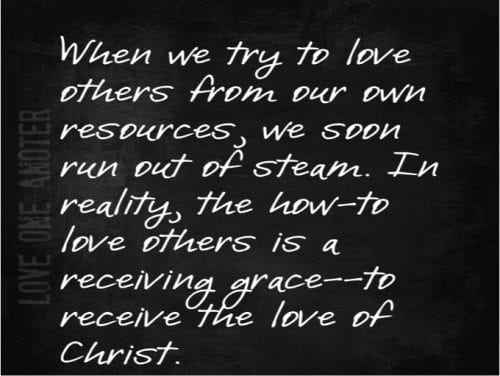
How easy it is to live the trying life of trying to obey God with our own resources. We often teeter between not loving others well with the agape-heart of Christ, or we love them above God. These are the challenges we face when we don’t continually receive God’s love that frees us from the selfish ways of our independent hearts.
Only as we receive and live-abide-dwell in Christ’s love for us can we truly love one another, free from the self-motivations of our flesh.

Oh yes…even as I have love you. This is the power that fuels our ability and desire to love one another.
In the book of John, love is mentioned more times than any other book in the Bible. 39 times God highlights the importance of love. (You can click the link to see all the love verses in John.)
My Father is glorified by this, that you bear much fruit, and so prove to be My disciples. Just as the Father has loved Me, I have also loved you; abide in My love. If you keep My commandments, you will abide in My love; just as I have kept My Father’s commandments and abide in His love. John 15:8-10

In this vital commandment, Christ reveals our deepest need, highest goal, and greatest gift.
Last Words on Love Are Not to Be Forgotten
My face flushed with shame. “I can’t sit across the table and pretend this never happened,” a friend recently admitted.
I have hurt a valued friend. I never intended to alienate my friend, but now there is misunderstanding and resentment where friendship used to be. It is partially my fault. I have neglected their concerns, presuming everything is okay beneath pleasant smiles that mask resentments hiding in silence.
The problem is silent no longer and the discord opens a thin, hurting place in my heart. Guilt leans over my shoulder, whispering, “Who do you think you are? You have no business, no right, to write about loving others.”
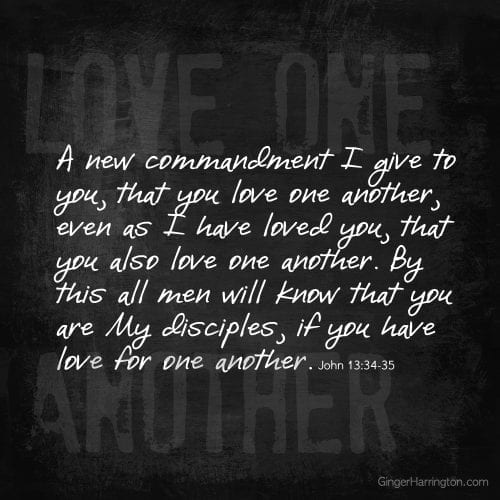
I read this verse and squirm at the times I’ve blown it. I begin to tap out words about love on this keyboard and feel a bit like a child playing dress up.
I cannot write these words from a perspective of giving advice, for loving others has hard moments and I fail frequently.
Jesus could have talked about many things on this last evening with the disciples. They could have spent the time reminiscing the many stories they had lived together. He could have explained in great detail what was about to happen. He could have reviewed three years of teaching.
But last moments are for the heart and Christ leaves his disciples with one last, powerful lesson on love.
Moments before, He has washed the feet of his students, turning social norms upside down. With the power of example, Christ shows his friends the importance of serving one another with humility.
[tweetthis]Heart trumps position in God’s economy.[/tweetthis]
A new commandment–from the position of a servant, hands wet with the dirty water, Jesus opens a fresh perspective on a familiar topic. A commandment is not an option, suggestion, or choice. These are words to be obeyed. Words to be lived.
Why does Jesus close out his time on earth, his last peaceful moments of friendship, emphasizing the importance of loving one another? These are the last moments before the world will rise against him with the harsh words chanted by frenzied crowds, “Crucify him, crucify him!”
When we dig beneath the soil of our ambitions, our greatest need and our deepest struggle is to love and be loved. “Love me,” is the cry of every heart. “Am I loved? Am I loveable? Am I worth loving?” is the question that hides in every motivation, desire, and conflict.
Why this lesson on love?
- Because love is hard and love is necessary. Like oxygen, we can’t live without it.
- Because love is where life is lived, salvation worked out, and victory won.
- Because loving God and loving one another is the one foundation we cannot do without.
Without love, obedience hardens into legalism, performance, and religiosity. Without love, service is meaningless, teaching becomes noise, and faith misses the point.
[tweetthis hidden_hashtags=”#loveoneanother”]Without love we are bankrupt souls and our greatest work turns to dust in the light of eternity. [/tweetthis]
Really, what else is there to talk about?
A picture of God’s heart
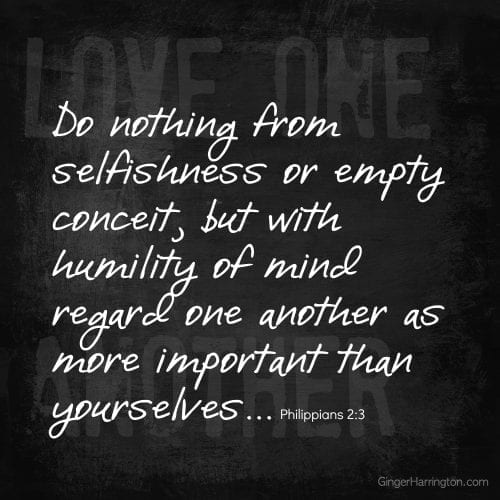 Through Christ, God shows us the core of his heart and what is most important to him.
When it comes to loving others, we teeter between not loving others well or loving them over and above loving God. Either way, we stumble with unsteady steps.
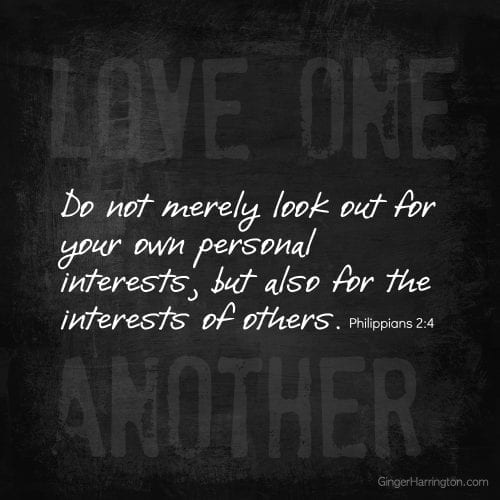
This side of heaven we are going to struggle to love God and love one another.
“He who began a good work in you will perfect it until the day of Christ Jesus.” Philippians 1:6
Maybe you are ready to wring your hands and shake your head in discouragement thinking, “it’s going to take a lifetime to learn to love God’s way.”
[tweetthis]What happens when we accept the fact that we cannot love and live God’s way on our own?[/tweetthis] Look at it from a different perspective–he is never done, never gives up on us. God will keep working in us and throughout our lives He will teach and train, convict and comfort, convince and empower us to keep growing step by step and day by day.
God loves with no limits or quotas. Every single day we have a fresh opportunity to lay aside the un-love-liness of our flesh, our do-it-myself-please-myself striving to feel loved and get our way.
How often have we tried to live as Christ’s disciple, trying to love others better?
Trying to do the right thing.
Trying to love God and do all the doing.
The try-hard life depends on our own resources. We cannot simply improve our behavior and do better, for matters of the heart will not be constrained to human effort.
Before we can love one another, we must begin with these words…
…even as I have loved you.

As I remember my own struggles to love and be loved, it is easy to forget love begins with God. It is only in the context of God’s love that my love has any hope of being real and true.
We love, because He first loved us.
This is the third post in a series on John 13. You can read the first two posts here:
Five Powerful Truths About Discipleship to Embrace Today
Knowing + Doing = Blessing
We sat down at the table, the steam rising from bowls of homemade soup. I looked across the table at my friend, a mom of four children with a world of experience. Pregnant with my first child, I was grateful for the time to learn about this mothering role. I had no clue how to be a parent.
I could barely take care of myself.
Lyn spent many lunches with me. Watching her care for children and manage a home was a living education I could have never learned from a book.
There is great power in example, being in the moment and watching firsthand.
If I then, your Lord and Teacher, have washed your feet, you also ought to wash one another’s feet. For I have given you an example, that you also should do just as I have done to you…If you know these things, blessed are you if you do them. John 13:14-15, 17
The big IF.
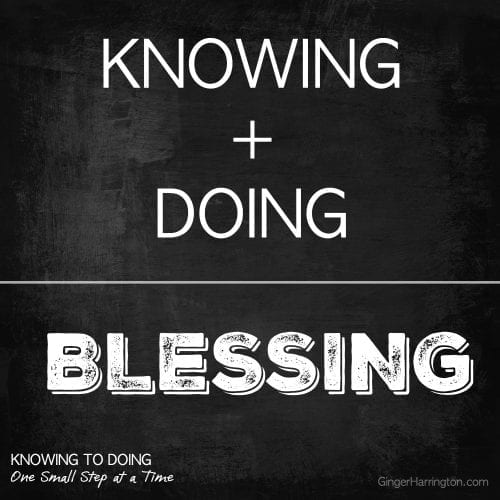
Knowing and doing are two completely separate states. You cannot DO without the KNOWING, but it is all too easy to KNOW and neglect the DOING.
Setting an example of humble service, Christ instructs his disciples on the importance of washing one another’s feet. If you know…this knowing is a seeing, experiential thing. Perceive, notice, discern, discover, pay attention are a few other traits of this word.
KNOW +DO= BLESSING
Easy, right?
The problem of IF
Knowing and doing are not a given. The privilege of choice is a crucial part of obedience. Following Christ and obeying His word is always a choice.
If is a word of possibilities and choices. It is also the gap between the knowing and the blessing, isn’t it?
Knowing is not enough by itself. You can’t know yourself into heaven, and you can’t know yourself into caring for others.
[tweetthis]Knowing is nearly a dead thing, having no power to produce life or motivate love. #applyGodsWord[/tweetthis]
It is the doing that changes everything.
A little later on this same evening of the Last Supper, Jesus explains more about this blessing that comes with obedience:
Whoever has my commandments and keeps them, he it is who loves me. And he who loves me will be loved by my Father, and I will love him and manifest myself to him.” John 14:21
Knowing AND doing brings the blessing of deeper intimacy with Christ.
This may seem just a little too basic.
We know we are blessed when we obey Christ’s commandments, but knowing doesn’t have the power to move our stubborn hearts to action. Somewhere between knowing and doing, we can run into a world of problems.
This is a very real issue in today’s information-junkie culture. We skim and scan incredible amounts of information. We have more Bible study material and more Christian books, talks, videos…more information than any other generation in all of history.
Yet how many times have we walked out of church, already forgetting the meaning of the sermon? Have you looked at a Bible study you completed a year ago, straining to remember specific truths you learned? I have.
This is our need for discipleship, to learn by seeing and living life together. [tweetthis]It is only in the doing that the knowing sticks. #applyGodsWord[/tweetthis] Embrace the value of taking shaky steps together for discipleship is relational. In the community of discipleship, we create a culture of intentionality and authentic obedience.
Here are a few ideas that help me move from KNOWING to DOING:


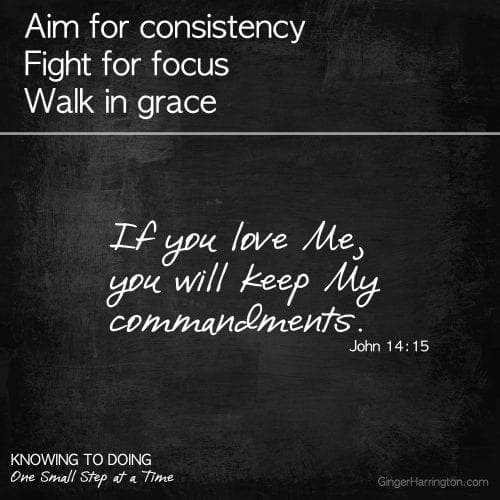
 Try these Action Starters
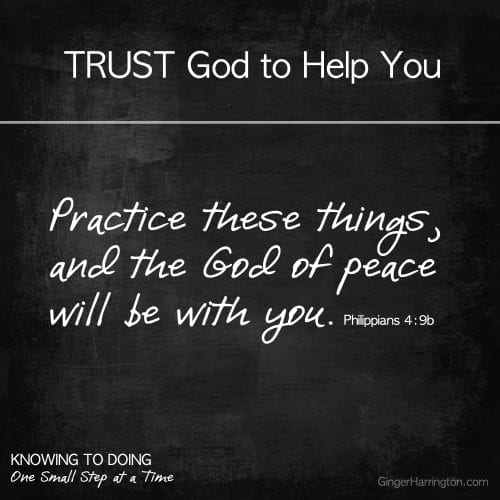 Try these Action Starters
- Ask a question
- Call a friend
- Choose patience
- Confess a sin
- Create a list
- Do a good deed
- Keep Going
- Evaluate a problem
- Explore an idea
- Forgive someone
Which one of these could you try today? What would you add to this list? Leave a comment and join the conversation.

Five Powerful Truths About Discipleship to Embrace Today
Don’t reduce discipleship to a dry concept stuffed tight with information that withers unused on the back shelves of our lives.
There is life to be lived well in the reality of being a disciple. God wants to teach and train us how to live and love with joy and authenticity.
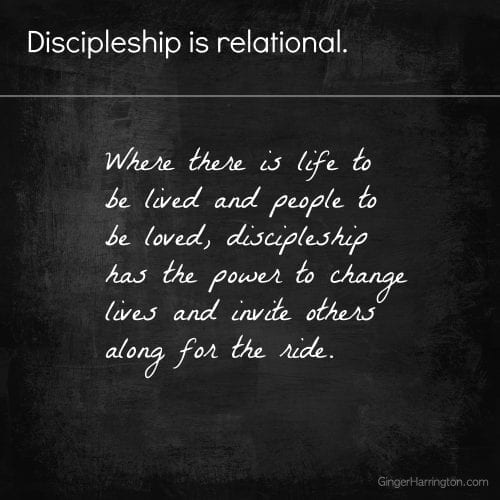
Discipleship is relational.
You see, here’s the plain, hard truth…we never outgrow our need to keep learning to love. And this is the heart of discipleship nestled into the divine lap of relationship.
Where there is life to be lived and people to be loved, discipleship has the power to change lives and invite others along for the ride.
As long as we struggle to love God and love others, as long as we hold onto the voracious hunger for significance gained through self-striving–we need discipleship.
…………………………………………………………………………………………….
Evening settles as men gather around a table for dinner. They do not yet know these are last moments carved out of time to have one final lesson with the Master.
When Jesus knew that his hour had come to depart out of this world to the Father, having loved his own who were in the world, he loved them to the end. John 13:3

[tweetthis]Discipleship begins and ends with loving others.[/tweetthis]
It is a time of sharing love and enjoying time together—this Jesus kind of love sticks to the end. It doesn’t skitter away when the hard hours arrive, for God’s love doesn’t end and never fails.
Jesus, knowing that the Father had given all things into his hands, and that he had come from God and was going back to God… John 13:3
Secure in his identity and purpose, Jesus holds the power and authority of God in his hands. Anything He could need or want is at his disposal. So what he does next is radical and completely unexpected.
Discipleship should never be boring and expected.
He “rose from supper. He laid aside his outer garments, and taking a towel, tied it around his waist. Then he poured water into a basin and began to wash the disciples’ feet and to wipe them with the towel that was wrapped around him. John 13:4-5
In our make-it or break-it world, a basin of dirty wash water and a gritty towel stand stark in contrast against the “all things” Jesus holds in his hands. Willingly he places himself in the position of servant, the one with the most menial of tasks–to wash the feet filthy with the dust of the road and the sludge of life.
Jesus gets up from the table, leaving the comfort of a good meal as he purposefully lowers his position.
Discipleship is intentional.
Active and involved, discipleship doesn’t shy away from the mess and the sin. [tweetthis hidden_hashtags=”#discipleship”]You can’t sit back and do your own thing if you are going to help others grow closer to God.[/tweetthis]
Do you know what I have done to you? You call Me Teacher and Lord; and you are right, for so I am. If I then, the Lord and the Teacher, washed your feet, you also ought to wash one another’s feet. For I gave you an example that you also should do as I did to you. John 13:12-15
Washing filth from feet, these are the actions of God as he demonstrates one last lesson on the wonder of love. Example becomes the tool–learning in the living, actions bring words to life and we will never be the same.
Knowing the moment of his betrayal by one of his own is set in motion, still Jesus washes feet that walk across the heartache and trouble of this world gaping wide with sin.
Discipleship serves with humility.
The example, the position and orientation from which Christ gives his last instructions cannot be separated from the lesson about loving God and others.
- When it comes to discipling, we cannot teach from a removed, lofty position, with an I’ve already got this attitude.
- We get up from the table and get down on the floor. We must be in the midst of living out the lessons—showing by example that comes alongside rather than stands over.
- There is no preaching in this moment. Isn’t it easy to preach and teach and lecture on what we know, pointing out what they should do? We must resist pushing standards down on people, setting rules and enforcing consequences. Our broken world works like this, sometimes even in the church.
- When we live the example, there is an authenticity that doesn’t come from being the experienced one or the expert. It is the influence of sharing and practicing what we’ve learned right in the work and mess of life.
What we do is far more powerful than what we say.
We cannot teach God’s children from a position of serve me or an attitude of laziness. We can’t disciple from the stance of wearing success and experience like a badge of authority and honor.
Jesus teaches his most powerful lesson from a position of extreme humility and so should we.

Trusting God: A Guest Post
. In God We Trust “In God We Trust.” It says it right on the dollar bill. But what about those times in our lives when we desperately need answers and can’t find them? Or when we are scared to do what we think God is calling us...

Are You Using Your Spiritual Gifts?

1. You have a gift.
Yes, you! As a believer in Christ, God has given you a spiritual gift. When it comes to calling and gifts we are often far more concerned with what we think we can’t do, rather than with what God can do.
Remember Moses, staring into the hot flames of the burning bush, conversing with God? God calls Moses to be a messenger, and Moses’ gut-level response is to object, “Who am I?” He continues, “What shall I say to them? What if they don’t believe me?”
Next Moses brings up the reason why he can’t do what God has asked–I’m not good at talking to people–I am slow of speech.
For every I’m not Moses gave, God responded with an I am–I AM who I am.
[tweetthis]God is with you, so be brave and use the gifts He has given.[/tweetthis]
2. When God calls, feeling ready is not the issue.
The Lord said to him, “Who has made man’s mouth? Or who makes him mute or deaf, or seeing or blind? Is it not I, the Lord? Now then go, and I, even I, will be with your mouth, and teach you what you are to say” (Exodus 4:11-12).
There is a powerful lesson contained in what some only consider a children’s story. What a struggle it is for me to get this past my head and into my heart. We forget that He has promised to provide for us in the process. It is only in stepping forward that we experience God’s equipping grace.
3. Don’t give into fear.
God has not given us a spirit of fear, especially when it comes to using our gifts. Yet so often, some form of fear or discouragement can derail our desire to boldly answer God’s call. When we compare our ability, evaluate our performance, measure our opportunities, we can struggle to believe God will use us right where we are.
The first time I was asked to speak to a group of women, fear rushed in and I wanted to say no. When God called me to take the spiritual leadership of a women’s ministry, I didn’t think I was qualified. I had a fist full of excuses.
In January 2014, Kori Yates approached me about starting a non-profit ministry for military women. I was interested, but the scope of the vision God gave was intimidating.
God has provided choices to serve in every place we’ve lived. Every time, some level of fear made it tempting to hold back. In every call, God gave what was needed and developed my gifts in the process of serving.
If we let fear hold us back, we forfeit the opportunity to grow through using our spiritual gifts.
4. It’s all about God.
I have had many conversations with God about this over the years. One conversation made it into the worn pages of my journal–words stretched tight over frustration and discouragement.
I call you and it is not because of what you have done or what you can do. Neither will it be inhibited by what you can’t do.
Each gift comes with My purpose and grace.
Know that I will show you what, when, where, and how. You don’t have to make it happen all on your own. Dance in your gift through a partnership of faith, for it is…
My gift.
My calling.
My purpose.
My grace.
The responsibility is on Me.
Your job is to learn and obey,
love and listen,
follow and participate,
release and rejoice.
Day by day and step by step follow me.
If your eyes are on me, you don’t have to figure out what is next.
Be encouraged Sisters. God has given you the gifts you need to serve God right where you are.
Use your gifts and enjoy the process!
This post first appears at Planting Roots. Continue reading at Planting Roots.
How has fear effected you when it comes to using your gifts?
The Reason We Let Them See: A Guest Post by Dr. Deb Waterbury
My youngest son, Miles, and I have a unique mother/son relationship. We most definitely relate on a familial level, but also he appreciates my counsel. As a minister, much of what I do for women is counsel, but rarely does a parent experience that sort of relationship with her child. Miles, on the other hand, seeks my counsel. And understand, I do not mean simply my advice. At twenty-six, he still comes to me for solid counsel on every topic imaginable.
Needless to say, I love that he does so. However, it has also presented some very touchy situations between the two of us, situations where I have found it necessary to be a little more honest than I would ordinarily be comfortable with when speaking to my son. I know the value of transparency as a teacher and as a counselor, especially in terms of my walk with God, but that transparency recently took on an entirely new level in a recent conversation I had with Miles.
Going through tough days.
He was going through some tough times in his life. He very candidly asked me how God could ever want anything to do with him considering some of the things he had done. My husband was out of the country and my oldest son was working that day, so Miles and I were headed to Easter lunch at a local Chinese restaurant we both wanted to try.
I had him all to myself, and on the flip side, he also realized he had me all to himself. As I looked into his sweet and troubled eyes, I saw myself so very clearly. I saw the doubts I’d had so many years ago, doubts about how a God who literally knew not only every vile deed I had committed but also every disgusting thought I’d ever had could love me, much less use me to His glory.
Set free.
I remember thinking that my deeds disqualified me for service; they disqualified me from anything except condemnation. And here’s the kicker: to most people, they did. After the life I lived became more of a public exhibition rather than a private prison, most people felt that my deeds disqualified me from everything. It took me many years to understand the love of a Savior who not only died for those sins, but actually knew about those sins before I committed them. His response in that knowledge was not to condemn me but to go to the cross to pay the penalty I deserved. That love is astounding, and finally understanding it freed me from the condemnation brought on by others and myself.
Now I was looking into the sweet green eyes of my son, eyes that were wet with tears I understood, and I wanted him to know what I knew. I wanted Miles to know that Jesus went to the cross knowing him, choosing him, loving him, and then willingly dying for him in spite of all of that because Miles is His.
Blessed be the God and Father of our Lord Jesus Christ, who has blessed us in the heavenly places, even as he chose us in him before the foundation of the world. (Ephesians 1:3-4)
Miles has always been His and therefore is qualified for service to Him.
The gift of transparency.
I was immediately aware of a truth I learned long ago as I’ve looked into so many eyes like my son’s over the years: I have to be transparent about my own sin so that others might know the unconditional, ever-present love of Jesus Christ, the Son of God and the Savior of His people. I needed to share with my son a concrete truth about my own past so that he could know and believe that sin doesn’t disqualify us for service.
If it did, there would be no one to serve.
Transparency is difficult. Once we pull back the curtain that we all safely hide behind in our day to day lives, we run the risk of rejection. There will be some who simply don’t like what they see behind that curtain, even if it is in the past, and they will either run from us or try to get others to do the same. That will happen, but it only happens rarely. What usually happens when I am transparent about my own sin is freedom from the bondage of isolation that sin and the knowledge of sin places on the woman with whom I am sharing. Often we think that our sin is too great or too horrible to be forgiven or to be passed over, even by the blood of Jesus, so we hide it or we cower under it.
Hiding no more.
What I loved as I looked into Miles’ tear-filled eyes is that he decided he didn’t want to hide anymore. Miles wanted to know how to get out from under the blanket of condemnation that was paralyzing him, so he asked me a very pivotal question. How was I going to respond?
When I’m asked that fateful question, “How can a person like me ever be used in God’s kingdom,” I know the door has cracked open a bit to freedom. The decision is always mine at that point whether or not to allow them to see behind my curtain and risk the pain of condemnation. I could do that or I could placate them with words of encouragement that inevitably heal nothing. Will I let them see? Was I going to let my son see who I am so that he can see the love of a Savior and King who forgives?
Courage to share.
The answer, of course, is yes! I told him of a time many Easters ago when I sinned so grievously that I had never spoken of it since. I told him that I carried that sin with me for many, many years, certain that not only the gravity of the sin, but the hypocrisy of committing it on Easter and then going to church and leading worship as if nothing were wrong was definitely enough to disqualify me for service.
As my tears ran freely to join his, I then reminded him of what God allows me to do today. I reminded Miles of how God graciously has not only forgiven my sin, but that He knew even then that one day I would be able to be transparent about my sin with thousands of women all over the world so that the freedom available only in Jesus’ sacrificial atonement would be made known to them as well.
Letting others see.
I reminded him of Paul and David and Peter and Abraham and of how God uses the least of us to show His magnificent glory. As we cried together, driving to a little Chinese restaurant in Tucson, Arizona, I let me son see me, just as I’ve let many other women see me, knowing that I might be slain for it. That’s a risk I’ve become more than willing to take. How can I be willing to do less in the face of what Jesus did for me? I am willing to be slain verbally by the few so that I might be an instrument in saving the many.
[tweetthis]Jesus was willing to be crucified by the few so that He would save the many.[/tweetthis]
But he was wounded for our transgressions; he was crushed for our iniquities; upon him was the chastisement that brought us peace, and with his stripes we are healed. (Isaiah 53:5)
Some will not understand.
There have been plenty of times that I have stood on stage and shared portions of my past with a group of women and that those facts have fallen on ears that no longer want to listen because of them. I understand that. But my reputation has become nothing in comparison to the freedom my transparency has provided for exponentially more women who have isolated themselves in a prison of guilt and despair because of their own sin.
If my past does not serve my Savior, then it is of no value. But if it serves to release the chains of bondage that condemnation invokes, then I rejoice in sharing, even if I am slain by the few.
Miles and I had a wonderful Easter lunch of dumplings and Chow Mein, but more importantly, we had a blessed afternoon of bonding in our freedom in Christ. I have no regrets about sharing with him that afternoon, nor will I have any compunction about doing so again if necessary. My reputation and what others think of me no longer rate in comparison to the beauty of letting even my past sin work to the glory of my Savior.
How important is your reputation to you?
Are you willing to be slain by the few so that you might be an instrument in saving the many? If you are, then make your past worth something more than a story or a rotting skeleton in a closet of despair. Make it the balm that soothes another hurting sister who can’t get past her own past. Make it about Jesus. You know, it is anyway…
Dr. Deb Waterbury is the President of Love Everlasting Ministries. In her desire to spread the truth that all Christians share an intimate relationship with Christ as their Bridegroom, Dr. Deb travels extensively, both nationally and abroad, leading conferences and teaching seminars at every opportunity. She has a special heart for the people of Africa, devoting much of her year to speaking in several countries there. Likewise, Dr. Deb is committed both to the women of her community as well as those in the United States, vehemently proclaiming that “God’s children are intimately loved by the Lord of lords and the King of kings!”

From Frantic to Settled: Inner Room Living in a Busy Life
When Martha Learns to be Mary
My brain is always working, spewing out thoughts and feelings. When my brain isn’t in conversational overdrive, activity is the name of the game. Doing and productivity push me to want to conquer my never-ending tasks.
Sometimes the better thing is to be still. The better thing is to listen rather than jibber on. The better thing is to step away from the pressure of my day and enter in to sacred secrecy with God.
Jesus said to a frantic and frazzled Martha–the one I know–the one trying to get it all done and get it all right:
You are worried and upset over all these details! There is only one thing worth being concerned about. Mary has discovered it, and it will not be taken away from her.–Luke 10:41-42.
How opposite from the demands of the day and the drive of this performance-crazy world. Jesus cuts through all the stuff that crowds us–the worry and stress, the doing and finishing, the external and temporary.
What secret had Mary discovered? What formula for delivering the soul and redeeming the day?
[tweetthis]Discover the secret of being present WITH Jesus.[/tweetthis]
Rest in the LORD and wait patiently for Him… Psalm 37:7
Sacred secrecy takes place in our inner room, that inmost heart, present and intimate with Christ. This is our holy of holies.
We need to cultivate sacred secrecy with God–not as in we should, but as in we really need it.
But what to do on those harried, chaotic Martha days?
Nothing is finished, the house is a wreck, and there is no quiet to be found. How do we get to this resting place when kids are crying and people are asking?
How does Martha learn to be Mary?

[tweetthis hidden_hashtags=”#loveGod, #innerpeace”]We need inner-room living in a busy world.[/tweetthis]
What if my inner room is a condition of the heart, rather than a space on the schedule, a place in the house, or a formula for spiritual growth?
For so long, I thought time with God had to be a certain way with a specific time and formula. It had to be quiet, with everything else stopped and put away. Too often, that quiet didn’t come.
And I felt guilty.
I felt lacking and displeasing to God.
I felt like a spiritual failure, as if God was depending on me to do everything just so.
The true secret to intimacy with God.

What if we learn to be present WITH God in the midst of the quiet moments as well as the busy times? What if we learn the secret of living WITH God, rather than working for God? WITH, that communion of spirit, enables us to pray, speak, work, and play with God–no lines and no divisions between sacred and secular, between doing and being.
As Martha learns to be Mary, we can learn to live like a monk long ago, who learned sacred secrecy in the doing of life:
WITH–the sacred secrecy of living with God–Mary and Martha can come together.
What helps you to choose the better way?
Other Posts from this series:
Four Reasons Serving Others Can Make You Resentful
Are You Busy, Worried, and Bothered?