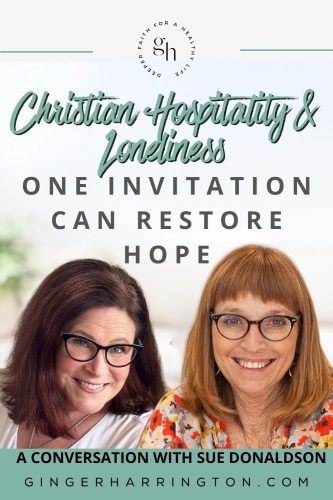
Discover how simple Christian hospitality can ease loneliness. One invitation can restore hope and build meaningful, faith-filled conversation with Sue Donaldson.
“Loneliness is at an all-time high.” I said those words as we opened this episode of the Habits of Hope Podcast, and I feel them deeply.
We are more connected digitally than ever—scrolling, liking, and DM’ing—but so many of us feel isolated and unseen, especially as the holidays approach. Underneath the full calendars and online noise, there’s a quiet ache:
Does anyone really see me?
What if one of God’s simplest answers to that ache is invitation?
Today I’m talking with Sue Donaldson—retreat speaker, author, podcast host, and hospitality mentor—about how Christian hospitality and loneliness are woven together, and how God can use our imperfect homes and ordinary meals to become a “never alone” kind of place.
Her new book, Never Alone: Stories of Invitation and Connection in an Isolated World, is packed with hope-filled stories and practical wisdom on living a life of welcome. In this conversation, she pulls back the curtain on her own loneliness, her first hesitant invitations, and the simple, doable ways we can practice hospitality as Christians—even when we feel tired, introverted, or insecure.
When You’re the One Standing Alone in the Parking Lot
Sue’s passion for hospitality didn’t begin in a picture-perfect home. It started in a church parking lot.
Single into her thirties—back when that was less common—she remembers standing alone after church while families packed kids into vans and headed home.
“I knew the people in my church loved me… and off they would go… and I thought, Why didn’t they invite me over for lunch? Because I needed a family to be in.” — Sue Donaldson
They liked her. They weren’t unkind. They just assumed she had an exciting single life. The truth? She was lonely and needed an invitation.
That ache became a holy nudge: What if I’m the one who invites?
Instead of waiting to be welcomed, Sue picked up the phone and called six women from church—each married, each with young children—to invite them to a Saturday brunch.
“I didn’t make very much money and I wasn’t Julia Child or Martha Stewart… but I could read. So I could read a recipe.” — Sue Donaldson
They were busy, but they came. Those simple brunches became a turning point. Those women became mentors. And Sue discovered that when you’re lonely, sometimes you have to make the first move.
That’s the quiet courage of Christian hospitality: not just waiting to be included, but asking God who you might invite.
Every Relationship Begins with an Invitation
As we talked, I returned to a line from my book Holy in the Moment that frames this entire conversation:
“Every relationship begins with an invitation.” — Ginger Harrington
An invitation doesn’t have to be complicated. It can sound like, “Hi, I’m Ginger,” or “Would you like to come for coffee?” Or even, “We’re having leftovers—want to join us?”
Sue shared how a simple question opened the door to lasting connection. After noticing a group of college students at church—and a college-age server she met at brunch—she asked about their lives and learned one young woman was a missionary kid who wasn’t currently attending church.
So Sue extended an invitation:
“Hey, you want to come for dinner a week from Tuesday?” — Sue Donaldson
All four young adults showed up. They shared their stories around her table, and one of those women became a close, long-term friend.
Sue traces moments like these back to the heart of God:
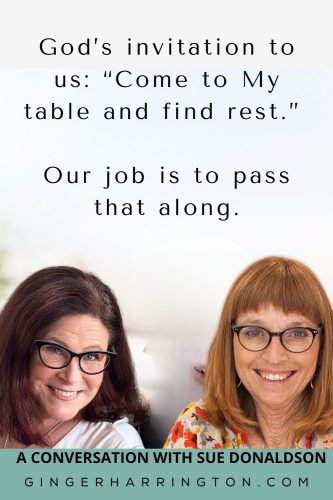
“God’s invitation to us was, Come to my table and you’ll find rest. And so our job is just to pass that along.” — Sue Donaldson
This is where Christian hospitality and loneliness meet—not in perfection, but at the table, in the story, and in the simple word come.
Loneliness as an “Unnecessary Disease” — and Hospitality as a Cure
At one point in our conversation, I referenced something Sue often says—that loneliness is an unnecessary disease, and simple hospitality can be part of the cure.
So what does God’s heart actually say about welcoming others?
Sue pointed us straight to Scripture:
“God’s word says, be hospitable without grumbling. And that’s not a command to a few—it’s a command.” — Sue Donaldson
Hospitality isn’t reserved for especially gifted believers or polished homes. In the New Testament, it’s a calling for all of us—not to impress, but to reflect God’s welcoming heart.
“You don’t have to go to seminary… You just have to go across the street and invite your neighbor over for banana bread that you didn’t even bake.” — Sue Donaldson
If you’re in a quieter season and wondering What now?, this may be one of God’s simplest answers:
Open your door.
You don’t need culinary skill or Pinterest perfection. You can buy dessert, host a potluck, serve leftovers, or invite someone for toast and coffee after church.
“You don’t have to like to cook to obey God… There’s one reason to do hospitality anyway—showing off God’s welcoming heart to someone who just needs to be invited.” — Sue Donaldson

Simple Christian Hospitality Ideas (That Don’t Require Perfect Anything)
One of the biggest barriers to practicing hospitality is perfectionism.
We tell ourselves, My house isn’t ready. The menu isn’t special enough. I’m too tired.
So I asked Sue how we push past those fears and open the door anyway.
Her answer began in the heart:
“We just take it to God… we surrender ourselves and ask Him for the courage and the guidance.” — Sue Donaldson
From that surrendered place, Sue shared simple ways hospitality can start right now:
- Use leftovers. She invited two women over for pulled pork, beans, and lemon cake—stored in baggies. They talked for nearly three hours and began a meaningful friendship.
- Serve toast and coffee. One hungry friend simply needed toast after church. That was enough.
- Welcome people into unfinished spaces. Even during a long home remodel—with lumber and no walls—Sue kept inviting people in. Hospitality didn’t wait for “after.”
- Invite teachers or neighbors for tea. Store-bought cookies, banana bread, and a pot of tea made space for connection.
“We’re all level in hospitality when we make mistakes in front of other people.” — Sue Donaldson
We don’t need marble countertops or homemade biscotti to be faithful—just willing hearts, imperfect homes, and the courage to say, Come sit at my table.
Hospitality vs. Entertaining: Who Is It Really About?
Part of what trips us up is confusing entertaining with hospitality.
Sue puts it plainly:
“There’s a huge difference between entertaining and hospitality. Entertainment is about the host, and hospitality is about the guest.” — Sue Donaldson
Entertaining says:
- “Look at my home. Look at my table. Look at my skills.”
Hospitality says:
- “How are you really doing?”
- “Tell me your story.”
- “I’m so glad you’re here.”
Hospitality is less about the strawberry shortcake and more about the soul across the table.
When we shift our focus from impressing guests to simply loving guests, the pressure slides off. We stop asking, Is my house good enough? and start asking, Who needs to feel seen today?
Mary, Martha, and Choosing the Better Part
When I think about hospitality, I often think of Mary and Martha.
Jesus is in their home. Martha is busy with preparations, “worried and bothered by many things,” while Mary sits at His feet, listening. When Martha complains, Jesus gently responds:
“Martha, Martha… Mary has chosen the better part.” (Luke 10, paraphrased)
It may not be a traditional hospitality passage, but the setting matters—a home, a meal, and service motivated by love. Martha is doing a good thing, yet missing the better one: being present with Jesus.
We can fall into the same trap, becoming modern-day Marthas—anxious about the menu, distracted by the mess, frustrated when things aren’t perfect.
But the goal of hospitality isn’t performance. It’s presence.
God uses our welcome, our listening, and our willingness to slow down so people encounter Him—not through a sermon in the living room, but through His Spirit at work in us.
“Through the power of the Holy Spirit, when we meet with people, they are experiencing Christ in us and through us.” — Ginger Harrington
When They Won’t Come to Church—but They’ll Come for Pancakes and Bacon
Some people aren’t ready to walk into a sanctuary.
Maybe they’ve experienced church hurt. Maybe they feel like they don’t know enough Bible. Maybe Sunday morning just feels like too much.
But they’ll come to your house.
“They may not come to a Bible study… or to church… but they’ll come to your house for chocolate chip pancakes and bacon on a Saturday morning.” — Sue Donaldson
Sue reminded us that you don’t have to cross an ocean to be a missionary. You can start with your own neighborhood, your own street.
The invitation itself is an act of love.
Encouragement for Introverts (and Tired Hosts)
Hospitality looks different for introverts—and for those of us whose energy changes with age and season.
I shared how, while my husband and I have always been “inviter” people, my energy in my 60s isn’t what it was in my 40s. I still love having people over, but large gatherings require more margin, communication, and grace.
Sue brings insight from the other side. She’s an extrovert married to an extreme introvert and a mom to an introverted daughter—and she’s learned that smaller gatherings often create deeper connection.
“Too many people dissipates the fellowship.” — Mark (quoted by Sue Donaldson)
For many introverts, hospitality works best when it’s simple and focused:
- One couple instead of a crowd
- A thoughtful conversation rather than constant small talk
- A few intentional questions instead of noise
That’s why Sue often uses conversation starters—sometimes even placing questions under plates—helping everyone feel seen and included.
She shared one small but meaningful insight:
“An introvert told me once, ‘I like having something in my hand when I walk in the door. It makes me feel more comfortable.’” — Sue Donaldson
So when an introverted guest offers to bring something, say yes. It’s a simple way to help them participate and feel at ease.
Learning Hospitality When You Didn’t Grow Up With It
What if you didn’t grow up in a hospitable home?
Maybe your family didn’t have people over. Maybe meals were functional, not communal. Maybe you don’t have a mental library of “how this goes.”
Sue’s mother is a beautiful picture of someone who broke the chain.
She wasn’t raised in a hospitable home, but as an adult, she started inviting people. She made mistakes (including memorable coffee mishaps!), but she kept going. She learned, grew, and modeled something new for her children.
“Breaking the chain of ungrace.” — Sue, referencing Philip Yancey
Now, all five of Sue’s siblings know how to make coffee, put on a pot of tea, and pick up a Costco pie.
That’s the hope for us, too. Even if hospitality feels foreign or intimidating, we can begin with small, awkward, imperfect steps—and our children and spiritual “children” will see something different.
When Dinner Goes Wrong (and God Still Uses It)
One of the gifts of this conversation was laughing over our kitchen disasters.
I shared my first attempt at stuffed shells—served completely uncooked because the recipe was unclear and “no-bake pasta” sounded convincing. I didn’t realize the mistake until the table went quiet and I heard it:
Crunch. Crunch.
Sue matched the story with her own early-marriage mishap: an undercooked stuffed meatloaf served to the pastor and his wife. She quietly reheated plates in the microwave while the pastor’s wife comforted her with stories of her own early failures. Mercifully, Sue remembers to this day—the pastor never used it as a sermon illustration.
The point isn’t the food. It’s what those moments teach us:
- You can survive hospitality mistakes
- Imperfection puts people at ease
- Laughter itself builds connection
“We’re all level in hospitality when we make mistakes in front of other people.” — Sue Donaldson
One Homeless Guest and a Lifetime of Impact
As we neared the end of our conversation, I asked Sue to share a story from her book Never Alone—one that captures how God uses hospitality to change lives.
She told us about Doug, a homeless man she met while working at a Catholic thrift store. He lived in his car, visited thrift stores daily, and often sang along with the Christmas music in a rich baritone voice.
At the suggestion of a coworker, Sue invited Doug to their Christmas Eve soup-and-bread potluck. He wasn’t sure his brother would invite him for the holiday—and when that invitation never came, Sue’s did.
He didn’t make it to church that evening, but he did come to her home—dressed in layers, carrying a small tray of crackers and American cheese. Sue made sure her children welcomed him, and in a full house, Doug was there—seen and included.
Later, Sue invited him to join the church choir. Though unsure at first, Doug came, met the choir director, and was warmly welcomed.
“He never stopped coming to church after that.” — Sue Donaldson
Over time, Doug found an apartment through the church, bought a suit to wear in the choir, and returned every Christmas Eve—his simple contribution improving a little each year. He became part of the family of God in a tangible, lasting way.
Doug passed away during COVID, and he is still deeply missed.
“It was a blessing to us.” — Sue Donaldson
That’s the quiet mystery of Christian hospitality and loneliness: what begins as an act of welcome often transforms not only the one invited—but those who open the door.
A Heart of Welcome Starts with Prayer
As we wrapped up, Sue shared a simple resource to help turn good intentions into action.
“There’s a prayer for a hospitality heart because it really does start with prayer. God may need to change our perspective—and He’s very good at changing me.” — Sue Donaldson
Along with that prayer, she offers a favorite recipe and mentoring worksheets designed to help you feel more confident sharing your life and faith around the table.
Sue’s reminder is simple and freeing: everyone has something to offer, and everyone belongs in a mentoring relationship—receiving hope from others and passing it along in everyday ways.
Resources & Links
You’ll find direct links in the show notes and on the podcast page, but here’s where to connect:
- Sue’s Website:
- welcomeheart.com — filled with free resources, stories, and speaking information
- Sue’s New Book:
- Free Hospitality Resource from Sue:
- A Prayer for a Hospitality Heart, a favorite recipe, and mentoring worksheets (link in the show notes)
A Closing Word of Hope: One Invitation at a Time
As we closed our conversation, one truth stood out clearly: hospitality isn’t about perfect recipes or picture-perfect tables. It’s about making space for God’s love to flow through ordinary lives.
One small invitation can open the door to connection, healing, and hope.
In a world where Christian hospitality and loneliness often exist side by side, we don’t have to fix everything. We simply have to notice, invite, and welcome—to offer coffee, leftovers, pancakes, or a place at the table.
A deeper life doesn’t begin with perfection. It begins with presence.
Sometimes all it takes is the simple courage to say, “You’re welcome here”.
And maybe, before the week is over, ask yourself:
Who is one person I can invite—to coffee, to my table, or into my everyday life—so they don’t have to feel alone?
Meet Sue Donaldson
 Sue Donaldson is a speaker, author, podcast host, and hospitality mentor passionate about helping others reflect God’s welcoming heart through everyday acts of invitation.
Through her ministry, Welcome Heart, Sue encourages believers to see hospitality not as entertainment, but as a simple, faith-filled way to combat loneliness and build meaningful connection. She has served as a missionary, teacher, and retreat speaker, and her own life experiences—including seasons of deep loneliness—have shaped her conviction that no one should feel alone. Sue hosts the podcast WELCOME HEART: Living a Legacy Life, and her new book, Never Alone: Stories of Invitation and Connection in an Isolated World, shares real-life stories of how God uses ordinary invitations to bring hope, healing, and lasting community.
 So glad you're here. I help busy women—gals like you— build healthy habits for living well with biblical wisdom and practical steps to deepen your faith, increase your hope, and thrive in your purpose.