

Peacemaker Vs. Peacekeeper? How Jesus Calls Us to Respond to Conflict
Learn the difference between a peacekeeper and a peacemaker, and explore how biblical conflict resolution begins with courage, grace, and spiritual strength.
Do you ever find yourself dodging difficult conversations—not because you don’t care, but because you’re tired of the tension?
Maybe it’s easier to stay silent, to scroll past, to hope things blow over. You tell yourself, “It’s not worth the drama… I’ll just keep the peace.”
But what if real peace isn’t found in keeping quiet—but in courageously stepping into the tension with God’s heart?
Today’s habit helps us do just that—because peacemaking isn’t passive.
It’s a holy, hopeful act of courage—a choice to bring peace where it’s needed most, even when it’s hard.
Let’s explore what it really means to be a peacemaker—and how choosing courage over avoidance can become a holy rhythm of biblical conflict resolution.
Peacemaking Starts with Courage: How to Be a Peacemaker in Real Life
Habit of Peace: Reach out with courage—because peacemaking means stepping toward people with grace, not away from conflict in fear.
Real peace begins with one small act of obedience—especially when comfort would tell us to keep quiet.
Peace doesn’t come from pretending everything’s fine or hoping conflict will fizzle out on its own.
Jesus calls us to be peacemakers—not peace-avoiders. Share on X
That means we don’t wait for others to fix things or for emotions to settle. Instead, we take the first step: offering a kind word, seeking reconciliation, or showing up with gentleness when it would be easier to shut down.
Peace grows when we move toward people with God’s heart—especially when it’s awkward, risky, or uncomfortable.
That’s the steady, brave work of a peacemaker.
Peacemaking begins with one small step of courage in the direction of grace.
What Matthew 5:9 Teaches About Biblical Conflict Resolution
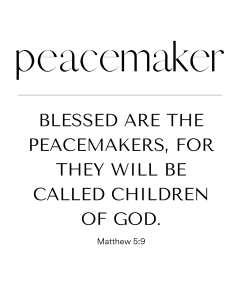 Let’s look at what Jesus says in Matthew 5:9, one of the most striking promises in Scripture:
“Blessed are the peacemakers, for they will be called children of God.” — Matthew 5:9 (NIV)
Peace doesn’t grow through avoidance—it grows through action. When Jesus spoke these words, He wasn’t offering a self-help tip or a personality trait to aspire to—He was describing the character of those who belong to His kingdom. So what does it really mean to live like a peacemaker?
This verse gives us one of the clearest pictures of biblical conflict resolution—inviting us to become agents of healing in the face of tension, rather than people who avoid or escalate it.
Matthew 5 is the beginning of the Sermon on the Mount, a sweeping message where Jesus redefines what it looks like to live in alignment with God’s kingdom. The Beatitudes—the opening statements of this sermon—flip worldly values upside down.
In a culture that admired power, status, and self-preservation, Jesus said things like:
- Blessed are the poor in spirit.
- Blessed are those who mourn.
- Blessed are the meek.
- And here: Blessed are the peacemakers.
Each “blessed” is a glimpse into the kind of life that reflects God’s heart—a life marked by mercy, purity, humility… and peace.
The Difference Between a Peacemaker and a Peacekeeper
Let’s unpack peacemaker vs. peacekeeper–honestly, we tend to interchange these two words. But they mean very different things. The word peacemaker refers to more than keeping things calm. It’s the courageous and creative work of making peace where it doesn’t yet exist.
It’s active. Intentional. Relational.
Peacemaking is the creative work of stepping into brokenness with God’s love. Share on X
Jesus didn’t say “blessed are the peacekeepers.” There’s a difference:
- Peacekeepers often seek to avoid conflict. They may suppress tension for the sake of surface calm.
- Peacemakers, on the other hand, step toward conflict with humility and truth. They’re not afraid to enter hard spaces with gentleness and grace, believing that God can bring healing where there’s been hurt.
This kind of peacemaking takes courage, because it risks rejection or misunderstanding. But it also reflects God’s heart. And it gives us a practical model for biblical conflict resolution that’s both courageous and compassionate—rooted in humility, not control.
When Keeping the Peace Isn’t Enough: A Call to Be a Peacemaker
In modern terms, peacekeeping often brings to mind military or diplomatic missions—designed to hold opposing sides apart, monitor ceasefires, and prevent further violence. These roles are critical, honorable, and often dangerous. But their primary aim is to maintain peace by managing conflict, not necessarily to reconcile it.
Spiritually, we can fall into that same mindset—trying to manage conflict by keeping things calm on the outside. We become emotional peacekeepers: avoiding confrontation, suppressing tension, and hoping everything stays quiet.
But the peace Jesus is talking about runs deeper.
- Peacekeepers try to hold things together.
- Peacemakers restore what’s been broken.
They move toward the source of tension with humility, grace, and truth—trusting that God’s presence can do what human effort alone cannot.
And that’s why Jesus says peacemakers will be called children of God—because they reflect the heart and character of their Father and they carry His peace into places that need it most.
Facing Conflict with Faith: One Step Toward Becoming a Peacemaker
Think for a moment—where in your life is peace missing?
Maybe it’s a conversation you’ve been avoiding. A relationship that feels tense. A silent space that used to be filled with laughter.
Peacemaking doesn’t always mean fixing everything. It starts with a single step—praying for someone who hurt you, softening your tone, or opening a door that’s been closed too long.
That’s the heart of biblical conflict resolution—it’s not about winning, but restoring.
So here’s the reflection for today:
Where is God inviting you to be a peacemaker?
Ask Him to show you one space, one relationship, or one moment this week where you can move toward peace—with courage and compassion.
Whether the tension is big or small, recent or long-standing—Jesus sees it. And He invites us to be part of His peace-making work in the world.
Let’s ask Him for the courage and grace to live this out.
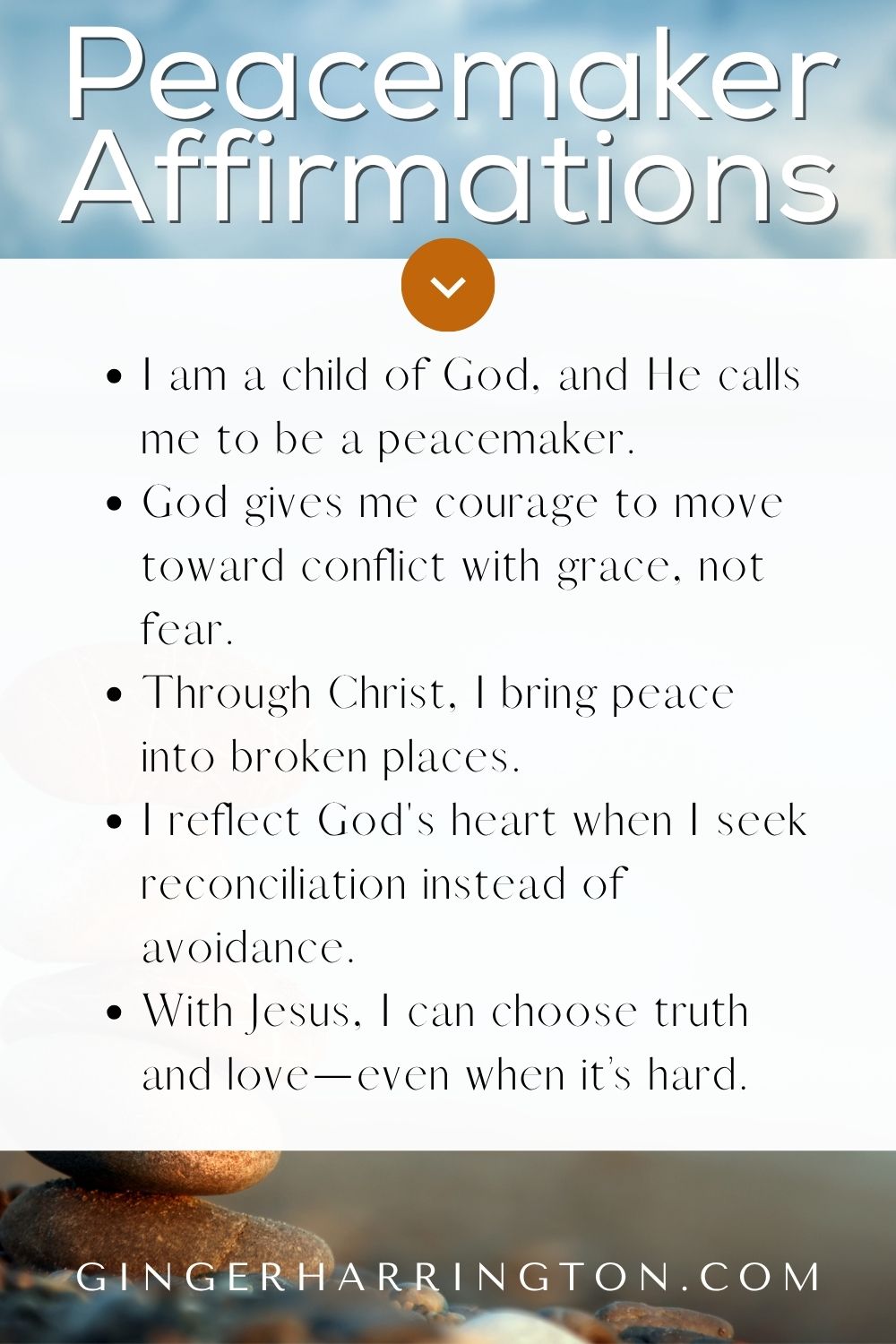
Courage to Make Peace: Scripture Truths to Strengthen Your Heart
When conflict weighs heavy or you feel tempted to avoid hard conversations, it helps to root your mindset in truth. Scripture affirmations are a way to agree with what God says is true—about peace, about courage, and about your identity as His child.
Here are five simple “I believe” statements to anchor your heart in God’s Word as you learn to be a peacemaker:
- I am a child of God, and He calls me to be a peacemaker.
Matthew 5:9 – “Blessed are the peacemakers, for they will be called children of God.” - God gives me courage to move toward conflict with grace, not fear.
2 Timothy 1:7 – “For God gave us a spirit not of fear but of power and love and self-control.” - Through Christ, I bring peace into broken places.
Colossians 3:15 – “Let the peace of Christ rule in your hearts…” - I reflect God’s heart when I seek reconciliation instead of avoidance.
Romans 12:18 – “If it is possible, as far as it depends on you, live at peace with everyone.” - With Jesus, I can choose truth and love—even when it’s hard.
Ephesians 4:15 – “Speaking the truth in love…”
Which of these truths do you need to cling to today as you seek peace in your relationships?
🙏A Prayer for Biblical Conflict Resolution and Peacemaking Courage
No matter where you are in the process—whether you’re facing a hard conversation or simply learning to let go of avoidance—God meets you with grace.
Let’s ask Him to give us the courage to reflect His heart as we step into peace.
Lord, thank You for calling us to more than surface peace. You are the true Peacemaker, and we want to follow Your lead.
Give us courage to move toward others with humility, even when it’s uncomfortable.
Soften our hearts, steady our words, and guide our steps into the places where peace feels far away.
Help us reflect Your heart—creating calm in the chaos and healing where there’s been hurt.
Make us bold in love and faithful in forgiveness.
In Jesus’ name, Amen.
Why Choosing to Be a Peacemaker Reflects Biblical Conflict Resolution
Friend, peacemaking may feel risky—but with Jesus, you never step in alone.
Every time you choose to speak peace into tension, show up with gentleness, or take that first brave step toward reconciliation, you’re walking in the way of Christ.
It’s not about having the perfect words or fixing every situation—it’s about reflecting the heart of your Father. That’s what it means to live like a peacemaker.
And when you do, you’re living out the identity Jesus gave you in Matthew 5:9—a beloved child of God who carries His peace into a broken world.
If today’s message encouraged you, take a moment to share it with someone who might be in a hard or tender season. Sometimes a gentle word is exactly what someone needs to breathe again.
-
Catch the Full Habits of Peace Series
Habits of Peace Episodes
- 40.Need a Little Peace? A Simple Habit to Notice When Peace is Missing
- 41.How to Pursue Peace God’s Way: A Simple Habit to Calm Your Soul
- 42.Peace is a Person: How to Embrace Calm in the Presence of Christ
- 43.How to Find Perfect Peace When You Feel Stressed (Isaiah 26:3)
- 44.One Peaceful Habit to Respond with Grace When You’re Angry
- 45.How to Let Go of Control and Let Peace Rule in Your Heart
- 46.Peacemaker vs Peacekeeper? How Jesus Calls Us to Respond to Conflict
- 47.Why Do I Keep Losing My Peace-Even When I’m Trying to Trust God?
- 48.How to Feed Your Soul and Grow Lasting Peace (Galatians 5:22)
- 49. Live in the Overflow: How to Experience God’s Peace Every Day (Romans 15:13)
Want to Respond with Peace Instead of Pressure? Start by Caring for Your Soul.
Download the Soul Care Made Simple guide for practical ways to reset your rhythms, release emotional overload, and refocus on God’s peace—so you can become a peacemaker from the inside out. Click here for your guide.
How to Let Go of Control and Let Peace Rule Your Heart
Learn how to surrender control to God by letting the peace of Christ rule your heart. Discover the biblical habit of surrendering to God’s peace each day. I don’t know about you, but sometimes the tighter I hold on, the more unsettled I feel. I...
One Peaceful Habit to Respond with Grace When You’re Angry
Struggling to stay calm when you’re triggered? Learn how to respond with grace when you’re angry by practicing one powerful habit that brings peace before conflict starts. Based on Proverbs 15:1.
How to Respond Instead of React When You’re Triggered
Have you ever walked away from a conversation thinking, “Why did I say that?” Maybe it was the heat of the moment or a well-worn reaction that rose too fast to stop. That sting of regret can settle in quick.
If you’ve ever wished for a do-over or felt the weight of your words after they slipped out, welcome to the club.
Oops, I Did It Again… Reacting Instead of Responding with Grace
I had one of those moments just last night during a conversation with my husband.
Our dryer has been on the fritz, and we’ve been waiting weeks for the repair—so I’ve gotten behind on laundry. I was standing there trying to figure out where to hang the wet clothes when he asked why I hadn’t washed his towel.
And I didn’t respond very well.
I didn’t mean to, but I let frustration lead. I was Miss Snippy-Snip—sharp tone, quick reply—and just like that, we were in a moment of tension. We worked it out (no worries), but it reminded me how quickly conflict can spark when we react instead of respond.
We’ve all had those times when the words fly out before our brain catches up—when we wish we could hit rewind and say it differently.
That little laundry moment was no big deal—but it was a reminder. A small spark of stress can stir up conflict fast, but the pressure is higher, the stakes feel heavier.
Let me take you back to a harder moment. One that still stings.
What Happens When Stress Speaks Louder Than Grace
A few years ago, I was an editor for a ministry—juggling multiple projects, tight deadlines, and learning everything the hard way by trial and error. I was stretched too thin but didn’t speak up. And then came one more assignment—important, but small in the big picture. The draft needed editing for an upcoming conference, and I didn’t have the bandwidth.
My own writing had slipped off the radar. I was trying to keep my head above water.
When a leader shared some last-minute feedback—things that should’ve been caught earlier—I let my stress get out in front of me. I fired off a quick email to the writer, trying to clarify the problem and fix it fast.
But my tone missed the mark. It came across harsher and more critical than I intended.
I meant to clarify—but I ended up wounding.
I apologized later. I took responsibility for my reaction, and the writer forgave me. But something shifted in that relationship. The trust didn’t quite recover.
And that still weighs heavy on my heart.
I’ve often wondered… did my reaction discourage a gifted writer from pursue her craft? Did I let my stress become a stumbling block?
That experience taught me something I won’t forget:
When I don’t pause—don’t breathe, don’t pray—my stress can speak louder than the actual intentions of my heart.
And sometimes, the cost isn’t just an awkward conversation. It’s a quiet regret that lingers long after the moment is gone.
Finding Peace When You Feel Angry: The Power of a Gentle Response
We’re diving into one powerful habit from Proverbs 15:1 that helps us respond with grace when we feel triggered, rather than react with anger or frustration.
“A gentle answer turns away wrath, but a harsh word stirs up anger.” (Proverbs 15:1)
This isn’t just a wise saying—it’s a spiritual strategy. In Hebrew, the word “gentle” means soft or tender. And that phrase “turns away” literally means to change direction.
That means a peaceful response can redirect the emotional temperature of a moment before it escalates into full-blown conflict.
Let’s be honest. Harsh words often feel justified in the moment, but they rarely bear good fruit. Even when you’re right, a sharp or sarcastic tone can derail a conversation. Suddenly, it’s no longer about the issue at hand but the way it was said.
A gentle answer flows from a heart that’s already chosen peace.
Can you think of a time when your tone shifted the direction of a conversation—for better or worse?
Why We React Before We Think: Understanding the Brain’s Stress Response
Have you ever felt like, “Why do I keep reacting like this—even when I don’t want to?” There’s a reason, and it’s not because you’re weak or unspiritual. When we feel threatened, even emotionally, our brains and bodies kick into survival mode faster than we realize.
One of the first things that happens is an “amygdala hijack.” This is when your amygdala—the part of your brain responsible for processing emotions and detecting danger—takes over. It bypasses your rational thinking brain and reacts instantly to a perceived threat. Whether it’s a sharp tone, a passive-aggressive text, or a disrespectful glance, your brain goes into alert mode.
Psychologist Daniel Goleman coined the term amygdala hijack to describe this moment when your emotional brain overrides your thinking brain. It’s like a fire alarm going off inside you. Your nervous system releases stress hormones like adrenaline and cortisol, preparing you to fight, flee, or freeze. And in that moment, your prefrontal cortex—the part of your brain that helps you think clearly, reflect, and respond wisely—actually slows down. This makes it all to easy for your emotions to override your rational thinking.
If you’ve ever said something and immediately thought, I wasn’t even thinking straight, you probably weren’t—at least not with your whole brain. Your body was trying to protect you, even though the situation didn’t actually require a full-blown emergency response.
The good news? You’re not stuck in this pattern.
Because of neuroplasticity—your brain’s ability to rewire—you can learn new habits, and those new patterns can become your default over time. And that’s where this simple habit comes in: pause, breathe, pray, and let peace lead. It’s not just spiritual wisdom—it’s also good brain science.
The Pause That Makes a Difference
One of the most effective tools to manage stress in heated moments is the intentional pause. Here’s the habit:
Pause. Breathe. Pray. Let peace lead. Share on X
It sounds simple, but don’t underestimate its power.
Pause: Even a 2-second pause gives your brain a chance to catch up and resets your nervous system.
Breathe: A slow, deep breath sends a signal to your body that you’re safe. Inhale peace, exhale reaction.
Pray: A simple breath prayer like “Jesus, be my peace” or “Spirit, slow me down” invites the Holy Spirit to lead.
Let peace lead: Choose your words from a place of grounded calm rather than emotional reaction.
Every time you practice this habit, you’re training your brain and spirit to respond rather than react. It’s a holy pause that makes space for peace.
Don’t let pride, pressure, or panic lead your response. Let peace go first.
The Pause to Train Your Heart to Respond with Grace
This kind of response doesn’t happen by accident. It takes practice and intention. Here are a few simple ways to make this habit to pause, breathe, and pray part of your daily life:
Visualize Peace Ahead of Time Think through situations that often trigger you. Imagine yourself choosing peace. This mental rehearsal begins forming a new, grace-filled habit.
Create a Grounding Prayer Use a breath prayer you can call on in the moment. Some examples:
Jesus, calm my heart.
Lord, help me respond with grace.
Spirit, give me Your words.
Practice When Pressure is Low Use low-stress moments (like waiting in traffic) to rehearse the pause, breathe, pray rhythm.
Set a Visual Reminder Place a sticky note on your mirror or dashboard that simply says, “Pause. Breathe. Pray.”
Reflect Without Shame After a tough interaction, take time to reflect:
What triggered me?
What was happening inside me?
How might I respond differently next time?
What one situation this week could you prepare for by deciding now to let peace go first?
A Habit That Helps in the Moment
You’re not expected to get this perfect. But every time you pause, breath, and pray instead of reacting, you plant seeds of peace in your relationships—and in your soul.
Responding with peace won’t always feel natural, but it will always bear fruit.
This week, choose just one moment a day to pause, breathe, pray, and let peace go first. Watch what happens when you let the Prince of Peace shape your response.
Want more encouragement like this? Try listening to the episode while you go for a walk, do dishes, or drive. You might be surprised how personal a podcast can feel—like I’m right there talking with you. It’s an easy way to hear God’s truth while you move through your day. Click play and give it a try. If it’s your first listen, I’d love to hear what you think!
Want to Learn More About What’s Happening in Your Brain During Stress?
Understanding the science behind your stress response can help you practice peace with more compassion for yourself—and more success. These articles go deeper into topics like the amygdala hijack, nervous system regulation, and how simple habits like breathwork and mindful prayer help restore calm and clarity in tense moments.
Daniel Goleman’s Website
https://www.healthline.com/health/stress/amygdala-hijackhttps://www.simplypsychology.org/amygdala-hijack
https://www.functionalneurohealth.com/post/how-your-breathing-reflects-the-state-of-your-nervous-system
Catch the Full Habits of Peace Series
Series Summary:10 Habits of Peace: A Complete Guide to Experiencing God’s Peace (Episode Summaries + Links)
Habits of Peace Episodes
40.Need a Little Peace? A Simple Habit to Notice When Peace is Missing
41.How to Pursue Peace God’s Way: A Simple Habit to Calm Your Soul
42.Peace is a Person: How to Embrace Calm in the Presence of Christ
43.How to Find Perfect Peace When You Feel Stressed (Isaiah 26:3)
44.One Peaceful Habit to Respond with Grace When You’re Angry
45.How to Let Go of Control and Let Peace Rule in Your Heart
46.Peacemaker vs Peacekeeper? How Jesus Calls Us to Respond to Conflict
47.Why Do I Keep Losing My Peace-Even When I’m Trying to Trust God?
48.How to Feed Your Soul and Grow Lasting Peace (Galatians 5:22)
49. Live in the Overflow: How to Experience God’s Peace Every Day (Romans 15:13)
How to Find Perfect Peace When You Feel Stressed (Isaiah 26:3)
Struggling to stay calm? Learn how to experience perfect peace (Isaiah 26:3) with Christian stress management tools for trusting God when you feel stressed.
Yes—perfect peace is possible, even when you’re feeling stressed.Isaiah 26:3 gives us the promise and the path:
“You will keep in perfect peace those whose minds are steadfast, because they trust in you.”
If your mind has been racing, your shoulders are tight, or your thoughts are stuck on repeat—this verse isn’t just poetic language. It’s a spiritual strategy for Christian stress management that can calm your heart and steady your soul.
Isaiah 26:3 isn’t just encouraging—it’s a practical Christian stress management tool to help you reclaim peace when your day feels out of control.
Let’s walk through how to experience perfect peace—not by avoiding stress, but by learning how to refocus and trust God in the middle of it.
Perfect Peace Isn’t the Absence of Stress—It’s the Fruit of Trust
Perfect peace doesn’t come from a spa day or a clear calendar. It comes from a steadfast mind—a mind anchored in trust, not tossed around by stress.
“You don’t have to feel peaceful to practice trust.”
Sometimes we think, “I lost my peace because I failed to trust God.” But this verse isn’t about earning peace. It’s not a test. God doesn’t slap our hands when we feel anxious—He invites us back to Him.
We don’t lose peace because God takes it away. We often stop experiencing it when our minds are overwhelmed, our emotions are loud, and our focus is scattered.
When stress builds, peace often slips away before we even realize it. But Isaiah 26:3 teaches us that peace isn’t lost—it’s redirected. And we can get it back.
“Trust is the bridge between our thoughts and God’s peace.”
Common Signs You’ve Lost Your Peace
Before we explore the path back to peace, it helps to recognize when peace is starting to fade. I call these “peace cues”—physical and emotional signals that alert us when stress is taking over. Recognizing these cues is a practical part of managing stress in a healthy way.
Physical cues:
Muscle tension (jaw, neck, shoulders)
Digestive issues or upset stomach
Changes in appetite
Headaches or fatigue
Emotional cues:
Irritability or overreacting to small things
Anxiety, restlessness, or racing thoughts
Difficulty focusing or making decisions
Feeling overwhelmed or emotionally flooded
Our bodies and emotions are finely tuned instruments, often signaling internal unrest before our minds are aware. These cues are early warning signs that it’s time to pause and bring God into what’s happening.
Recognizing these stress signals is the first step in finding peace when you feel stressed, and it’s part of how we build spiritual resilience.
When we start to notice these signals, we can make different decisions—ones that lead us back to peace.
A Real-Life Moment of Stress and Peace
Last fall, I visited my daughter and son-in-law in Canada. They were expecting their first baby and urgently needed a larger apartment. Both of them worked from home, and their current space—a one-bedroom with no dining table or desk—wasn’t going to work.
I joined them on a few apartment tours. We looked at places that were cramped and overpriced. Anxiety started creeping in. I remember thinking, How in the world is this going to work?
My daughter pointed to a building she loved and said, “That’s the apartment I really want—but there’s no vacancy, and it’s over our budget.”
So I suggested we take a prayer walk around the building and the neighborhood. We invited God into the process. And something shifted. As we prayed and focused on God’s ability to provide, our stress started to settle.
I remember waking up in the night still anxious. But I had to remind myself—The Lord’s got this. He’s provided so many times before. I don’t know how, but I trust that He will again.
That moment reminded me: trust calms the heart even when the outcome is still unknown.
Soon after—on the exact day they learned they had to leave their current apartment—they got a call. A unit had opened in the sister building across the street. It was in their price range and met their needs.
“God’s perfect peace often follows His perfect provision—and His timing is always on time.”
Breaking Down Isaiah 26:3: The Promise, the Practice, and the Peace
This verse gives us a powerful three-part structure for peace:
1. God’s Role: “You will keep…”
God promises to maintain peace—not us. He is the Keeper of peace.
2. Our Role: “…those whose minds are steadfast…”
Steadfast means steady, focused, and firm. It’s a mental posture we cultivate with intention.
3. The Bridge to Peace: “…because they trust in you.”
Trust connects our thoughts to God’s peace. It doesn’t mean we’re never anxious—it means we choose to believe anyway.
The Hebrew phrase for “perfect peace” is actually “shalom shalom.” That double usage isn’t redundant—it’s emphatic. It’s a deep, complete, enduring peace that doesn’t depend on your circumstances.
And it’s not a personality trait. A steadfast mind isn’t something some people are born with. It’s a habit we cultivate—day by day, thought by thought.
“Steadying your mind is a spiritual habit, not a personality trait.”“The peace of God is promised, but it flows through the path of trust and a steadfast mind.”
The 3Rs: A Simple Habit to Refocus and Regain Peace
When stress strikes and peace disappears, try this simple three-step habit:
1. Recognize
Notice what’s causing stress. Pay attention to your thoughts, body, and reactions.
You might notice a tightness in your chest or a pit in your stomach before your mind even catches on. These are peace cues—early warning signs that it’s time to slow down and pay attention.
2. Reflect
Ask: What’s really going on here?Then turn your attention to God’s character. Think about His faithfulness in the past and the truth of who He is.
Ask: Is this situation truly out of control, or am I letting fear take over? Reflecting brings clarity—and opens space to remember who God is.
3.Refocus
Intentionally shift your thoughts to God’s promises. Choose to believe that He’s trustworthy, even if the situation hasn’t changed yet.
Sometimes, this means speaking truth out loud. “Lord, You are faithful. I choose to trust You.” That moment of refocusing invites peace to return, even before anything changes externally.
“When peace slips away, return to trust.”“Peace isn’t a destination. It’s a daily decision.”
Practice Makes Peace: A Scripture Journaling Idea
To help you put Isaiah 26:3 into practice, try this simple journaling prompt:
Write the verse in your own handwriting.
Describe what’s disturbing your peace right now.
Name your thoughts and feelings honestly.
Remember a time God was faithful or a truth about His character.
Write a prayer of trust, even if you still feel stressed.
This kind of reflection turns scripture into a conversation with God—and it builds the habit of trusting Him when you’re stressed.
“Believing in God is a decision, not an emotion.”–Holy in the Moment
Perfect Peace is Possible—One Trusting Thought at a Time
You may not be able to remove every source of stress in your life. But you can shift your focus. You can choose to trust God today—even when your feelings haven’t caught up yet.
Peace isn’t earned. It’s received. And it flows through trust and a steadfast mind.
Catch the Full Habits of Peace Series
Series Summary:10 Habits of Peace: A Complete Guide to Experiencing God’s Peace (Episode Summaries + Links)
Habits of Peace Episodes
40.Need a Little Peace? A Simple Habit to Notice When Peace is Missing
41.How to Pursue Peace God’s Way: A Simple Habit to Calm Your Soul
42.Peace is a Person: How to Embrace Calm in the Presence of Christ
43.How to Find Perfect Peace When You Feel Stressed (Isaiah 26:3)
44.One Peaceful Habit to Respond with Grace When You’re Angry
45.How to Let Go of Control and Let Peace Rule in Your Heart
46.Peacemaker vs Peacekeeper? How Jesus Calls Us to Respond to Conflict
47.Why Do I Keep Losing My Peace-Even When I’m Trying to Trust God?
48.How to Feed Your Soul and Grow Lasting Peace (Galatians 5:22)
49. Live in the Overflow: How to Experience God’s Peace Every Day (Romans 15:13)
🧡 A Christian Stress Management Tool to Refresh Your Soul
When life feels overwhelming, caring for your soul isn’t a luxury—it’s a lifeline. Soul Care Made Simple is a beautifully practical, Christ-centered guide that helps you slow down, breathe deeply, and reconnect with God in your everyday rhythms.
Whether you’re spiritually exhausted or just need a gentle reset, this guide offers simple practices rooted in grace—not guilt.
👉 Download your free copy of Soul Care Made Simple and begin your journey toward lasting peace.
Peace is a Person: Finding Calm in the Presence of Christ
Find peace through Christ—not in perfect plans, but in His presence. Explore how Jesus, the Prince of Peace, calms anxious hearts and restores hope.
Do You Need Peace Today?
When you can’t quiet your thoughts and everything feels like too much, peace can seem impossible to find. But what if peace wasn’t something you had to chase or earn—what if it was someone you already know?
In today’s post, we’re exploring a powerful truth from Isaiah 9:6 that reminds us: peace isn’t just a feeling. Peace is a person.
When your mind is anxious, your heart unsettled, or your emotions spiraling, you don’t need a perfect plan—you need a steady presence.
Let’s discover how embracing Jesus as our Prince of Peace brings calm to the chaos and offers a habit of hope we can carry into every day.
The Name That Changes Everything
Isaiah 9:6 says:
“For to us a child is born, to us a son is given… and he will be called Wonderful Counselor, Mighty God, Everlasting Father, Prince of Peace.”
Because we sing these words so frequently at Christmas, it’s easy to overlook the meaning. Let’s slow this verse down and take it to heart.
The phrase “He will be called…” introduces four names of Jesus that are rich with meaning. Each one reveals something essential about who He is:
Wonderful Counselor – His wisdom guides with truth and compassion.
Mighty God – He is powerful and sovereign, fully divine.
Everlasting Father – He protects and loves with the heart of a faithful Father.
Prince of Peace – He rules with peace and restores what fear and chaos have broken.
These names aren’t just poetic. They describe the character and purpose of Christ.
Jesus didn’t come just to give peace—He came to be peace.
Enjoy watching the video of this episode.
What It Means to Know the Prince of Peace
“Prince of Peace” is more than a Christmas title—it’s a daily invitation.
Jesus brings peace not by fixing every circumstance but by being present in the midst of them.
He doesn’t offer peace apart from Himself. He gives us Himself.
When your emotions are stirred, your heart anxious, or your mind racing, try something simple and powerful:
Whisper His name.
In doing so, you’re not just praying—you’re reconnecting. That small act of returning your focus to Jesus can shift everything. In His presence, we find rest. In His name, we find peace.
A Habit of Hope: Call on His Name
Here’s a peace practice to return to again and again:
Whisper the name of Jesus when you feel upset, unsettled, or overwhelmed—let His name bring your heart back to peace.
It’s not about perfect words or religious formulas. It’s about choosing connection over control.
Try one of these simple rhythms:
When peace feels far away, turn to the One who is always near.
Shift from panic to presence: pause, breathe, and call on Jesus.
Trade control for connection—peace begins when we reach for Him.
Anchor your anxious heart in Christ by naming who He is in the moment you need Him most.
You don’t need perfect words. Just His name is enough.
Real-Life Moments to Practice Peace
This habit isn’t reserved for quiet mornings and devotional time. It’s meant to meet you in the middle of ordinary, stressful, even chaotic moments. Here are a few examples of how this might look in real life:
You’re in the car after a hard conversation. Your heart races. Whisper, “Jesus, You are my peace.”
You’re at the kitchen sink, worn thin from the day. Pause and breathe His name.
You’re lying awake at 2 AM. Place your hand on your heart and say, “Prince of Peace, be near.”
You’re stuck in traffic or faced with disappointment. Rather than spiraling, say His name and invite His presence.
These moments—when we whisper His name—can become sacred ground where peace meets you right where you are.
Truths About the Peace of Christ
Let these truths speak to your heart today:
Peace is not the absence of problems—it’s the presence of a person.
Jesus doesn’t give peace apart from Himself—He gives us Himself.
When you call on His name, you’re not just praying—you’re reconnecting.
Peace doesn’t come from holding it all together—it comes from being held.
Whisper His name. Remember His heart. Rest in His presence.
These aren’t just quotes—they’re anchors for your soul in anxious moments. Keep them close. Write them down. Return to them as needed.
Coming Up Next in the Habits of Peace Series
The next post in this series will explore what to do When Peace Slips Away. We’ll talk about how to recognize when your peace starts to unravel and how to find your way back. You’ll discover encouragement from Isaiah 26:3 that will help you recover calm when life pulls you off-center.
What’s one moment recently when you needed peace—and how did you experience God’s presence in it?
(Or… what helps you return to peace when life feels overwhelming?)
Catch the Full Habits of Peace Series
Series Summary:10 Habits of Peace: A Complete Guide to Experiencing God’s Peace (Episode Summaries + Links)
Habits of Peace Episodes
40.Need a Little Peace? A Simple Habit to Notice When Peace is Missing
41.How to Pursue Peace God’s Way: A Simple Habit to Calm Your Soul
42.Peace is a Person: How to Embrace Calm in the Presence of Christ
43.How to Find Perfect Peace When You Feel Stressed (Isaiah 26:3)
44.One Peaceful Habit to Respond with Grace When You’re Angry
45.How to Let Go of Control and Let Peace Rule in Your Heart
46.Peacemaker vs Peacekeeper? How Jesus Calls Us to Respond to Conflict
47.Why Do I Keep Losing My Peace-Even When I’m Trying to Trust God?
48.How to Feed Your Soul and Grow Lasting Peace (Galatians 5:22)
49. Live in the Overflow: How to Experience God’s Peace Every Day (Romans 15:13)
How to Pursue Peace God’s Way: A Simple Habit to Calm Your Soul
Learn how to pursue peace God’s way with biblical steps to peace from Psalm 34:14. Discover what it means to seek peace and practice it in daily life.
Peace isn’t something that just shows up when life gets quiet. It’s something we seek and something we choose. The truth is, we either cultivate peace or we crowd it out. And in today’s noisy world, that choice happens moment by moment.
What Does It Mean to Pursue Peace God’s Way?
Pursuing peace God’s way means actively seeking the kind of peace that flows from obedience to His Word and closeness to His presence. It’s not about avoiding stress or pretending everything is fine—it’s about practicing habits that align your heart with God’s truth, even in the stress of life.
Why We’re Talking About Peace (and How to Practice It)
This post is part of the Habits of Peace series—gentle, practical reflections to help you experience God’s peace in everyday life. Each week, we’re exploring a simple biblical habit that can anchor your soul and quiet the noise, one step at a time.
If you missed the first habit, take a moment to read this post about noticing what steals your peace to start at the beginning of the series.
What It Means to Seek Peace and Pursue It (Psalm 34:14)
Today we’re focusing on a short but powerful verse:
“Turn away from evil and do good; seek peace and pursue it.” – Psalm 34:14 (ESV)
This verse doesn’t treat peace as something passive. It uses action words: seek and pursue. That means peace is something we go after, not just something we wait for.
Peace doesn’t just happen. Pursue it.
Psalm 34 was written by David, and the title tells us it was “when he pretended to be insane before Abimelek, who drove him away.” This takes us back to 1 Samuel 21, when David fled for his life, sought shelter with the Philistines, and feared he’d be killed. So he acted like a madman to escape.
This was not a peaceful season.
David was desperate, fearful, and vulnerable. And yet—this is the moment he writes, “seek peace and pursue it.”
David wasn’t writing these words from a cozy mountaintop. He was hiding, uncertain, and under pressure. And still—he says pursue peace.
Not escape.
Not comfort.
Not control.
But peace–the kind that comes from turning from fear and walking toward God’s goodness, even when the world feels dangerous.
This makes Psalm 34:14 even more powerful: peace isn’t the absence of problems—it’s a habit of direction.
Biblical Steps to Peace That Start with Obedience
Peace grows in the soil of consistent choices rooted in God’s Word.
Here are five simple but powerful ways to begin pursuing peace—habits that reflect obedience to God’s Word and create space for His peace to take root.
Peace is a pursuit: It’s an intentional direction of your heart, mind, and choices.
Small habits create peace: Things like regular prayer, healthy boundaries, or even choosing stillness for five minutes can shift your atmosphere
Disruptions to peace are clues: When you lose your peace, it’s a signal—not a failure. Ask: What broke my peace today? What helped restore it?
Obedience is part of pursuing peace: The verse doesn’t just say “pursue peace”—it starts with “turn away from evil and do good.” That reminds us that peace isn’t just a feeling; it’s a fruit of walking in the right direction. If we want peace to grow in our lives, we have to say no to the things that stir up chaos, sin, or unrest—whether that’s in our thoughts, our words, or our actions.
Sometimes the most powerful way to pursue peace is to turn away from what disrupts it.
What’s one small, intentional step you can take today to pursue peace in a stressful area of your life?
How Psalm 34 Guides Us to Lasting Peace
“I sought the Lord, and he answered me and delivered me from all my fears.” – Psalm 34:4
Just a few verses earlier, David reminds us that seeking peace begins with seeking the Lord. He connects deliverance from fear with intentional spiritual pursuit.
When we pursue peace, we’re really pursuing the presence of God.
“The Lord is near to the brokenhearted and saves the crushed in spirit.” – Psalm 34:18
Even when peace feels out of reach, God’s nearness is our reassurance. You can pursue peace even in broken places—because He is near.
“Psalm 34 is a psalm of movement—David is praising, seeking, turning, fearing God, and doing good. It’s not passive peace. It’s practiced peace.”
Make Pursuing Peace Your Habit
Habit of Peace: Make peace a pursuit, not a wish—take one intentional step toward peace today.
Here’s the truth: peace doesn’t just drop into our day like a surprise delivery. It’s something we pursue—on purpose. Scripture tells us to seek peace and pursue it. That means we don’t just long for peace—we look for it. We move toward it. We choose it in the middle of everything else pressing in.
It doesn’t have to be big—but it does need to be real. A choice that opens the door for peace to enter in.
Here are a few biblical steps to peace you can apply today:
🕯️ Pause before answering that stressful text or email. Breathe. Pray. Then respond.
📖 Start your day with Scripture instead of scrolling. Set your tone before the world does.
🗓️ Say no to one extra thing today so your soul can breathe.
🚶♀️ Take a quiet walk without noise—no phone, no podcast, just space to be with God.
🤲 Pray over the thing you keep obsessing about instead of replaying it in your mind.
🎧 Put on peaceful worship music while you cook, drive, or fold laundry.
👥 Resolve a tension with kindness. Sometimes pursuing peace means initiating reconciliation.
Your peace isn’t random. It’s shaped by your habits.
As you reflect on today’s message, take a few minutes to sit with these questions:
– What situations or habits tend to break your peace most often?
– What’s one small, intentional step you can take today to pursue peace in a stressful area of your life?
– Are there any thought patterns or behaviors you need to turn away from to protect your peace?
You don’t have to do it all—but one habit can begin to shift everything.
A Prayer for Pursuing Peace in Your Life
Lord, I long for Your peace to steady my heart in the chaos of life. Help me to seek peace—not just as a feeling, but as a daily pursuit that begins with choosing You. Show me the habits that build peace and the patterns that break it. Give me courage to turn away from anything that stirs up unrest in my thoughts, words, or actions. Thank You for being near when I’m overwhelmed and for guiding me with Your truth. May Your peace grow in me as I walk in obedience and trust You more each day. In Jesus’ name, amen.
Practice the Habit of Pursuing Peace This Week
Friend, peace is possible—even in a chaotic world. But it doesn’t happen by accident. It happens when we seek it, pursue it, and build it—one decision at a time.
Don’t miss next week’s episode about the truth that peace isn’t just something we feel—it’s someone we follow. We’ll talk about what it means that Jesus is our Prince of Peace and how knowing Him personally brings the kind of peace the world can’t offer or take away—a peace that isn’t just a feeling, but a powerful force.
If this episode helped you reframe peace as a pursuit, would you share it with a friend who could use some peace today? Be sure to subscribe so you won’t miss what’s coming next—and join us as we keep building spiritual strength through everyday habits of hope.
If this message stirred something in you today, go back and listen to Episode 1 of the Peace Series. We talked about how to recognize the moments when peace starts to slip—and how noticing those early warning signs can lead us back to God’s steadying presence.
Don’t miss next week’s episode about the truth that peace isn’t just something we feel, it’s someone we follow. We’ll talk about what it means that Jesus is our Prince of Peace and how knowing Him personally brings the kind of peace the world can’t offer and can never take away—and how God’s peace isn’t just a feeling, it’s a powerful force.
More from the Habits of Peace Series
Need More Peace: A Simple Habit to Notice When Peace is Missing
Catch the Full Habits of Peace Series
Series Summary:10 Habits of Peace: A Complete Guide to Experiencing God’s Peace (Episode Summaries + Links)
Habits of Peace Episodes
40.Need a Little Peace? A Simple Habit to Notice When Peace is Missing
41.How to Pursue Peace God’s Way: A Simple Habit to Calm Your Soul
42.Peace is a Person: How to Embrace Calm in the Presence of Christ
43.How to Find Perfect Peace When You Feel Stressed (Isaiah 26:3)
44.One Peaceful Habit to Respond with Grace When You’re Angry
45.How to Let Go of Control and Let Peace Rule in Your Heart
46.Peacemaker vs Peacekeeper? How Jesus Calls Us to Respond to Conflict
47.Why Do I Keep Losing My Peace-Even When I’m Trying to Trust God?
48.How to Feed Your Soul and Grow Lasting Peace (Galatians 5:22)
49. Live in the Overflow: How to Experience God’s Peace Every Day (Romans 15:13)
Need More Peace? A Simple Habit to Notice When Peace Is Missing
Feeling overwhelmed? Learn how to notice when peace is missing, understand its biblical meaning, and find calm in stressful seasons with this simple habit.
This post was originally part of a reader-favorite series on peace—and it inspired the first episode in the Peace Series on the Habits of Hope Podcast. If you’re craving more calm in your soul, you’ll love this deeper, updated reflection.
Ever find yourself saying, ‘I just need more peace? The funny thing about peace is that you appreciate it most when you don’t have it.
If your heart feels hurried or your soul feels cluttered, this is for you.
Why Peace Feels So Hard to Find—Even in Summer
Summer brings a different rhythm, doesn’t it?
It turns out, summer isn’t always the stress-free break we imagine. Travel planning, disrupted routines, and the juggle of work and family can leave many of us feeling more scattered than refreshed.
What’s supposed to feel restful can actually leave us running on empty.
This is why, for the next few weeks, we’re slowing things down with a special series called Habits of Peace.
This summer, stress doesn’t get the final word.
Whether you’re juggling routines, travel, or tension at home, the Peace Series offers a toolkit of biblical stress busters—quick, practical faith habits to anchor your heart and renew your mind.Less pressure.
More peace.
Right where you are.
In these short episodes and articles, we’re pressing pause to practice peace—one habit at a time. Each week, you’ll get a simple way to invite God’s peace into your real, everyday moments.
Everyday Stress Triggers that Can Steal Your Peace
Let’s be real—peace can feel like a distant dream when the stressors of daily life press in. Here are just a few things that can quietly chip away at our calm:
The pace of life is so busy, you’re considering installing a revolving door on your house.
The house is such a wreck, you can’t think straight.
Laundry has taken over and is threatening to swallow you whole.
There’s too much month left at the end of the money.
There’s no white space on the calendar—and no margin for rest in the schedule.
You can’t remember your last quiet moment—frazzled becomes both a hairstyle and a state of mind.
No matter how hard you try to get your ducks in a row, one ALWAYS gets away.
Summer travel requires the logistics of a military operation.
Hosting houseguests when what your soul really needed was solitude.
Children are crying, fussing, arguing, screaming, or banging—sometimes all at once.
Any of this sound familiar?
You’re not alone—and that’s exactly why we’re talking about peace in this series…because peace isn’t about perfect circumstances.
It’s about receiving what Jesus is already offering—right in the middle of all this.
I chose this theme because I’ve been feeling it too. The pressure. The noise. The weight of the world and the swirl in my own thoughts.
The Peace You’re Longing For Can’t Be Manufactured
One thing’s for sure, peace is a priceless commodity that we’ll never find on sale at Walmart!
Many things parade as peace. Some things promise peace. Lots of things look like peace–counterfeit peace–but there isn’t really any true substitute for peace.
Peace can’t be manufactured, processed, or imitated.
Not really. Not in any way that lasts.
And I’ve realized—peace isn’t something I can just will into being.
It’s something I need to receive.
So if you’re longing for more calm in your spirit… if your mind feels cluttered or your heart feels heavy… this series is for you.
Together, we’ll practice noticing where peace is missing—and learning how to receive it in everyday moments, one habit at a time.
Because God’s peace is not out of reach. It’s already been given.
What John 14:27 Really Means About Receiving Peace from Jesus
Today we’re anchoring in a beautiful promise from Jesus in John 14:27:
“Peace I leave with you; my peace I give to you. Not as the world gives do I give to you. Let not your hearts be troubled, neither let them be afraid.”
Let’s talk about the context for a moment.
Jesus is speaking these words on the night before the cross. He’s gathered with His disciples in the Upper Room.
He’s just washed their feet. Judas has left to betray Him. Peter’s denial has been foretold.
And Jesus is preparing His friends—His closest followers—for what’s coming: His death, their confusion, and the days ahead without His physical presence.
In the middle of all of that, He says:
“Peace I leave with you… my peace I give to you.”
This wasn’t a casual comment.
It was a deeply intentional moment—spoken into anxiety, fear, and uncertainty.
He knew their hearts were troubled, and He offered peace before the storm even broke.
In this verse we discover that peace is a gift—not a generic one-size-fits-all peace. My peace (the peace of God) I give to you. Wrapped up tight in this God-peace is God’s name.
His power.
His trustworthiness.
Because He is peace and He is present, our hearts can rest. Fear has no place when God’s peace is present. What a blessing. What a gift. Don’t you need a little peace today?
The Deeper Meaning of Peace in the Bible—Shalom and Eirēnē
Now let’s look a little deeper at that word peace.
In the Old Testament, “shalom” is used to describe the peace God gives, the peace between people, and the peace with oneself. The concept of shalom emphasizes the importance of wholeness and well-being, not just the absence of conflict.
In the original Greek, the word is eirēnē—and it means far more than the absence of conflict. It encompasses a sense of tranquility, harmony, and well-being, and it’s linked to the peace that comes from Christ that is beyond our understanding.
When Jesus says, “My peace I give you,” He’s not offering a feeling.
He’s offering Himself.
His kind of peace is steady and unshakable. It’s not something the world can manufacture—and it’s not something the world can take away.
This isn’t peace based on good circumstances. It’s not the “everything’s fine” kind of peace we sometimes try to fake.
Peace isn’t something we earn, hustle for, or wait until life calms down to receive.
It’s given. Right here. Right now.
The Moment I Realized I Was Missing God’s Peace
Not long ago, I was anxious over something small—a quick decision that shouldn’t have rattled me. But my mind spun in circles, and my heart just wouldn’t settle. I paused, took a breath, and remembered John 14:27.
And in that moment, God gently reminded me:
Peace isn’t something I create. Peace is something I receive.
But here’s the thing—I had to first notice that peace was missing.
If I hadn’t slowed down long enough to pay attention to what was happening in my heart, I would have kept pushing through, missing the gift Jesus was offering.
Where is peace missing in your life right now?
Is it in a relationship? A decision? A worry that wakes you up at night?
Noticing where peace is absent can be the first step toward receiving it.
A Simple Habit to Help You Receive Peace Today
Here’s your Habit of Hope for today:
Pause and ask two simple questions:
“Where is peace missing in my heart right now?”
“Jesus, what kind of peace are You offering me today?”
Say them aloud. Write them in your journal. Whisper them in prayer. Let these questions become your mid-day reset or your bedtime surrender.
Peace begins with noticing—and then receiving what Christ has already given.
A Prayer for Peace When You Feel Overwhelmed
Jesus, thank You for giving us Your peace—deep, real, and always available.
Help us pay attention to where peace is missing in our lives.
Quiet our anxious thoughts. Guard our hearts from fear.
Teach us to stop striving and start resting.
We trust that You are near and Your peace is enough.
In Your name, Amen.
Friend, peace is not out of reach.
Jesus already gave it—you just need to notice… and receive.
Catch the Full Habits of Peace Series
Series Summary:10 Habits of Peace: A Complete Guide to Experiencing God’s Peace (Episode Summaries + Links)
Habits of Peace Episodes
40.Need a Little Peace? A Simple Habit to Notice When Peace is Missing
41.How to Pursue Peace God’s Way: A Simple Habit to Calm Your Soul
42.Peace is a Person: How to Embrace Calm in the Presence of Christ
43.How to Find Perfect Peace When You Feel Stressed (Isaiah 26:3)
44.One Peaceful Habit to Respond with Grace When You’re Angry
45.How to Let Go of Control and Let Peace Rule in Your Heart
46.Peacemaker vs Peacekeeper? How Jesus Calls Us to Respond to Conflict
47.Why Do I Keep Losing My Peace-Even When I’m Trying to Trust God?
48.How to Feed Your Soul and Grow Lasting Peace (Galatians 5:22)
49. Live in the Overflow: How to Experience God’s Peace Every Day (Romans 15:13)
How to Forgive Church Hurt Without Losing Your Faith
Learn how to heal from church hurt with biblical wisdom, Christian conflict resolution, and steps to forgive after betrayal in faith communities. Have you ever felt hurt by the very people who were supposed to love you well? Church hurt can...

How to Build Biblical Community When You Feel Disconnected
Tired of feeling disconnected from church or your faith community? Discover 15 simple, biblically grounded ways to build stronger Christian community based on Acts 2:42 and the example of Jesus. In a world where we can connect with thousands of...