Learn what it means to seek God first (Matthew 6:33) and how to order your life around what matters most with trust, wisdom, and hope.
Have you ever noticed how easily good intentions can quietly turn into pressure?
You begin a new year—or a new season—wanting to live faithfully. You want to use your time well. You want to make thoughtful choices. You want to carry forward what God has already taught you.
And then, almost without realizing it, that desire can start to feel heavier.
Instead of wisdom, there’s urgency.
Instead of trust, there’s pressure to figure everything out.
A plan for provision. A plan for the future. A plan for what comes next.
Into that anxious swirl, Jesus doesn’t step in with a checklist or a warning—but with an invitation:
“Seek first the kingdom of God.”
Not strive.
Not secure.
Not solve.
Seek.
This invitation from Matthew 6:33 shows us how to order our lives around what matters most, especially when the future feels uncertain.
What We’ll Explore in This Post
In this post, we’ll walk through:
- Why Jesus’ invitation to seek first is a response to worry, not a spiritual platitude
- What Matthew 6:33 really means in the context of everyday provision and anxiety
- What it looks like to seek God’s kingdom instead of living from fear
- How seeking God’s righteousness is about identity, not performance
- How “seek first” becomes a simple, repeatable habit of hope
- Practical ways to apply this verse to decisions, conversations, and daily life

What Does It Mean to Seek God First in Matthew 6:33?
“Seek first the kingdom of God and His righteousness, and all these things will be added to you.”
—Matthew 6:33
This verse comes at the end of a longer teaching where Jesus addresses very real concerns: food, clothing, work, daily provision, and the fear of not having enough.
Jesus isn’t speaking to people chasing luxury.
He’s speaking to people wondering how they’re going to get by.
Throughout Matthew 6, Jesus contrasts two ways of living:
- A life organized around anxiety—focused on securing needs, chasing outcomes, and living in constant “what if”
- A life organized around trust—shaped by God’s kingdom and God’s ways
When Jesus says, “But seek first…”, that small word but matters.
It signals a turning point.
A change of pattern.
A different way of ordering your life.
When God is first, you don’t have to carry the full weight of provision on your own.
This isn’t a promise of ease or abundance—it’s the assurance that God is faithful and present, and that you can trust Him.
Why Seeking First Is Jesus’ Practical Answer to Worry
It’s easy to think of Matthew 6:33 as a beautiful verse that sounds good—but doesn’t quite touch real life.
But this is Jesus’ practical response to anxiety.
Seeking first isn’t abstract. It’s how we reorder our lives when the future feels uncertain.
Instead of beginning with fear, Jesus invites us to begin with God.
Not after we plan.
Not once we feel secure.
But first.
What Seeking First Is Not
Before we go further, it’s important to name what Jesus is not saying.
Seeking first is not:
- A productivity strategy
- A formula that guarantees specific outcomes
- A way to eliminate responsibility
- A method for controlling results
Jesus isn’t saying, “If you do this right, everything will go the way you hope.”
He is saying this:
When your love is rightly ordered, you can trust God with what follows.
Seeking first is about ordered love—loving God above all else so everything else finds its proper place.
What Does It Mean to Seek God’s Righteousness?
When Jesus invites us to seek His righteousness, He isn’t calling us to perform better or try harder.
He’s not adding something else to your already-full schedule.
He’s inviting you to live from a different center.
God’s righteousness is revealed in His character—
His faithfulness.
His mercy.
His truth held with love.
It’s God’s way of doing and being right—pure, holy, and good.
And when we belong to Christ, righteousness becomes something we live from, not something we strive to achieve.
We aren’t seeking righteousness to earn God’s love.
We seek it because we’re already loved.
This matters because anxiety has a way of shaping how we respond.
Fear influences our tone, our timing, and our choices.
Seeking God’s righteousness invites a different question:
Not “What do I need to get?” but “What does it look like to reflect God’s heart here?”
Righteousness becomes practical when it shows up in everyday moments:
- How we speak when we’re frustrated
- How we listen when we feel misunderstood
- How we respond when things don’t unfold the way we hoped
Sometimes the most honest prayer is simply:
“Lord, would You express Your righteousness through me right now?”
There have been seasons in my life where anxiety shaped far more of my thinking and decision-making than I realized. I wasn’t always aware of it at the moment—I was just trying to stay ahead, trying to manage what might come next, trying to keep things from unraveling.
Over time, I began to see how often fear was driving my emotions and my need for control. Learning to seek God first—again and again—became one of the ways the Lord gently reoriented my heart. I still have moments where anxiety surfaces, but it no longer defines the direction of my life the way it once did.
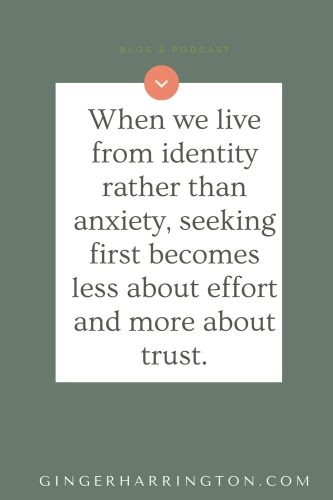
When we live from identity rather than anxiety, seeking first becomes less about effort and more about trust.
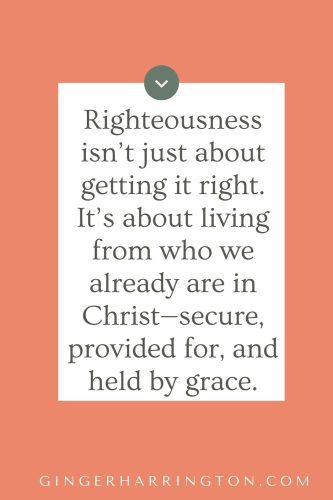
Righteousness isn’t just about getting it right.
It’s about living from who we already are in Christ—secure, provided for, and held by grace.
Why Seeking First Is About Direction, Not a Task
Seeking first isn’t something to add to your to-do list—though sometimes writing it at the top of your list can help orient your heart.
When Jesus says seek, He’s talking about direction and focus.
- What has the first claim on your attention?
- What shapes your yes or your no?
- What steadies you when you feel unsure?
Seeking first is less about what you do and more about who you depend on.
It’s choosing to begin—not with outcomes—but with God.
How Does Seeking First Reveal Our Motivations?
We don’t often pause to analyze our motivations—but they’re always influencing us. I know that’s true for me. Most days, I’m not stopping to ask, Why am I doing this right now? I’m just moving forward, responding, deciding, reacting. And yet, underneath it all, something is always driving those choices.
That’s where seeking first becomes such a gracious gift. It gives us a simple filter for discernment—without requiring endless self-analysis.
It invites honest questions like:
- Am I seeking God first here—or myself?
- Am I trusting God’s provision, or trying to secure my own?
- Am I acting from trust—or from the need to protect, prove, or control?
That last one can sting a little. I know it does for me. There are moments when that question feels like a bullseye—when I realize my urgency isn’t coming from faith, but from fear. And none of us gets this right all the time. That’s one of the reasons this practice needs to become a habit, something we return to again and again.
Often the issue isn’t what we’re choosing—but why we’re choosing it. We might say the same words, take the same action, or have the same conversation, but everything shifts depending on what’s driving our heart.
When God is first, our motivations are shaped by faith instead of fear.
We may still do the same things—but we do them differently. Our tone softens. Our urgency eases. Our responses are guided more by trust than by the need to control the outcome.
Seeking first helps us name what’s really going on inside—and then gently reorient our hearts toward God’s way instead.
How Seeking First Grows Out of Wisdom, Not Urgency
This invitation to seek first doesn’t come from a soft aside—it comes from Jesus’ clear, instructive teaching about worry and misplaced focus.
In Matthew 6, Jesus names what we actually struggle with. He asks direct questions that expose the futility of anxiety:
- Why do you worry?
- Why exhaust yourself over what you cannot control?
- He points to the flowers and the grass—not sentimentally, but decisively—to show how little our worry accomplishes.
Worry does not provide. It does not secure the future. It does not add wisdom. It only multiplies pressure.
Jesus contrasts anxious striving with a wiser way of living. Those who do not know God run after provision as if everything depends on them. But His followers are called to live differently—grounded in the knowledge that their Father already knows what they need.
This is where wisdom comes in.
Psalm 90:12 reminds us, “Teach us to number our days, that we may gain a heart of wisdom.” Wisdom doesn’t rush. Wisdom pays attention. Wisdom recognizes limits—and refuses to pretend it can carry tomorrow today.
Seeking first grows out of that wisdom.
Instead of asking, What do I need to make happen?
We begin asking, Where is God already at work—and how do I align with that?
Seeking first is not avoidance or passivity. It is the wise reordering of our lives in light of what worry cannot do and what God has already promised to do. Jesus doesn’t deny that each day has trouble of its own—He simply refuses to let tomorrow’s trouble dictate today’s faithfulness.
Wisdom acknowledges reality.
Urgency tries to outrun it.
Seeking first chooses wisdom.
How Seeking First Addresses Anxiety Without Ignoring It
Even knowing what Jesus says about worry, anxiety can still show up. It certainly does for me. What seeking first has given me is not the absence of anxious thoughts, but a way to respond when they rise.
Remembering to seek first helps dial down my tendency to worry because it interrupts the urgency. It reminds me that anxiety is not something I have to obey or fix before moving forward. Instead of letting fear set the agenda, seeking first reorients my attention back to God—His kingdom, His care, His faithfulness.
Jesus acknowledges that each day has trouble of its own. Seeking first doesn’t deny that reality. It simply keeps today from being dominated by tomorrow. When I return to that question—What does it look like to seek God first right here?—the weight shifts. I’m no longer carrying provision on my own. I’m choosing trust over control, one moment at a time.
Trusting God with “All These Things”
For me, seeking first when anxiety shows up often comes down to the promise Jesus attaches to this invitation: “and all these things will be added to you.” That phrase pulls my attention away from everything I’m trying to manage and back to the heart of the issue—who am I trusting to provide?
Seeking first is a choice to trust that God knows what I need and will be faithful with it. It doesn’t mean disengaging from responsibility or pretending needs don’t exist. It means I don’t have to secure provision before I obey. I don’t have to carry the full weight of outcomes to move forward in faith.
When worry starts to take over, returning to that promise steadies me. It reminds me that provision is received, not chased—that my role is faithfulness, not control. Seeking first reorders my confidence, shifting it from my own effort to God’s care. And in that shift, anxiety loses its authority, one decision at a time.
How Seeking First Looks in Everyday Life
Trusting God with provision doesn’t stay theoretical for long. It shows up in ordinary moments—real decisions, real conversations, and real limits on our time and energy. When we ask, What does it look like to seek God first right here, today? these practices give us a simple place to begin.
- With Time and Daily Work
Begin the day with this posture of trust:
“Lord, order my day. Help me do what You want me to do today.”
- In Decision-Making
Begin with a simple prayer:
“Lord, help me seek You first in this decision.”
Ask: What does God’s kingdom look like here? How does His righteousness apply?
- When Anxiety Surfaces
Instead of spiraling forward, pause and ask:
What would it look like to trust God with this outcome?
- When Priorities Feel Crowded
Return to this grounding question:
What matters most in light of God’s kingdom?
- In Difficult Conversations
Before responding, pray:
“Lord, help me express Your righteousness here.”
When our hearts and our choices are aligned with God’s leading, urgency loosens its grip—and faith takes its place.

How These Episodes Fit Together
These episodes were sequenced intentionally:
- Reflection helps us pay attention to what God has been teaching and discern what to carry forward
- Numbering our days forms a wise awareness of time—shaping how we live with gratitude, intention, and humility
- Seeking first reorders our motivations around trust instead of fear or selfishness
Jesus isn’t asking us to do more.
He’s inviting us to live from a deeper center.
Frequently Asked Questions About Seeking God First
What does “seek God first” really mean?
It means ordering your life around trust in God rather than anxiety about outcomes. It’s about direction, not perfection.
Is seeking God first a productivity strategy?
No. While it can bring clarity to how we use our time, its purpose is spiritual alignment, not efficiency.
How does Matthew 6:33 help with anxiety?
It shifts the burden of provision from your shoulders to God’s care, reminding you that He is faithful with what follows.
Can seeking first become a daily habit?
Yes. When practiced consistently, it becomes a default posture—a habit of hope that shapes decisions and responses.
Living from Trust, One Day at a Time
You don’t have to carry tomorrow today.
When your heart is aligned with God’s kingdom, you can trust Him with what comes next.
Seek first—and rest in the God who provides.
Because a deeper life begins when we trust God—first.

Practice “Seek First” in the Moments That Matter Most
If today’s message about seeking God first resonated with you, Holy in the Moment: Simple Ways to Love God and Enjoy Your Life was written for this exact journey.
This book isn’t about striving harder or adding spiritual pressure. It’s about learning how to return to God right in the middle of real life—when anxiety rises, decisions feel heavy, and trust feels hard.
Holy in the Moment offers simple, practical ways to live from a steadier center, so faith becomes something you practice moment by moment—not something you postpone until life feels easier.
👉 Get Holy in the Moment and start choosing “seek first” in the ordinary moments that shape your days.
 So glad you're here. I help busy women—gals like you— build healthy habits for living well with biblical wisdom and practical steps to deepen your faith, increase your hope, and thrive in your purpose.