
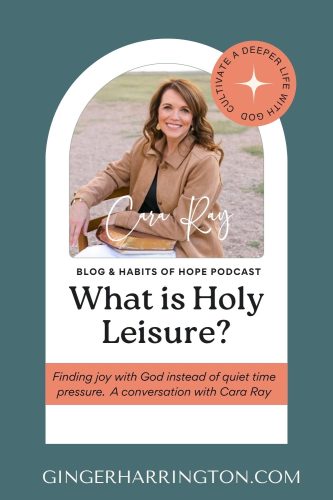
Struggling with quiet time pressure? Discover how “holy leisure” transforms your time with God from duty into joyful, life-giving communion.
There are seasons when something meant to nourish our souls begins to feel like pressure.
We know time with God matters, and we truly want it. But somewhere along the way, it quietly shifts—from delight to duty, from relationship to routine.
That’s why this conversation with Cara Ray felt like such a deep exhale for me. Her message about “holy leisure” gently invites us back to something we often forget: God isn’t waiting for our performance—He’s inviting us into His presence. And that changes everything.
Why Does Quiet Time Start to Feel Like a Chore?
Before we dive into the heart of holy leisure, Cara shares how this tension first showed up in her own story.
Ginger Harrington:
You describe yourself as a former “quiet time checkbox checker.” Can you take us back to that season? When did you begin to realize your spiritual rhythms had shifted from delight to duty?
Cara Ray:
I became a Christian very early in life, around six or seven. But as a teenager, I really wanted to own my faith and grow spiritually. I was being discipled to have a daily quiet time, and all of that was very well-meaning.
But it became something I felt like a spiritual failure at.
If I wasn’t getting up early, I wasn’t doing it right. If it wasn’t an hour long, I wasn’t doing it right. If I didn’t have an emotional experience, I wasn’t doing it right.
And that mindset stuck with me for a long time.
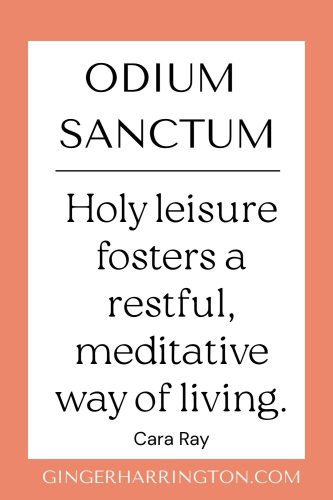
Then about seven years ago, I was reading The Celebration of Discipline and came across a phrase—odium sanctum, or “holy leisure.” It described this restful, meditative way of life.
That phrase captured my attention. I realized, this is what I’ve been missing.
I wanted my time with God to feel like something I enjoyed—like going to coffee with a friend or watching a sunset. And I began to ask: Why can’t time in God’s Word feel like that?
I wanted my time with the Lord to feel leisurely… something I enjoy, not something I have to check off.
How Do You Enjoy God Without Pressure in Your Quiet Time?
As Cara began to unpack this idea, it revealed something deeper about how we relate to God.
Ginger Harrington:
I think many of us can relate to evaluating our quiet time—was it good enough? Did I get something out of it? That mindset can lead us into performance instead of communion.
Cara Ray:
Yes, exactly. And I think holy leisure frees us from that.
It becomes a habit—someth building a muscle.
Not every time in God’s Word is emotional or euphoric. Sometimes the Spirit speaks very gently. But as we continue returning, something deeper is being formed in us.
When we remove that checkbox mentality, it changes how we approach God’s Word—and what we receive from it.
“When we remove the checkbox mentality, it changes how we approach God—and what we receive from Him.”
What Is the Difference Between Union and Communion with God?
Before moving into how this plays out practically, Cara introduces a foundational truth that reshapes everything.
Ginger Harrington:
You talk about union with Christ versus communion with Christ. Can you explain that?
Cara Ray:
Our union with Christ is secure. It’s the relationship we have because of what Jesus has done—not anything we do. Nothing can interrupt that.
But our communion—our felt closeness with God—can fluctuate. Sometimes sin or distraction interrupts that flow.
Understanding that changed everything for me. I realized I’m not earning God’s favor by showing up—I already have His favor in Christ. And now I want to enjoy that relationship.
What Is Holy Leisure—and What Does It Actually Mean?
Now that we’ve explored the heart behind it, let’s define what holy leisure actually means—and what it doesn’t.
Ginger Harrington:
For someone hearing this phrase for the first time, what does holy leisure not mean?
Cara Ray:
It doesn’t mean doing nothing.
We often think leisure is passive—like watching TV—but that’s not what I’m talking about. True leisure is an engagement of the mind, the heart, and the will.
It’s a pursuit of what is good, true, and beautiful. And ultimately, that’s what leads our souls into rest.
So rest isn’t about doing nothing—it’s about rightly engaging with what nourishes your soul.
Why Does God Often Do His Deepest Work in Hidden Places?
As we begin to see holy leisure differently, it naturally reshapes how we think about our time with God.
Ginger Harrington:
Why do you think the hidden places—those quiet moments with God—are where He does such deep work?
Cara Ray:
Because that’s where formation happens.
That’s where it’s just you and the Lord. No one else sees it, but that’s where your heart is rooted in Him.
Over time, as you develop those patterns of prayer and Scripture, something steady is being formed in you. And that quiet work begins to shape everything else.

How Does Holy Leisure Help You Enjoy God Without Pressure in Everyday Life?
From those hidden places, Cara describes how this way of being with God begins to overflow into daily life.
Ginger Harrington:
How does holy leisure carry into everyday life without becoming another strategy for productivity?
Cara Ray:
We do have to fight that tendency—we’re wired for productivity.
But holy leisure is about overflow. It’s how your time with God begins to shape your interactions—your home, your work, your relationships.
Sometimes it doesn’t even feel like something you want to do in the moment. But as you step into it, you often discover the joy in it. That’s where the delight begins to grow.
“Holy leisure is not about doing less—it’s about enjoying God more in what you’re already doing.”
Can You Enjoy God Without Pressure Even in Hard Seasons?
This next part of the conversation moves into something we all face—seasons of dryness, suffering, and doubt.
Ginger Harrington:
How does holy leisure speak to hard seasons without offering shallow answers?
Cara Ray:
Those seasons are difficult, and sometimes we don’t even want to go to God’s Word.
But that’s exactly where we need Him most.
In those moments, He meets us. He gives us living water. He awakens our hearts and reminds us of what is true.
Sometimes those seasons of dryness are what draw us closer to Him. And holy leisure gives us a way to pursue God and even enjoy Him in the middle of suffering.
“Sometimes we avoid the very things we need most—but God meets us there.”
How Does God Produce Fruit Through Every Season?
As Cara shares, even the hardest seasons are not wasted.
Ginger Harrington:
How does this journey lead to fruitfulness?
Cara Ray:
I love the image of the vine and branches.
God prunes us—not to harm us, but so we’ll bear more fruit. And that process can be painful.
But over time, it leads to something beautiful—the fruit of the Spirit growing in us.
To bear fruit, we have to abide. We stay connected. We keep returning to God’s Word and prayer. And as we do, that fruit begins to grow.
“To bear fruit, we have to abide—stay connected and keep returning.”
An Invitation to Slow Down and Enjoy God
What I love most about this conversation is how gently it brings us back to what matters most.
Not more effort or better discipline, and not a perfectly consistent routine—but presence.
Because hope doesn’t grow through striving. It grows through communion.
And maybe the next faithful step isn’t to try harder, but simply to slow down and remember that God is already near—and He is inviting you to enjoy Him.
Habit of Hope
As you carry this conversation into your own rhythms this week, begin here:
Open your Bible not as a task to complete, but as a place to enjoy time with the God who is already with you.
Frequently Asked Questions About Quiet Time and Enjoying God
Why does my quiet time feel like a chore instead of something life-giving?
Quiet time often starts to feel like a chore when it becomes performance-driven instead of relational. When we focus on doing it “right” rather than meeting with God, it can shift from delight to duty. Reframing it as time with God—not a task for God—can restore joy.
What is “holy leisure” in the Christian life?
Holy leisure is the practice of enjoying God through unhurried, attentive time in His presence. It’s not about doing nothing—it’s about engaging your heart, mind, and spirit with what is true, good, and beautiful, especially through Scripture and prayer.
How can I enjoy time with God again if I feel spiritually dry?
Start small and simple. Instead of trying to fix everything, return to God’s Word with openness rather than expectation. Even in dry seasons, God meets us. Over time, consistency—not intensity—helps restore connection.
What’s the difference between union and communion with God?
Union with God is your secure relationship in Christ—it never changes. Communion is your experience of closeness with Him, which can ebb and flow. Understanding that your relationship is secure helps remove pressure and invites you to enjoy His presence more freely.
What is one simple way to reconnect with God today?
A practical step is to read a passage like Ephesians 1–3 and notice every phrase that says “in Christ” or “with Him.” This helps anchor your identity in truth and renew your desire to know God more deeply.
Meet Cara Ray
Cara Ray is a writer, Bible teacher, and host of the Writers Block Podcast. She encourages Christian women to slow down, savor Scripture, and enjoy God in everyday life. Cara is the author of The Pursuit of Holy Leisure: Enjoying God in Everyday Places and lives in Gilbert, Arizona, with her husband and family.
Resources & Links
- The Pursuit of Holy Leisure: Enjoying God in Everyday Places by Cara Ray (Affiliate link)
- Visit Cara Ray’s website for more information and content from Cara.
 So glad you're here. I help busy women—gals like you— build healthy habits for living well with biblical wisdom and practical steps to deepen your faith, increase your hope, and thrive in your purpose.