
Discover how the Holy Spirit helps you in weakness—guiding your prayers, meeting your needs, and sustaining your hope through God’s steady, present help.
There are moments when life doesn’t feel dramatic or urgent—just heavy. Not overwhelming enough to call it a crisis. Not clear enough to know what to do next. Just tired. Uncertain. Weak in ways that don’t show on the outside. And in those moments, many of us quietly assume we should be able to handle things better by now.
We tell ourselves we should be stronger. More capable. Less affected. But Scripture speaks directly into that assumption.
When we hear the word help, we often imagine it as a backup plan—something we reach for after we’ve exhausted our own strength. Help becomes what we request when independence fails.
What a relief that Scripture doesn’t present help as a supplement to our competence. Scripture shows us about Holy Spirit help—God meeting us in our weakness with His presence.
It presents help as God’s nearness.
- Not because we’ve tried hard enough.
- Not because we’ve run out of options.
- But because God knows our limits—and meets us there.
This post is part of a 3-part series on the Holy Spirit and His work in our lives:
- How the Holy Spirit Guides You Into Truth
- How the Holy Spirit Helps You in Your Weakness
- How the Holy Spirit Comforts You in Hard Seasons (next week)

What Did Jesus Mean by “Helper”?
Before we talk about what help looks like, it’s important to hear how Jesus Himself introduced the Holy Spirit.
In John 14:16–17, Jesus says:
“I will ask the Father, and He will give you another Helper, that He may be with you forever… the Spirit of truth… you know Him because He abides with you and will be in you.”
This is not a small promise.
The Helper is:
- A gift given by the Father, not something we earn
- With us forever, not temporary or conditional
- Abiding with us and in us, not distant or external
God’s help is not something we summon—it is Someone who abides with us.
And this reframes everything.
Help is not something we achieve by doing life well. It is something we receive because God is near.
When Needing Help Feels Like Weakness
In the world around us, needing help is often seen as:
- Weakness
- Inadequacy
- Lack of qualification
It can feel uncomfortable—even exposing—to admit we need help.
But in God’s economy, the opposite is true.
The more we recognize our need, the more help we receive.
There is no shame in needing help from the Lord.
In fact, it is often the doorway into experiencing His presence more deeply.

How the Holy Spirit Helps You Pray When You Don’t Know How
Romans 8:26–27 says:
“The Spirit also helps our weakness… for we do not know how to pray as we should, but the Spirit Himself intercedes for us with groanings too deep for words.”
This meets us right where we live—because there are moments when we don’t know what to pray, what the right outcome is, or even what we truly need. Sometimes the situation is so confusing or overwhelming that all the options feel uncertain, and we are left without words.
And Scripture assumes that.
It assumes there will be times when we do not know how to pray.
But in that very place of uncertainty, we are not left alone. The Spirit knows what is in our hearts, He knows the will of God, and He intercedes for us in ways we cannot fully express.
Even when we cannot form the words, God is already at work.
When Prayer Feels Impossible
There are moments when even forming a sentence feels like too much.
You may want to pray—but feel completely unable to.
You may feel:
- Emotionally exhausted
- Spiritually dry
- Mentally overwhelmed
And in those moments, it can feel like you are failing.
But Scripture tells a different story.
God’s will is not threatened by your lack of words.
Even when you struggle in prayer:
- The Spirit is already interceding
- The Spirit is already helping
- The Spirit is already at work
This is not correction. It is provision.
- Not: “You should be doing this better.”
- But: “I know you need help—I am already helping you.”
Prayer Is Not a Performance
Many of us carry quiet pressure when it comes to prayer.
We wonder:
- Am I saying the right thing?
- Do I sound spiritual enough?
- Am I doing this correctly?
Prayer is not a performance—it’s a conversation.
And sometimes, the most honest prayer looks like a pause: “Lord, I need help right now. Give me words.”
Even that is enough, because help in prayer is not based on your ability, but on God’s presence.

The Holy Spirit’s Help Is Received Not Earned
Hebrews 4:16 brings this truth into focus:
“Let us draw near with confidence to the throne of grace, so that we may receive mercy and find grace to help in time of need.”
Notice what this invites us into.
We are not told to prove ourselves, fix ourselves, or prepare ourselves—we are invited to draw near and receive. Help is not something we achieve through effort; it is something we find in the presence of God.
And just as importantly, we are drawing near to a throne of grace, not a throne of scrutiny or judgment.
So when you feel unworthy, unprepared, or unsure, that is not a reason to stay away.
It is the very reason to come.
When You Feel Like You Don’t Deserve Help
There are moments when you may hesitate to come to God.
You may think:
- I’ve messed up too much
- I should have known better
- Why would God want to hear from me right now?
It’s important to embrace the truth that Hebrews 4:16 is an invitation and an instruction.
“Let us draw near with confidence.”
So you can come with it all:
- Your mistakes and regrets
- Your unmet expectations and question
- Your anger and your pain
Do not let these things keep you at a distance.
Because God’s help is not reserved for when you have it all together. It is given in your time of need.
God Is Your Helper
Psalm 54:4 says:
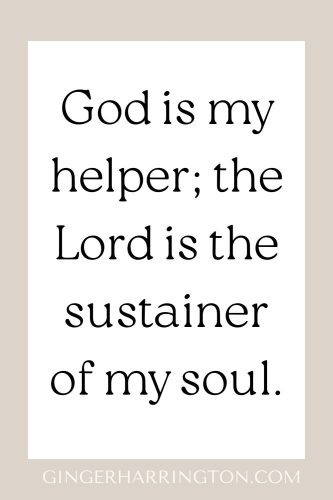
“Behold, God is my helper; the Lord is the sustainer of my soul.”
This is not abstract—it is deeply personal.
God is not just a helper—He is your helper, and His help is not occasional or situational. He is the sustainer of your soul, which means His help is ongoing, steady, and present in every moment, not just in times of crisis.
There are days when your soul feels dry:
- No motivation
- No clarity
- No strength
And in those moments, when you do not have what you need to keep going,
God sustains what you cannot.
When You Don’t See God’s Help Right Away
Sometimes, you can look back and clearly see how God helped you.
Other times, you are in the middle of it and you don’t see anything yet.
This can be really discouraging to say the least.
But God’s help is not limited to what you can see.
- He may be protecting you in ways you don’t recognize
- He may be working ahead of you
- He may be sustaining you quietly
God’s help is not occasional intervention—it is a sustaining presence.
God’s Help When Anxiety Rises
Isaiah 41:10 says:
“Do not fear, for I am with you… I will strengthen you, surely I will help you, surely I will uphold you…”
Notice how many times God repeats Himself:
- I am with you
- I will strengthen you
- I will help you
- I will uphold you
This is not uncertain language.
This is promise.
And this promise becomes especially powerful when anxiety rises.
Because in those moments, it’s easy to look around for solutions.
But this verse gently redirects us:
“Do not anxiously look around you… I am your God.”
God’s help does not depend on your ability to stay steady.
He is the one holding you steady.
A Habit of Hope
The habit we are practicing is simple—but deeply countercultural:
Release the habit of carrying things alone and rest in the reality of God’s help.
So often, we carry things as if it all depends on us:
- Figuring it out
- Holding it together
- Finding the right answers
But God’s help was never meant to be a last resort.
It is meant to be our starting place.
And part of releasing what we were never meant to carry is learning how to think differently in the middle of need.
Take Doubt Out of the Conversation
There is a powerful shift that happens when you choose to believe what God has already said.
Instead of thinking:
- Maybe God won’t help me
- Maybe I just need to try harder
You begin to say:“Lord, I believe You are my help. Help me see it.”
This is not ignoring reality.
It is anchoring yourself in truth.
Scripture says God is:
- Your helper
- Your refuge
- A very present help in trouble
Will you let doubt define the conversation…
or will you let truth lead it?
Because when you take doubt out of the conversation, something shifts.
You stop striving to prove your strength…and start resting in God’s presence.
God Is a Very Present Help in Trouble
Psalm 46:1 says:
“God is our refuge and strength, a very present help in trouble.”
This is not a distant promise or a future possibility—it is a present reality.
God does not say He might help, or that He will help eventually. He says He is a very present help, right in the middle of trouble, not just after it passes.
And that matters, because trouble is not avoided or minimized in Scripture—it is acknowledged as part of life. Yet in the midst of it, God’s presence is not reduced or delayed.
He is near, active, and already at work.
When Help Doesn’t Look Like What You Wanted
Sometimes God’s help does not look like the outcome we hoped for, the timing we expected, or the resolution we imagined.
Instead, His help often meets us in a deeper way—by sustaining us within the very circumstances we wish would change. While we tend to focus on what is right in front of us, God is working with a much broader perspective, shaping not only the situation but also our hearts within it.
And in that place, His help is not absent—it is active, steady, and sufficient for what we are walking through.
A Real Picture of God’s Help
There are moments in life where you can see this clearly.
Moments when:
- You had no strength
- No clarity
- No ability to hold yourself together
And yet—you were held.
There are times when God gives:
- Strength you did not have
- Joy that has no visible source
- Peace that does not match your circumstances
Not because everything is fixed…
but because He is present.
The Connection Between Help and Hope
All of this leads to one steady truth:
Hope is not built on clarity—it is sustained by presence.
You do not have to:
- Understand everything
- See how it will work out
- Have the answers
Because even when you feel:
- Unsure
- Tired
- Wordless
- Out of options
God is actively at work on your behalf.
He is not waiting for you to get it right.
He is not standing at a distance.
He is present. Helping. Interceding.
Practical Ways to Rest in God’s Help
These are not steps to make God act.
They are ways to respond to the help He has already given.
1. Ask the Holy Spirit to Help You Pray
When you don’t have words, say so.
Silence and sighs are not prayer failures.
2. Draw Near with Confidence
Not because everything is resolved…
but because help is promised in your need.
3. Remind Yourself: “God Is My Helper”
When you feel overwhelmed:
“Lord, You are my helper.”
4. Remember God Is with You
Especially when anxiety rises.
Even if fear doesn’t disappear right away.
5. Rest in God as Your Refuge
When life feels unsettled:
You are held, even when nothing feels stable.
Ask for Help in the Moment
Simple prayers like:
- “Lord, help me love right now.”
- “Help me respond with wisdom.”
- “Help me experience Your peace.”
Frequently Asked Questions
What does it mean that the Holy Spirit helps us?
It means God meets you in your weakness. The Holy Spirit actively intercedes, guides, and strengthens you—even when you don’t know what to do.
What if I don’t know how to pray?
That is exactly when the Spirit helps. Scripture says He intercedes for you when you don’t have the words.
Does God only help when I ask?
No. The Spirit helps your weakness—even when you don’t think to ask. He is already at work.
Why doesn’t God’s help always change my situation?
Because sometimes His help is not about changing your circumstances—but sustaining you within them.
How can I trust God is helping when I don’t feel it?
God’s help is based on His promise, not your feelings. He is a very present help—even when you don’t feel it.

A Final Word of Encouragement
God has not left you to figure things out on your own.
He has not asked you to carry your weakness by yourself, nor has He stepped back to see how well you can manage it. Instead, He has given you His Spirit—present, helping, interceding, and actively at work on your behalf.
You are not failing at faith because you feel needy.
In many ways, need is the very place where we begin to recognize God’s help most clearly, not because everything suddenly changes, but because we become more aware of His presence within it.
And as you release the habit of carrying things alone and begin to rest in the reality of His help,
you may discover that hope has been holding you all along.
If you want a quiet way to practice this—learning to draw near, notice God’s presence, and receive grace for each day—you might begin with a simple rhythm of reflection and prayer.
Not striving.
Not performing.
Just receiving what God has already given.
About the Author
Ginger Harrington is the host of the Habits of Hope Podcast and creator of resources designed to help you build rhythms of faith for everyday life. Through her writing, speaking, and teaching, she encourages women to grow deeper in hope, resilience, and spiritual formation—one small habit at a time.
Related Content
This post is part of a 3-part series on the Holy Spirit and His work in our lives:
- How the Holy Spirit Guides You Into Truth
- How the Holy Spirit Helps You in Your Weakness
- How the Holy Spirit Comforts You in Hard Seasons (next week)
 So glad you're here. I help busy women—gals like you— build healthy habits for living well with biblical wisdom and practical steps to deepen your faith, increase your hope, and thrive in your purpose.